
Lieferung heute & morgen

Qualitätsgarantie

Willkommens-Angebote freischalten: KOSTENLOSE Lieferung | Bis zu 80 % RABATT | Kostenlose 30-Tage-JoyPlus-Testphase
App herunterladen
A double induction hob promises flexibility and efficiency, whether in a small student flat, a garden house, or as a portable cooking solution for camping. The technology enables rapid heating and precise temperature control. However, the market is filled with models whose practical performance often falls short of their advertising claims. Before you make a decision, it's crucial to understand the common pitfalls to avoid a costly mistake.
As your Joybuy Product Recommendation Officer, I'll help you identify the essential features and make an informed choice.
Many units look similar at first glance, but the details determine whether cooking is a joy or a test of patience. Pay special attention to these three points:
To avoid these problems, you should carefully check three technical aspects before buying. These determine the actual functionality and user-friendliness of your future double induction hob.
Total power, usually between 2800 and 3500 watts, is an important indicator. However, the power distribution (Power Sharing) is more crucial. Good models allow you to flexibly distribute the power across both hobs. For example, you can sear on one hob at high power while keeping a sauce warm at a low temperature on the other. Check the product description for details on the maximum power per hob when both are in use simultaneously.
For precise control while cooking, the number of selectable levels is key. A good portable induction hob should offer at least 8, ideally 10 or more, power and temperature levels per hob. This allows for fine adjustments for a wide variety of cooking methods—from searing to gently melting chocolate. An induction plate with a timer is also a useful feature that allows you to set cooking times exactly and prevent overcooking.
A modern portable hob must be safe. Essential features include:
The cooking surface should be made of high-quality ceramic glass. This material is not only robust and scratch-resistant but also very easy to clean, as spills don't burn onto the surface.
Based on these criteria, we have selected a few products from our range that offer a suitable solution for different user profiles.
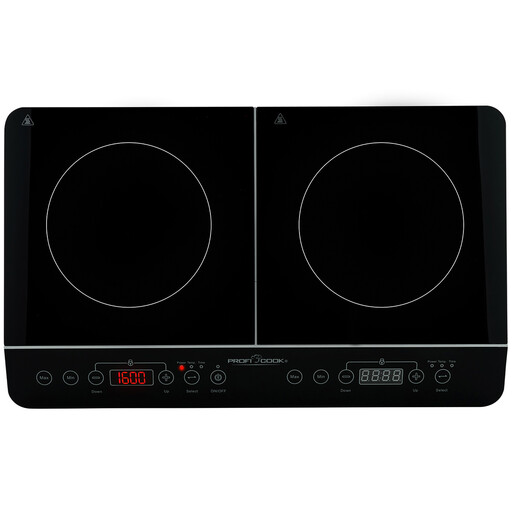
Why This Fits Their Persona: Ideal for small kitchens, garden sheds, or as an additional unit for parties. This model offers two full-fledged cooking zones and high total power to prepare even more demanding dishes in parallel.
With 10 temperature levels per hob (60–240 °C), it bypasses the trap of imprecise heat control. The controls allow for fine adjustments instead of just switching between "on" and "off".
High total power of 3500 W and a 180-minute timer with an automatic shut-off for convenient cooking. The sensor-touch control panel is modern and easy to clean.

Why This Fits Their Persona: Perfect for students in dorms or individuals with extremely limited space. For those who rarely need more than one hob, this provides a powerful and compact solution.
Instead of a weak double hob, this model focuses on a single, powerful 2000 W zone. This avoids the compromise of inadequate power distribution found in cheap dual hobs.
The ultra-slim design (44.5 mm) makes storage easy. 7 preset cooking functions and a child lock offer convenience and safety in a small footprint.
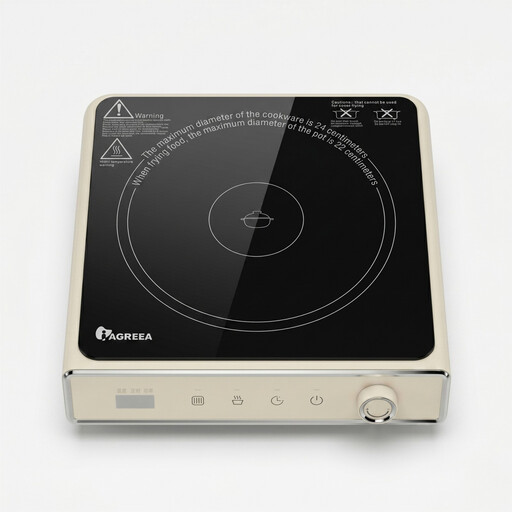
Why This Fits Their Persona: For users who want a portable hob but wish to continue using their existing cookware made of aluminium, glass, or ceramic. This ceramic glass hob works with all types of pots.
This model bypasses the biggest limitation of induction—the need for magnetic cookware. It offers universal compatibility, saving you the expense of buying new pots and pans.
The infrared heating technology ensures fast and very even heat distribution. The control via a rotary knob is intuitive and precise.
We have compiled a complete, up-to-date list of products that fully meet these strict selection criteria and German safety regulations.
For an induction hob, you need cookware with a ferromagnetic base. You can easily test if your existing cookware is suitable with a magnet: if it sticks to the bottom of the pot, the pot is induction-compatible. Materials like cast iron, enamelled iron, and special induction-ready stainless steel work. Pots made of pure aluminium, copper, glass, or ceramic are not compatible.
That depends on the specific model and its maximum total power. On most portable double induction hobs, the total power is shared between the two zones. This means if one hob is running at maximum power, the available power for the second hob is reduced. It is rarely possible to operate both hobs at their full individual power at the same time. Pay attention to the manufacturer's specifications on "Power Sharing".
The power consumption depends on the set power level and the duration of use. A hob with a 3500-watt maximum total output consumes 3.5 kilowatt-hours (kWh) per hour at full load. Because induction technology is very efficient and generates heat directly in the base of the pot, very little energy is lost. Compared to conventional electric hobs (solid-plate hobs), energy consumption is generally lower for the same cooking performance because the heating-up time is shorter.