
Lieferung heute & morgen

Qualitätsgarantie

Willkommens-Angebote freischalten: KOSTENLOSE Lieferung | Bis zu 80 % RABATT | Kostenlose 30-Tage-JoyPlus-Testphase
App herunterladen
A double roller blind clip fix without drilling can quickly provide rented flats, homes and offices with privacy and sun protection. Unlike a conventional indoor roller blind, a day and night double roller blind can be adjusted flexibly using alternating transparent and opaque fabric panels. Depending on the position, more daylight can enter or the room can be screened off more effectively.
To avoid ending up with the wrong product, however, buyers should check several technical details. Terms such as ‘lightproof’, ‘thermal blind’ or ‘easy installation’ are not always defined consistently. What really matters is the actual dimensions, the frame thickness and the blind’s construction.
For many clip-on roller blinds, the stated overall width does not correspond to the usable fabric width. Brackets and side components require additional space. According to the manufacturer, the fabric on several WOLTU double roller blinds is approximately 4 to 5 cm narrower than the overall width.
If you only measure the window pane and order exactly that width, you may not get sufficient privacy at the sides. At the same time, a duo blind for windows and doors must not obstruct the window handle. Before ordering, you should therefore check the pane width, frame width, handle position and the desired overlap.
A clip-fix system is attached directly to the window frame. The clamps require a specific frame-thickness range. Depending on the model, the stated ranges may be 1 to 10 mm, 13 to 23 mm or 16 to 22 mm, for example.
Wooden windows, roof windows, sliding windows and permanently glazed windows are expressly excluded for some of the models presented here. Installation can also be problematic with tilt windows if the blind catches when the window is opened. Any existing sealing profile should be taken into account when measuring.
A privacy blind that allows light through regulates the amount of light entering through its alternating fabric panels. In an intermediate position, daylight remains in the room while visibility from outside is reduced. However, depending on the overlap of the fabric, the side of the window and the amount of light entering from the sides, some residual light may still be visible.
For bedrooms, media rooms or rooms with direct sunlight, a separate blackout roller blind is often more suitable. A day and night double roller blind, on the other hand, is ideal when flexible light control and privacy are more important than creating an especially dark room.
For a double roller blind, first measure the width of the glass and then the height of the entire window frame. For many models, the recommended ordering width is stated as glass width plus approximately 4 cm. This measurement is product-dependent and should always be checked against the relevant installation instructions.
For balcony or patio doors, you should also check that the door handle remains free to move. Sufficient height prevents the fabric panel from getting in the way when opening or closing the door.
Frame thickness is a non-negotiable criterion. A clamp bracket for 13 to 23 mm will not automatically sit securely on a 10 mm frame. If you are unsure, measure the frame thickness at several points. Uneven, heavily rounded or delicate surfaces can make fastening more difficult.
For permanent installation, some models also offer screw fixing to the wall, ceiling or window. This option is interesting for homeowners, but it changes the advantage of damage-free installation.
Polyester is widely used for indoor roller blinds. According to the manufacturer, the double roller blinds mentioned consist of 100% polyester; thermally cut edges are intended to reduce fraying. For kitchens and bathrooms, moisture-resistant materials and easy cleaning with a soft brush or slightly damp cloth are practical.
A roller blind with a chain mechanism can be adjusted continuously and, on some models, can be fitted on the left or right. A chain holder should be secured so that the chain and operating mechanism are not freely accessible to children or pets. If you would rather avoid a chain, you can choose a cordless thermal blind operated using a bottom rail.

Why this product suits this profile: Measuring 60 × 150 cm, this double roller blind offers straightforward clamp installation for window frames between 13 and 23 mm thick. The operating chain can be fitted on the left or right.
Frame compatibility and the difference between clamp and screw installation are clearly stated. Even so, the frame must still be measured before purchase.
100% polyester fabric, continuous light control, chain holder and cleaning with a damp cloth or soft brush.
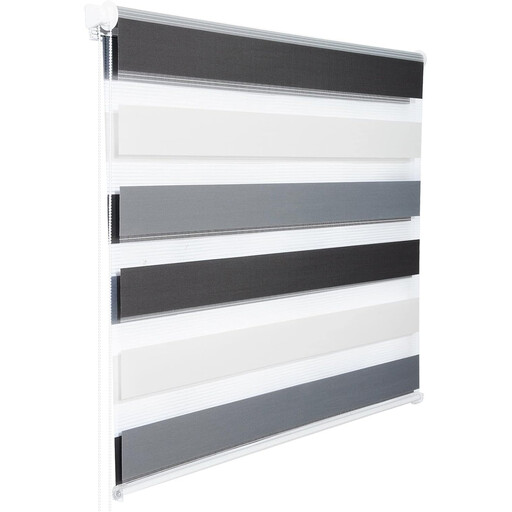
Why this product suits this profile: The 90 × 120 cm version combines alternating fabric strips with thermally cut edges. It is designed for various living spaces as well as balcony and patio doors.
The product details explicitly state the suitable frame thickness of 13 to 23 mm and the narrower fabric width. This makes it easier to plan the installation realistically.
100% polyester, chain mechanism that can be fitted on the left or right, plus an additional screw option for alternative fixing.
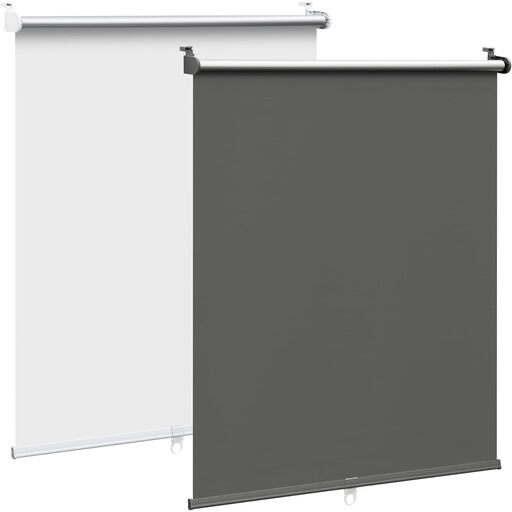
Why this product suits this profile: This cordless blind is designed for rooms where as little light as possible should pass through the fabric, such as bedrooms, children’s rooms or heavily sunlit home offices.
Rather than equating day-and-night functionality with blackout performance, this is a separate opaque blind. The frame thickness of 16 to 22 mm must be suitable.
According to the manufacturer: 200-g/m² polyester, silver-coated backing, cordless operation via the bottom rail, and clamp or screw installation.
We have put together a complete, regularly updated list of products that fully meet these strict selection criteria and the safety regulations applicable in the EU.
The clamp brackets are placed on the upper window frame and then connected to the roller blind. Depending on the product, no tools are required. A suitable frame, an unobstructed handle area and secure fixing before use are essential.
Its lifespan depends on the fabric quality, mechanism, exposure to sunlight and how it is operated. According to the manufacturer, thermally sealed edges can help reduce fraying. Operating the chain mechanism carefully and cleaning with a soft brush or damp cloth helps prevent unnecessary wear.
A manually operated roller blind with a chain mechanism or handle does not require electricity. There are therefore no ongoing energy costs. A thermal blind can affect the amount of solar heat entering through the window; however, specific savings cannot be guaranteed across the board, as orientation, glazing, room ventilation and heating habits are all important.