
Lieferung heute & morgen

Qualitätsgarantie

Willkommens-Angebote freischalten: KOSTENLOSE Lieferung | Bis zu 80 % RABATT | Kostenlose 30-Tage-JoyPlus-Testphase
App herunterladen
A double roller blind without drilling can quickly provide rented flats, offices and homes with privacy and sun protection, without leaving drill holes in the window frame or wall. Clip-fit double roller blinds, also known as duo blinds or zebra blinds, are particularly popular. Thanks to two layers of fabric positioned one behind the other, you can adjust the amount of light entering the room from light-filtering to more covering.
However, no-drill installation is not automatically suitable for every window. If you focus only on colour and price, you risk ending up with an ill-fitting clip bracket, restricted operation or inadequate privacy.
For many double roller blinds, the stated width is the overall width, including the brackets. According to the product details, the actual fabric width may be around 4 to 5 cm narrower. If you measure only the glass pane, light gaps may appear at the sides.
The following can serve as a guide for many models:
The specific measuring instructions for the product in question always take precedence. For doors, you should also check that the blind has enough clearance from the door handle and reveal when opening and closing.
A light-filtering blind filters daylight and reduces visibility from outside, but normally does not create complete darkness. A duo blind with alternating transparent and opaque stripes can alter the amount of light entering the room. However, side light gaps may remain between the fabric layers.
For bedrooms, children’s rooms or rooms with screen-based workstations, it is therefore important to distinguish between:
A genuine blackout effect depends not only on the fabric, but also on the width, side clearances and installation position.
Clip brackets only fit certain frame thicknesses. Several WOLTU double roller blinds are designed for frames with a thickness of 13 to 23 mm. Other models, such as a particular WOLTU blackout blind, specify 16 to 22 mm. Seals, window handles and sloping frames may also affect installation.
Wooden windows, roof windows, sliding windows or permanently glazed windows are expressly excluded for some products. Before buying, you should therefore compare the installation method, frame thickness and window type with the product description.
A clip-fit blind is usually hooked directly onto the top of the opening window sash. This option is particularly suitable for tenants, provided that the frame thickness is compatible and the window can be opened. Some products may also allow an alternative screw installation, but this is no longer completely drill-free.
Pleated blinds with suction cups are designed for smooth surfaces such as glass or tiles. They may be suitable for standard windows, balcony doors or certain roof surfaces, but require a clean, smooth surface for adhesion. Textured walls and uneven surfaces are unsuitable.
Double roller blinds with side-chain operation can usually be operated from the left or right. The chain should be secured so that it does not hang freely. In households with children or pets, a cordless blind with a control handle is a worthwhile alternative to consider.
All installation components must be securely fastened. Small accessories should be kept out of the reach of young children during installation and use. Always follow the relevant instructions and the manufacturer’s safety information.
Polyester is commonly used for the models listed above. Care usually involves wiping with a soft, slightly damp cloth or using a soft brush. Many fabrics must not be washed or machine-cleaned. Harsh cleaning products and abrasive materials can damage coatings and surfaces.
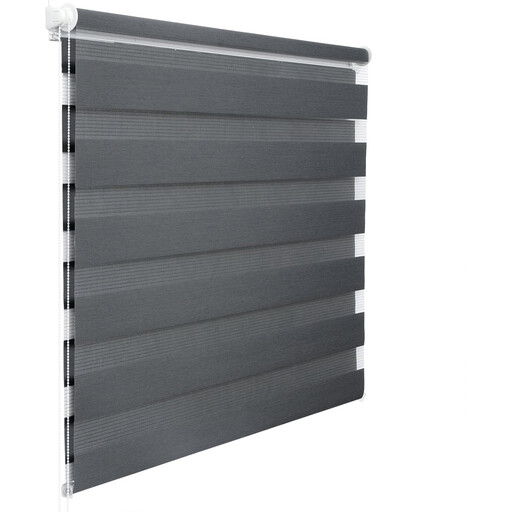
Why this product suits this profile: Its compact size and clip-fit installation make it suitable for users looking for a straightforward introduction to flexible light control.
The product details specify a frame thickness of 13–23 mm and the option of no-drill installation. However, the glass width and frame height must still be checked before ordering.
100% polyester, side-chain operation can be installed on the left or right, cleaning with a cloth or soft brush.

Why this product suits this profile: The honeycomb structure and adjustable clip-fit installation appeal to buyers who value precise frame compatibility and additional fabric properties.
The specified clip brackets are designed for frame thicknesses of 10–23 mm. According to the product description, this model is not suitable for roof windows.
100% polyester, upper and lower control handles, moisture-repellent surface and cleaning with a damp cloth.

Why this product suits this profile: This model is designed for rooms where a more covering fabric, thermal construction and operation without a pull chain are required.
The description specifies clip-fit installation for frames measuring 16–22 mm and points out that the fabric is around 4 cm narrower. Roof windows are excluded.
Cordless operation via the bottom rail, coated backing, 200-g/m² polyester and wipe-clean surface.
We have put together a complete, regularly updated list of products that fully meet these strict selection criteria and the safety regulations applicable in the EU.
This depends on the frame thickness, installation surface, product weight and correct fastening. A suitable clip bracket can remain securely in place when installed according to the instructions. Before ordering, you should check the window sash, seals and handles for possible obstructions.
According to the product description, many models are suitable for windows and doors. The key factors are the door-frame thickness, available movement and clearance from the door handle. On frequently used balcony doors, the blind should not catch or shift when the door is opened.
A manually operated blind does not require electricity. Depending on the fabric and installation, a thermal blind may affect direct sunlight; however, no specific saving can be guaranteed in general. The decisive factors are the window area, orientation, glazing, room ventilation and the distance between the blind and the pane.