
Lieferung heute & morgen

Qualitätsgarantie

Willkommens-Angebote freischalten: KOSTENLOSE Lieferung | Bis zu 80 % RABATT | Kostenlose 30-Tage-JoyPlus-Testphase
App herunterladen
A double roller blind without drilling can quickly provide rented homes, offices and living spaces with privacy and sun protection, without leaving drill holes in the window frame or wall. However, not every clip-fix system is suitable for every window. Terms such as “blackout”, “thermal protection” and “light-filtering” are also used differently by different retailers.
If you focus only on colour and price before buying, you risk ending up with a blind that touches the window handle, does not stay securely in place or darkens the room less than expected. This guide explains which details really matter and which type of product is best suited to each situation.
For many double roller blinds, the stated width is the total width, including the brackets. As a result, the fabric is usually around 4 to 5 cm narrower. If you measure only the glass width and fail to take the fabric width into account, you may end up with strips of light at the sides.
For better coverage, several WOLTU models recommend choosing an order width approximately 4 cm wider than the glass width. However, the blind must not cover the window handle or any other protruding parts.
A zebra blind, also known as a day-and-night blind, consists of alternating transparent and opaque stripes. Moving the layers of fabric allows you to adjust the amount of light entering the room. This provides privacy and flexible light control, but it does not necessarily replace a fully blackout blind.
For bedrooms or rooms exposed to direct sunlight, a separate blackout blind without drilling with a coated reverse side is often more suitable. A light-filtering blind, on the other hand, is ideal for living rooms, kitchens or offices where you want to retain natural daylight.
Clip-fix brackets are attached directly to the window frame. The key factors are the frame thickness, the opening style and the type of window. For example, some models are designed for frame thicknesses of 13 to 23 mm, while others are suitable for narrower frame ranges.
Roof windows, wooden windows, sliding windows or fixed-glazing windows may not be compatible. Check these details before buying instead of relying solely on the description “clip-fix double roller blind”.
For rented homes, a clip-fix blind is practical because it can be fitted without permanent fixings. Check the following in advance:
Suction cups can also be an option for smooth glass or tiled surfaces. However, these systems are not designed for rough or uneven surfaces.
Polyester is widely used for indoor blinds and can generally be cleaned with a soft cloth or soft brush. The actual light effect depends on the weave, stripe arrangement and coating.
It is not possible to make a blanket statement about room temperature or energy savings without taking the specific building conditions into account.
An indoor blind with a chain mechanism can be positioned continuously. On some models, the chain can be fitted on either the left or right. In households with children or pets, the chain must be secured using the supplied safety device and kept out of reach.
A cordless version operated using a handle reduces the risk associated with a freely hanging operating chain. Nevertheless, fitting, operation and cleaning must always follow the relevant manufacturer’s instructions.
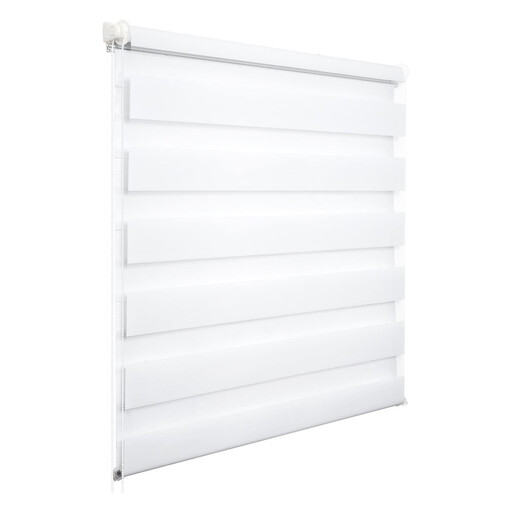
Why this product suits this profile: This model combines drill-free clip fitting with a chain mechanism and is suitable for standard windows and doors with a frame thickness of 13–23 mm.
The product details clearly state the frame thickness, fabric width and measuring method. This allows you to check before ordering that the handle and frame will remain clear.
100% polyester, a chain mechanism that can be fitted on the left or right, plus clip or screw fitting.

Why this product suits this profile: Cordless operation using a handle and the coated reverse side are designed for rooms where light protection and a neat appearance are the top priorities.
The product width, fabric width approximately 4 cm narrower, and suitable frame thickness of 16–22 mm are clearly stated. This helps prevent incorrect orders caused by inaccurate measurements.
Cordless operation, 200-g/m² polyester according to the product details, and a wipe-clean surface.

Why this product suits this profile: This pleated blind without drilling is designed for windows and doors with frame thicknesses of 10–23 mm and can be positioned flexibly using the upper and lower handles.
The restriction to interior windows and the compatible frame range are clearly stated. This prevents the model from being selected accidentally for roof windows or unsuitable frames.
Honeycomb structure, 100% polyester, clip-fix fitting and operation using two handles.
We have put together a complete, regularly updated list of products that fully meet these strict selection criteria and the safety regulations applicable in the EU.
The usual method is to use clamp brackets attached to the top of the window frame. Depending on the product, adhesive brackets or suction cups may also be suitable. The frame thickness and window type must match the manufacturer’s specifications.
Yes, some models are specifically designed for windows and doors. Before buying, check the height, width, door movement range and handle position. A chain mechanism must not rub against moving parts.
Its service life depends on the fabric, mechanism, fitting and operation. Regular, gentle operation, secure attachment and cleaning according to the instructions can help maintain its function. A general service life cannot be specified for different models.