
Lieferung heute & morgen

Qualitätsgarantie

Willkommens-Angebote freischalten: KOSTENLOSE Lieferung | Bis zu 80 % RABATT | Kostenlose 30-Tage-JoyPlus-Testphase
App herunterladen
A double roller blind that fits without drilling can provide privacy and shade in rented homes, offices and living spaces without permanently altering window frames or walls. To make sure it fits properly and works reliably day to day, though, you should look beyond colour and price.
For many day and night blinds, the stated width includes the brackets. The fabric is often around 4 to 5 cm narrower. If you only measure the glass and don’t check the product details, you may not get enough privacy or shade at the sides.
A no-drill clip-on blind needs a suitable frame. Many WOLTU models are designed for frames 13 to 23 mm thick, while other products require 16 to 22 mm or 10 to 23 mm. Depending on the model, wooden windows, roof windows, sliding windows and certain fixed-glazed windows may not be suitable.
A zebra blind with alternating sheer and opaque stripes lets you control the light, but it isn’t the same as a blackout blind. A light-filtering day and night blind may be suitable for bedrooms or rooms where you work at a screen; if you want to keep the room as dark as possible, choose an indoor blind with a specialist coating.
Start by measuring:
For several WOLTU double roller blinds, the recommended order width is the glass width plus around 4 cm. Always follow the installation instructions for the specific model. The blind shouldn’t block the window handle or catch when you open or tilt the window.
For a door blind, also check that the door can still open fully. For balcony or patio doors, a side-mounted chain may be more practical than a control that sticks out into the doorway.
A classic day and night blind or zebra blind is made from two layers of fabric that move past one another. Aligning the sheer and opaque stripes changes the level of privacy. The blind is often operated using a chain-operated indoor blind mechanism, which can be fitted on the left or right, depending on the model.
Check the product’s actual description:
Clip-on brackets attach to the top of the window frame. Check that seals, handles or the shape of the frame won’t get in the way. Some models can also be screw-fitted, but this may not be suitable for every renter.
Chains and pull cords must be secured as instructed and kept out of children’s reach. A supplied child-safety device doesn’t replace correct installation. Before using the blind, check that it’s secure and that the chain moves smoothly.
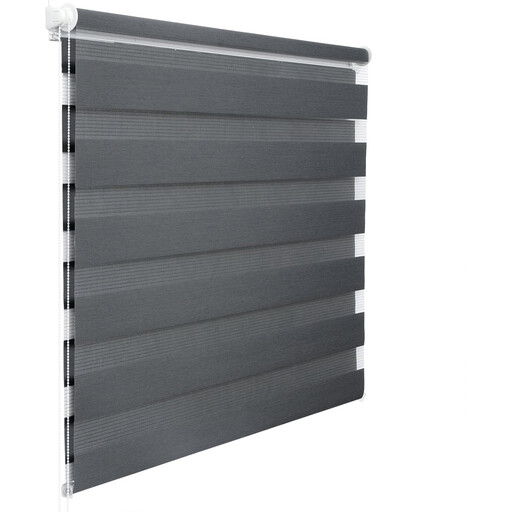
Why this product suits this profile: Its compact size is ideal for smaller standard windows. It comes with clip-on brackets and can also be screw-fitted, while the chain can be fitted on either the left or right.
The product description specifies a suitable frame thickness of 13–23 mm and notes that the fabric is around 4 cm narrower than the overall width.
Made from 100% polyester, wipe-clean with a damp cloth, and designed for operation from either the left or right.

Why this product suits this profile: This model combines double-layer fabric, clip-on brackets and a chain that can be fitted on the left or right. The product details also include a chain holder and a two-year guarantee.
The description distinguishes between clip-on and screw-fit installation, and specifies a suitable frame thickness of 13–23 mm.
Made from 100% polyester, wipe-clean with a damp cloth, supplied with fittings for two installation methods and an integrated chain holder.

Why this product suits this profile: For bedrooms, meeting rooms or spaces where you need to block out more light, a dense fabric is a better choice than a traditional zebra blind.
The description clearly states the required frame thickness of 16–22 mm and notes that the blind isn’t suitable for roof windows.
Operated using the bottom handle, with no chain; made from 200 g/m² polyester and, according to the product details, has a silver-coated backing.
We’ve put together a complete, regularly updated list of products that meet these strict selection criteria and the safety regulations in force across the EU.
The clip-on brackets are usually placed over the top of the window frame and adjusted to fit securely. First, check the frame thickness, window handle and seals. Then hang the blind and secure the chain guide as instructed.
Its lifespan depends on the material, installation, how often it’s used and how it’s cleaned. A securely fitted bracket, a smooth pull on the chain and cleaning with a soft cloth can help reduce wear. Avoid harsh cleaning products and pulling too hard.
A manually operated window blind with a chain or handle doesn’t need electricity, so there are no ongoing energy costs. When choosing a blind, though, remember to factor in spare parts, installation accessories and any delivery costs when working out the total price.