
Lieferung heute & morgen

Qualitätsgarantie

Willkommens-Angebote freischalten: KOSTENLOSE Lieferung | Bis zu 80 % RABATT | Kostenlose 30-Tage-JoyPlus-Testphase
App herunterladen
A double-sided stainless steel chopping board can make everyday food preparation easier. One side is suitable for sturdier foods such as meat, while the other is designed for vegetables, fruit or bread. But the material is only part of the story. The construction, ease of cleaning, stability and care instructions all determine whether a board is practical for everyday use.
Even with kitchen accessories marketed as hygienic, three common marketing pitfalls can lead to the wrong purchase:
Stainless steel is often chosen for its smooth, water-resistant surface. Maxcook’s model is listed as 304 stainless steel. This is a clear technical specification and should be stated explicitly in the product description.
Several models have a reverse side made from a combination of wheat straw fibre and PP plastic. This can provide a lighter, more knife-friendly surface. If you’re looking for a stainless steel and wheat straw chopping board, check that information on food contact, material composition and care is available.
A BPA-free chopping board should only be described as such if the manufacturer clearly confirms this property. “Food-safe” and “BPA-free” are not automatically interchangeable claims.
Using one side for raw meat and the other for vegetables can help you organise food preparation and reduce the risk of cross-contamination. The board must still be cleaned thoroughly after use. Poultry, meat and fish require particularly careful handling.
It’s useful to have a clear purpose for each surface:
A chopping board for meat and vegetables isn’t automatically suitable for all foods at the same time. The two sides help keep foods separate, but they don’t replace good kitchen hygiene.
The 25 x 36 cm size offers a good balance of workspace for many households, but it needs enough room on your worktop. Before buying, check the thickness, weight and handle design too.
A non-slip chopping board should sit securely thanks to a textured underside, rubber feet or a suitably grippy material. If this isn’t specified, placing a damp cloth underneath can help improve stability. The board shouldn’t wobble or slide while you’re chopping.
For a dishwasher-safe chopping board, follow the manufacturer’s instructions. Stainless steel alone doesn’t prove that the entire composite board is suitable for the dishwasher. Dry both sides thoroughly after washing. Deep cuts, cracks, chips or warping are reasons to stop using the board.
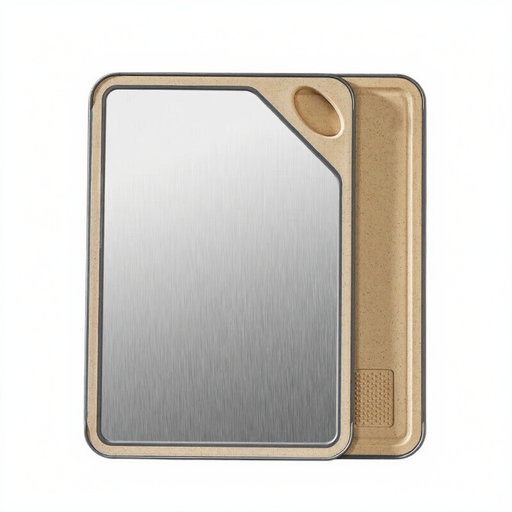
Why it suits this profile: The stated size of 25 x 36 cm provides a manageable workspace for everyday food preparation. The two different sides make it easy to keep foods separate.
The product description specifies 304 stainless steel on one side and a wheat straw and PP composite on the reverse. This makes the materials clearer than a surface that isn’t described in detail.
Double-sided design, specified 304 stainless steel side, hanging hole and compact dimensions.
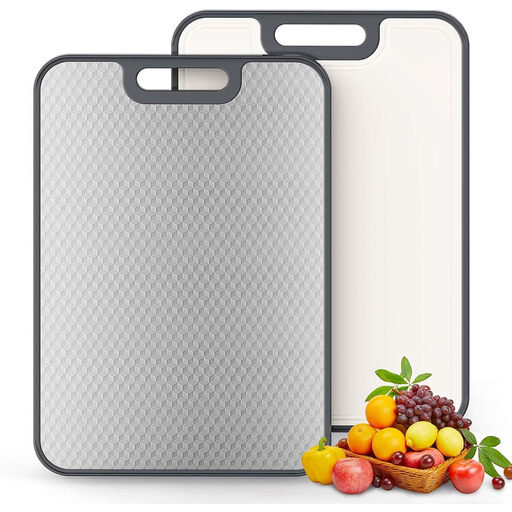
Why it suits this profile: The product details specify a size of 17 x 12 inches, a textured surface, and resistance to water, oil and odours. They also explicitly state that it can be cleaned in the dishwasher.
The care instructions clearly distinguish it from wooden boards that must be washed by hand. Buyers can check whether the stated dishwasher suitability fits their household routine.
Double-sided use, specified textured surface, generous workspace and stated dishwasher cleaning suitability.

Why it suits this profile: Three sizes, juice grooves and built-in handles make this set a good fit for households that regularly switch between chopping, serving and preparing different ingredients.
The sizes and juice grooves are clearly specified. Hand-washing is also explicitly required, so the care instructions won’t be confused with those for dishwasher-safe composite boards.
Three sizes, juice grooves, carrying handles and a stated moisture-reducing bamboo construction.
We’ve put together a complete, regularly updated list of products that meet these strict selection criteria and the safety regulations in force in the EU.
Everyday habits are key to keeping a chopping board hygienic:
Stainless steel is robust and easy to care for, but it can be harder on a knife blade than wood or softer composite materials. For regular chopping, the softer reverse side may therefore be a better choice. Consider the specific surface texture and type of knife you’re using.
The separate sides make it easy to allocate one surface to each type of food, such as stainless steel for meat and composite material for vegetables. However, this doesn’t automatically prevent cross-contamination. After contact with raw animal products, clean and dry the side you used thoroughly.
There’s no reliable way to give a set lifespan. It depends on how often and how vigorously you chop, your knife technique, cleaning, dishwasher use and storage. A scratch-resistant chopping board may show fewer signs of wear, but it won’t stay free of cuts for ever. Check the surface regularly and replace the board if damage could compromise hygiene.