
Lieferung heute & morgen

Qualitätsgarantie

Willkommens-Angebote freischalten: KOSTENLOSE Lieferung | Bis zu 80 % RABATT | Kostenlose 30-Tage-JoyPlus-Testphase
App herunterladen
A double-sided stainless steel chopping board can make preparing meat, vegetables, fruit and bread more organised. However, models vary considerably in terms of surface, stability, cleaning and knife-friendliness. For keen home cooks, families and hygiene-conscious households, it is therefore worth looking closely at the actual product features rather than relying on attention-grabbing advertising claims.
An antibacterial chopping board is often advertised with a low-porosity or easy-to-clean surface. This can make it easier to remove residue, but it does not replace thorough washing or keeping raw meat separate from ready-to-eat foods. Unless independent evidence is available, buyers should regard claims about reducing germs as statements made by the manufacturer.
The description stainless steel chopping board alone also says nothing about the precise alloy, material thickness or whether there is a declaration confirming suitability for food contact. The “304” designation describes a common grade of stainless steel, but it is not an independent quality seal.
A chopping board with two sides is only practical if each side can clearly be assigned a different purpose. If both stainless steel surfaces look almost identical, there is a risk that the intended separation will not be followed in everyday use. Sides made from different colours or materials make it easier to tell them apart.
It is still important to remember that after preparing raw meat, knives, boards and worktops should be cleaned thoroughly. Simply switching to the other side does not prevent cross-contamination.
A chopping board with a juice groove can collect liquids, but it also takes up some of the available worktop space. On very small boards, juice can quickly run over the edge despite the groove. The external dimensions are therefore crucial when preparing family meals or larger cuts of meat. A large board also requires a sufficiently wide and stable work surface.
When choosing a stainless steel chopping board, buyers should check the specific material description, the finish of the edges and any visible unevenness. Stainless steel is water-resistant and absorbs fewer odours than open-pored materials. Nevertheless, deep scratches, sharp edges or damaged coatings can make cleaning more difficult.
A textured surface can improve grip while cutting. However, percentage claims such as “90 per cent fewer scratches” should be viewed as advertising from the particular seller unless a clear comparison is provided.
The combination of stainless steel and wheat straw PP gives suitable models two distinct areas of use:
“Wheat straw PP” refers to a composite material made from plastic and wheat straw fibre. The term does not automatically mean that the product has comprehensive environmental certification.
For one person, around 25 × 36 cm may be sufficient. If you regularly prepare vegetables, meat or several ingredients, you will benefit from a larger surface. A heavier board is often more stable, but may be more difficult to fit in the sink or dishwasher.
You should also look for:
Not every dishwasher-safe chopping board can automatically be cleaned on every programme. The temperature, size and manufacturer’s care instructions are decisive. After washing, both sides should be allowed to dry completely.
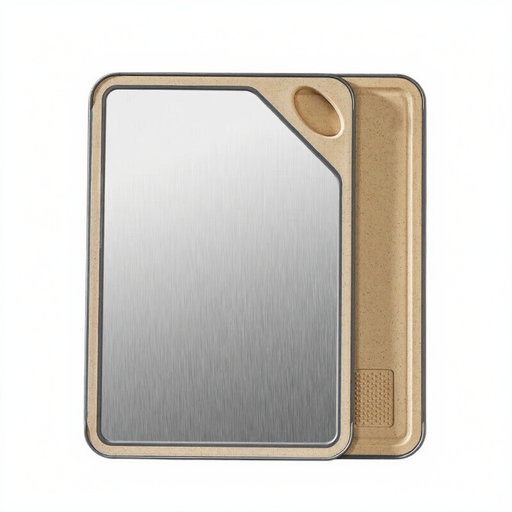
Why this product suits the profile: Measuring 25 × 36 cm, it is suitable for everyday preparation, while the stainless steel and wheat straw PP sides cover different tasks.
The different sides make the intended separation clear both visually and by touch. The product details also state that the stainless steel side is easy to clean; however, dishwasher suitability is not expressly specified.
304 stainless steel on one side, wheat straw PP on the reverse, a hanging hole and a relatively compact format.
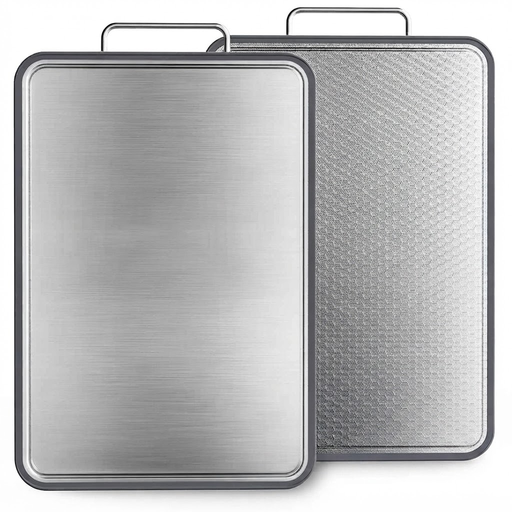
Why this product suits the profile: The 435 × 281 mm format provides plenty of workspace. Two stainless steel sides and juice grooves will appeal to users who prefer a consistent, low-porosity surface.
The juice groove can collect liquids when preparing meat or fruit. As both sides are made from stainless steel, they should be clearly assigned to different types of food in your household.
Stainless steel on both sides, a double-sided juice groove, rust-resistant material specifications and an integrated handle for carrying or hanging.
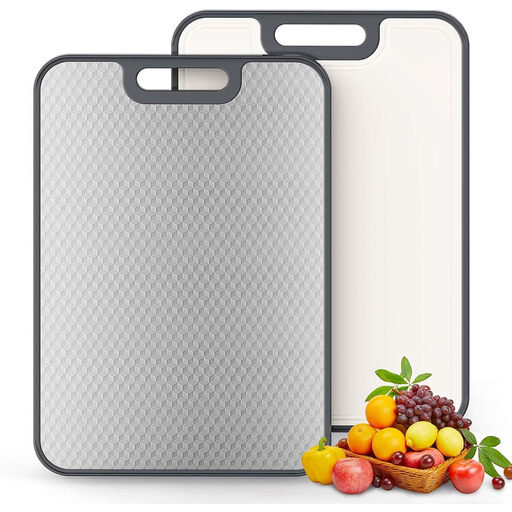
Why this product suits the profile: Measuring 17 × 12 inches or approximately 43.2 × 30.5 cm, this model is aimed at households that regularly prepare large quantities of food.
The separate material sides reduce the risk of confusion during preparation. The product details state that it is resistant to water, oil and odours and suitable for dishwasher cleaning; both sides should be allowed to dry completely afterwards.
Generous surface, textured finish, stainless steel and wheat straw PP sides, plus dishwasher-safe cleaning according to the product details.
We have put together a complete, regularly updated list of products that fully meet these strict selection criteria and the safety regulations applicable in the EU.
For a hygienic kitchen chopping board, your routine matters more than any individual advertising promise:
Stainless steel has low porosity and can often be washed easily. This can make it easier to remove food residue. However, hygienic use also depends on cleaning the board immediately, allowing it to dry completely and keeping raw and ready-to-eat foods separate during preparation.
The hardness of the surface can put more strain on knives than softer cutting surfaces. How quickly a knife loses its sharpness depends on factors including the blade steel, cutting angle, pressure and the properties of the board’s surface. For delicate knives, the softer wheat straw PP side may be a suitable alternative.
It is not possible to give a reliable fixed lifespan. Material thickness, edge finishing, use and care are the key factors. A stainless steel board should not be treated with wire wool or aggressive cleaning products. If scratches become very deep, edges become sharp or the surface remains permanently warped, replacing the board is advisable.