
Lieferung heute & morgen

Qualitätsgarantie

Willkommens-Angebote freischalten: KOSTENLOSE Lieferung | Bis zu 80 % RABATT | Kostenlose 30-Tage-JoyPlus-Testphase
App herunterladen
As a Joybuy Product Recommendation Officer, I see countless products every day. My job is to cut through the noise and give you objective, practical advice. Today, we're diving into a product that has become a staple in many kitchens: double-walled glasses. They look elegant and promise to keep hot drinks warmer for longer and cold drinks cooler. But the market is flooded with products that overpromise and underdeliver.
Many buyers invest in a set of beautiful thermal glasses, only to find that after just a few weeks, water collects between the walls, the insulation fails, or the glasses crack at the first touch of hot water from a drip coffee maker. Before you make a decision, you should know the three most common pitfalls that lead to disappointment and wasted money.
To avoid these problems, you should check three core parameters before buying. These features distinguish a durable, functional product from a short-lived marketing gimmick.
The industry standard for high-quality coffee glasses and tea glasses is borosilicate glass. Unlike conventional glass, it is characterized by a very low coefficient of thermal expansion.
The size of the glass isn't just an aesthetic feature; it's a functional necessity.
Before you buy, measure the maximum cup height your coffee machine allows. Nothing is more frustrating than a new set of latte macchiato glasses that won't fit under the coffee spout. For fans of filter coffee from a coffee maker with a glass carafe, glasses with a capacity of 250 ml or more are a great choice.
A good double-walled glass feels sturdy despite its lightness. The outer wall should remain comfortably cool to the touch, even with hot beverages—that's the main purpose of the double wall. Glasses with handles offer extra safety and comfort, especially with larger volumes. Also, check the manufacturer's claims about dishwasher safety. A high-quality seal at the base should be able to withstand it.
Based on these objective criteria, we have identified a few products suitable for different user profiles and use cases.
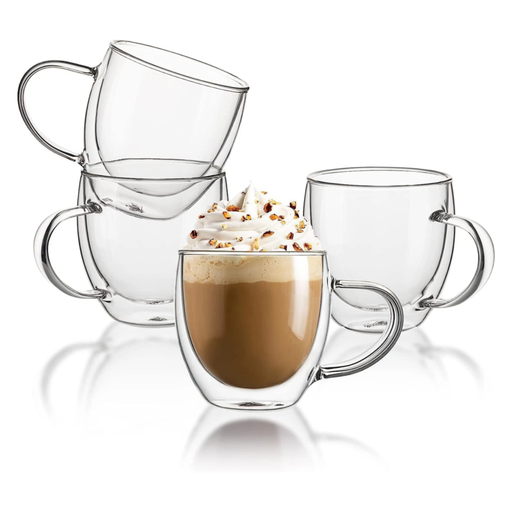
Why This Fits Their Persona: Ideal for the daily cappuccino or coffee from a drip machine. The handle provides a secure grip, and the 250 ml size is a versatile standard for most hot drinks and coffee makers.
Made from borosilicate glass, it prevents cracks from hot liquids. The practical handle also avoids direct contact with the glass wall, increasing handling safety.
Practical handle for comfortable use; the uniform shape allows for space-saving stacking in the cupboard.
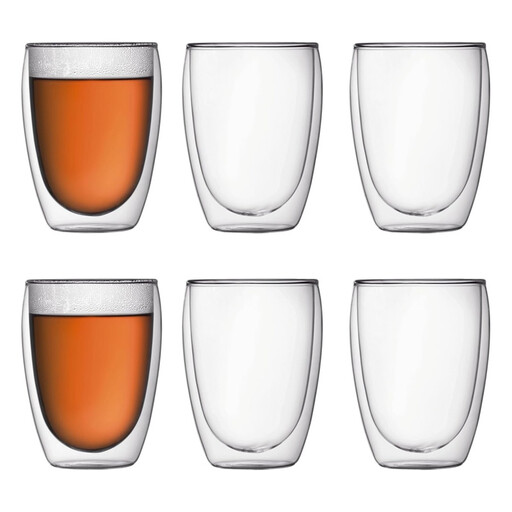
Why This Fits Their Persona: The tall, slim shape and 350 ml capacity are specifically designed for preparing and presenting layered coffee specialities like latte macchiato.
These glasses bypass the impractical design trap. Their height is sized to fit under most common fully automatic coffee machines, while the volume leaves enough room for milk foam.
The clear borosilicate glass visually enhances the layers of espresso, milk, and foam, elevating the drinking experience.

Why This Fits Their Persona: This set is more than just a drinking vessel; it's a complete system for tea preparation. It's aimed at users who celebrate the brewing process and value control and aesthetics.
It solves the problem of over-extraction common with many simple teapots. The integrated infuser allows you to stop the brewing process at the exact moment the desired strength is reached.
The functional separation of tea leaves and water prevents the tea from becoming bitter, ensuring a consistently aromatic result.
We have compiled a complete, up-to-date list of products that fully meet these strict selection criteria and relevant safety standards.
Many manufacturers claim their glasses are dishwasher-safe. However, to maximise the lifespan of the seal at the bottom, washing in the top rack at lower temperatures is often recommended. The main risk is that harsh detergents and high water pressure can damage the silicone seal, leading to water ingress. Gentle hand washing is therefore often the safer method.
If moisture or condensation forms in the gap, it's a clear sign of a defective seal at the base of the glass. The vacuum responsible for the insulation has been compromised, and water has entered. Such a glass has lost its function as a thermal glass and is essentially just a normal, albeit thicker, glass. This is a quality defect.
For a classic cappuccino, cappuccino cups with a volume of about 150 to 250 ml are ideal. This provides enough space for a double espresso and the right amount of milk foam. For a latte macchiato, which consists of more milk and is typically served in layers, tall latte macchiato glasses with a capacity of 300 to 450 ml are the right choice.