
Lieferung heute & morgen

Qualitätsgarantie

Willkommens-Angebote freischalten: KOSTENLOSE Lieferung | Bis zu 80 % RABATT | Kostenlose 30-Tage-JoyPlus-Testphase
App herunterladen
Double-walled glasses combine a transparent look with an insulating layer of air between two glass walls. This means the exterior can feel more comfortable to hold when serving hot drinks and can produce less condensation with cold beverages. That makes them appealing for coffee, tea, espresso, cocktails and soft drinks.
However, not every product labelled “thermal glass” is suitable for the same purpose. Focusing solely on design or supposedly high heat resistance can lead to a poor choice in terms of capacity, care requirements and everyday usability.
A double-walled glass may be made from heat-resistant borosilicate glass and still be damaged by a fall or a hard impact. The term “heat-resistant glasses” is not a licence for extreme temperature changes either. Filling a glass directly from the freezer with boiling water can create stress within the material.
As a practical rule: allow the glass to acclimatise before use, avoid sudden temperature changes and follow the manufacturer’s instructions.
A 200 ml glass is suitable for espresso, smaller coffee specialities or individual portions of tea. For a large latte or a drink with ice, 350 to 400 ml is generally more appropriate. With double-walled glasses, the outer shape can appear larger than the actual filling capacity.
Do not rely solely on product images. Check the stated capacity in millilitres instead. For several people, a thermal glass set with six glasses can be more economical than buying individual pieces.
According to their product descriptions, some borosilicate glasses are dishwasher- or microwave-safe. Other models have restrictions. For example, a product may be suitable for the dishwasher but not for use in the oven. Glasses with lids, wooden components or seals require particularly careful attention when it comes to cleaning and care.
The information on the relevant product page is decisive. If the instructions are unclear, hand-washing with a soft sponge is the gentler option for the material.
Borosilicate glass is often used for heat-resistant glasses and is generally suitable for changing temperatures. This does not mean, however, that every borosilicate glass can be heated as desired or cooled abruptly. The workmanship, wall construction and instructions for use are also important.
Be cautious with products that do not specify the material clearly. Terms such as “heat resistant” or “thermal insulation” are no substitute for precise information about the material, cleaning requirements and temperature limits.
In a double-walled glass, the space between the walls creates a thermal barrier. This can help hot drinks cool more slowly, while cold beverages absorb heat from their surroundings less quickly. The exact duration depends on factors including the quantity of liquid, starting temperature, room temperature and the shape of the glass.
An insulating construction also often prevents water from quickly collecting on the outside of a glass filled with ice. This can help protect table surfaces, but it does not always replace a coaster for very cold or particularly condensation-prone drinks.
For coffee and tea, coffee glasses with handles are practical when the glass needs to be lifted securely. A handle provides additional grip, especially with larger capacities. Small, handleless glasses look more compact and are often well suited to espresso, whisky or desserts.
Also check the rim, base and height of the glass. Tall glasses do not fit in every dishwasher and can be difficult to position beneath some bean-to-cup coffee machines.
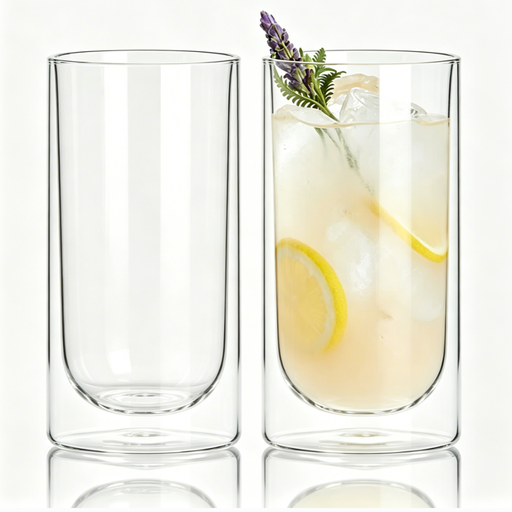
Why it’s a good fit: The 280 ml capacity is suitable for everyday servings of coffee, tea and smaller cold drinks. The two-piece pack is a manageable choice for single-person households or couples.
The clearly stated capacity reduces the risk of choosing a glass that looks large but offers limited room in practice.
Double-walled construction, 280 ml capacity and described as suitable for both hot and cold drinks.
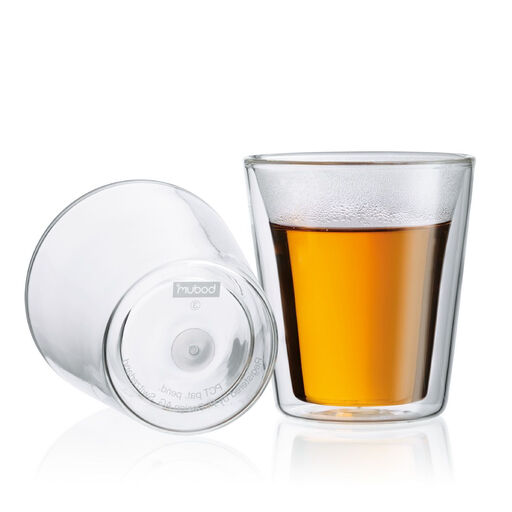
Why it’s a good fit: The six-glass set is designed for breakfast, coffee gatherings or entertaining several guests. Its transparent form keeps the colours and layers of drinks on display.
The set size and exact volume are clearly specified rather than being promoted with a vague “Family Size” claim.
Six glasses, double-walled construction and dishwasher-safe according to the product description.
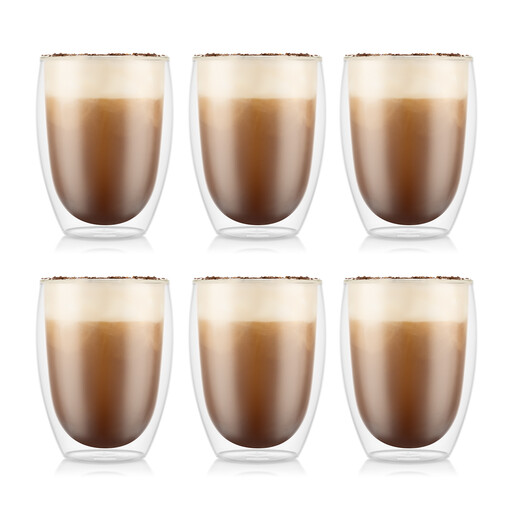
Why it’s a good fit: With 350 ml of capacity, there is ample room for lattes, cappuccinos, iced tea, cocktails or drinks served with ice cubes.
The capacity is clearly stated for generous servings, rather than being judged solely from the product images.
Six-piece set, 350 ml capacity and double-walled thermal-glass construction.
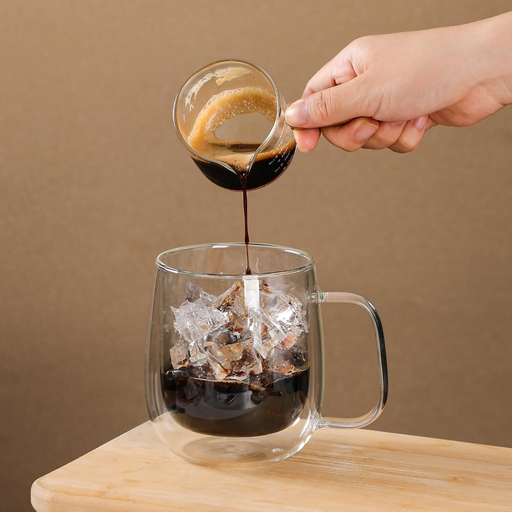
Why it’s a good fit: The handle provides a secure grip for larger servings. The glasses are described as suitable for both hot and cold drinks.
The handles and capacity are immediately apparent, making everyday handling easier to assess.
Two-piece set, 350 ml capacity, integrated handles and dishwasher-safe according to the product information.
We have put together a current selection of products that can be compared by capacity, construction and stated care instructions.
The double wall reduces heat exchange with the surrounding environment. As a result, a drink may cool more slowly than it would in a single-walled glass. However, no general heat-retention time can be guaranteed, as the quantity, temperature, shape of the glass and room conditions all play a role.
That depends on the individual model. Some products are described as dishwasher-safe, while others recommend hand-washing. Check the product details before buying and avoid harsh cleaning agents or sudden temperature changes.
Around 80 to 100 ml is suitable for espresso. Smaller coffee specialities and tea often fit well in 200 to 250 ml glasses. For lattes, cappuccinos, iced coffee or larger servings, 280 to 400 ml is more practical. If you want to cover several uses, you can combine different sizes from a thermal glass set.