
Lieferung heute & morgen

Qualitätsgarantie

Willkommens-Angebote freischalten: KOSTENLOSE Lieferung | Bis zu 80 % RABATT | Kostenlose 30-Tage-JoyPlus-Testphase
App herunterladen
Drawing and craft sets for children often look similar at first glance: lots of colours, numerous accessories and eye-catching packaging. For parents, grandparents and educational professionals, however, the number of pieces is not the only consideration. What matters is whether the set suits the child’s age, motor skills, available space and intended use.
A children’s painting case with 100 or more pieces sounds comprehensive. However, it may contain lots of similar pens, small paint pots or accessories that a younger child cannot yet use safely. So check the components that can actually be used: are paper, brushes, paints or templates included? Is there a storage solution?
With washable pens for children, the claim usually refers to skin or certain fabrics, and to quick cleaning. Dried paint can still leave marks. Water-based products are often easier to manage in everyday use, but should be removed promptly with water and, if necessary, soap after use.
A craft set for ages 3 and over may contain small parts that are unsuitable for younger children. A set labelled for ages 6 and over may also require children to read instructions, cut precisely or concentrate for longer periods. The age recommendation is therefore an important guide, but does not replace an adult’s assessment of whether the child is ready.
For children from around 2 years old, large handles, short steps and clearly recognisable colours are helpful. Jumbo dot markers are generally easier to hold than thin felt-tip pens. With finger paints, the packaging should explicitly state a suitable age recommendation. Small parts, sharp points, liquids and materials such as glitter or beads should only be used under appropriate supervision.
Look out for:
Water-based paints such as gouache paints for children or tempera paints can generally be diluted with water and rinsed out of brushes. Fabric paints have different requirements: after fixing, they may be more durable, but this involves an additional step. With a window paint set, check which smooth surfaces the paint is intended for and how easily it can be removed afterwards.
It is important to distinguish between:
Marketing terms should always be checked against the specific product details. Claims such as ‘non-toxic’ or ‘safe’ should not be interpreted as blanket guarantees. Children should not put paints or pens in their mouths; for sensitive skin or known intolerances, the list of ingredients and safety warnings is particularly important.
For travelling, waiting times and small homes, compact DIY creative sets without glue or scissors are a good choice. A children’s art set with lots of colours, on the other hand, is better suited to a dedicated craft area. Before buying, ask yourself:
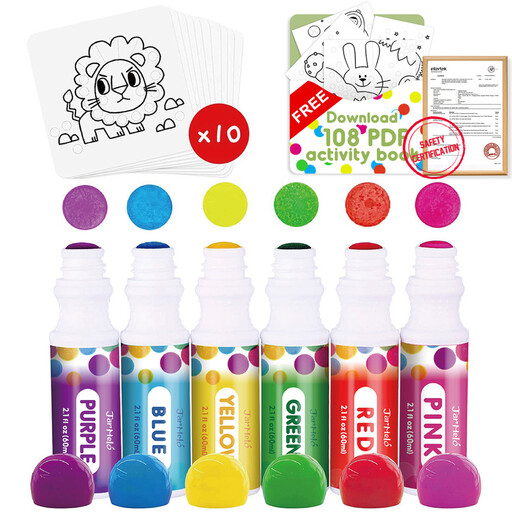
Why this product suits this profile: The six jumbo markers are designed for small hands and are suitable for creating dots, lines and larger areas. Activity sheets, together with access to additional PDF templates, complement this children’s drawing set.
Instead of lots of small individual pieces, this set focuses on six easy-to-grip markers. Even so, the stated washability should be understood in line with the manufacturer’s instructions.
Water-based, alcohol-free and odour-free ink, a jumbo shape and 10 physical activity sheets.
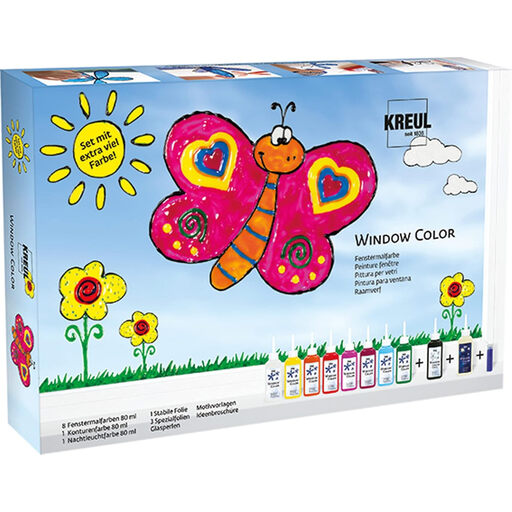
Why this product suits this profile: The window colour set contains ten colours, outline paint, films, templates and instructions. According to the product details, it is intended for children aged 6 and over and is suitable for smooth surfaces such as glass, mirrors and tiles.
The intended surfaces and the process using outline paint are clearly described. Even so, liquid paint should be removed before it dries, as it may stain textiles.
10 bottles containing 80 ml each, water-based and blendable colours, plus templates and films.
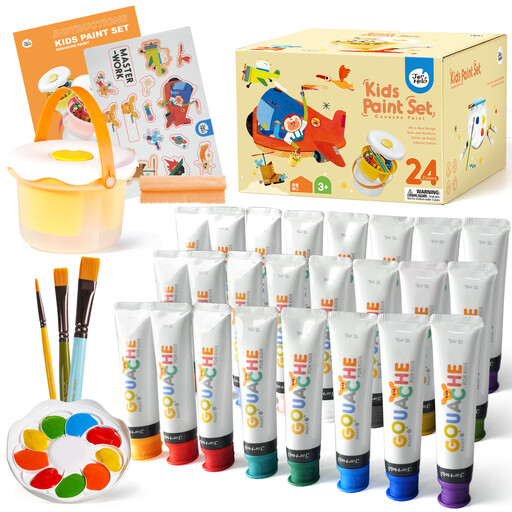
Why this product suits this profile: For regular painting sessions at home, this children’s art set offers 24 gouache colours, three brushes, a rinse cup and a portable container with a palette lid. It is stated to be suitable for children aged 4 to 12.
The components are grouped together in one container. This helps keep the tubes, brushes and mixing surface together, rather than requiring them to be stored separately after just a few uses.
24 paint tubes, a palette lid, rinse cup and storage in one portable set.
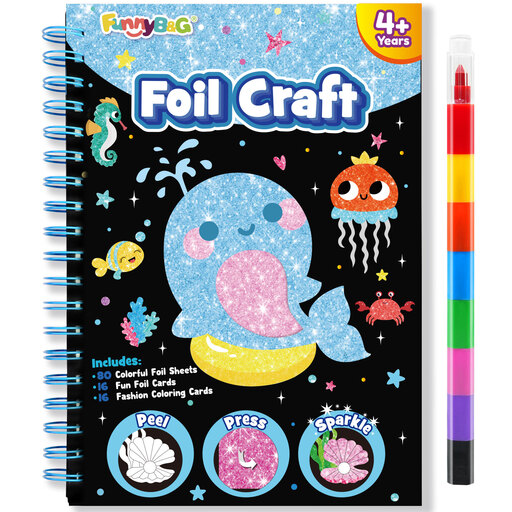
Why this product suits this profile: According to the product details, this foil art craft set is intended for children aged 4 to 10. It involves peeling, placing and pressing, and requires neither glue nor scissors.
The design focuses on short, clearly defined steps. Compared with liquid paints, this reduces the amount of material needed and the cleaning involved.
112 pieces, including foils, picture boards, cards and a rotating pen with eight colours; compact for travelling and waiting times.
We have put together a complete, regularly updated list of products that fully meet these strict selection criteria and the safety regulations applicable in the EU.
Depending on age and interests, a Scratch Art Set with 130 pre-cut note sheets, a Marble Paint Set for marbling projects or a classic Pelikan school paint set for ages 3 and over may also be worth considering. For children aged 8 and over, a DIY creative set for decorating glitter pens is a good option. Finger paints are appealing to very young children, but should only be used on suitable surfaces and under supervision.
Anyone who would like to try out different techniques can choose a larger painting case containing watercolours, acrylic paints and oil paints. With sets like these, it is particularly important to consider whether the child can already use each material safely and whether the cleaning involved is realistic for everyday life.
From the age of 3, simple colouring sheets, large wax crayons, easy-to-grip markers and clearly labelled school paints may be suitable options. The specific safety warnings, the size of individual parts and adult supervision remain crucial.
Their lifespan depends on how well they are sealed, how they are stored and how frequently they are used. Pens should be closed fully after every use. Paint tubes and pots stay usable for longer when sealed properly and stored somewhere dry and protected from heat. Dried-up paint cannot be restored for use with every product.
In addition to the purchase price, you may need to buy paper, replacement paints, brushes or additional templates. Sets with reusable tools and their own storage are easier to budget for day to day. With liquid paints, you should also factor in a protective covering, cleaning and, where necessary, protective clothing.