
Lieferung heute & morgen

Qualitätsgarantie

Willkommens-Angebote freischalten: KOSTENLOSE Lieferung | Bis zu 80 % RABATT | Kostenlose 30-Tage-JoyPlus-Testphase
App herunterladen
Purchasing a changing table is one of the first major decisions for the nursery. The selection is vast, but not every model delivers on its promise. As a Joybuy Product Recommendation Officer, I'll help you distinguish essential features from superfluous ones and make a choice that combines safety, practicality, and longevity.
Many well-intentioned designs prove impractical in daily use. Pay attention to these three points to avoid a bad purchase:
To avoid these pitfalls, you should check three core parameters before buying. These determine whether a changing table dresser is a sensible and long-term investment.
Your child's safety is the top priority. A solid changing table with a topper must have two fundamental safety features:
The changing station will be used several times a day. A well-thought-out design makes daily life considerably easier.
A convertible changing table is a sustainable choice. On these models, the changing topper can be removed easily and without a trace after the nappy-changing phase. What remains is a neutral dresser that can be used for many more years in a child's or teenager's room. Make sure that no visible drill holes are left on the top surface after removing the topper.
Here are some recommendations tailored to the different needs of parents, specifically designed to avoid the pitfalls mentioned.
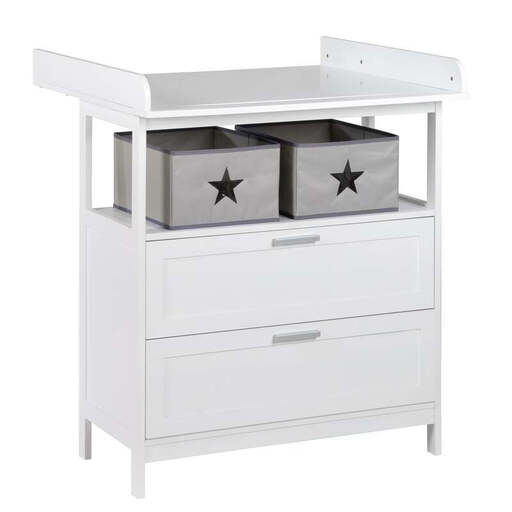
Why it's a great fit: Ideal for parents who value clear structure and organisation. The combination of open compartments for quick access and closed drawers for clothes and supplies offers a well-thought-out system for the changing station.
The removable topper ensures the dresser has long-term usability. The 92 cm changing height is ergonomic, and the included anti-tip kit provides stability.
Structured storage with two drawers and two open compartments with boxes. The classic white changing table fits into almost any room design.

Why it's a great fit: Perfect for anyone who wants to store larger items like nappy packs or baby blankets out of sight. The large storage space behind the doors offers more flexibility than fixed drawers.
This model is also a convertible changing table. The ergonomic height and the included wall mount meet the core requirements for safety and comfort.
Maximum flexible storage behind two doors, supplemented by open compartments for quick access. Ideal for storing bulkier items.
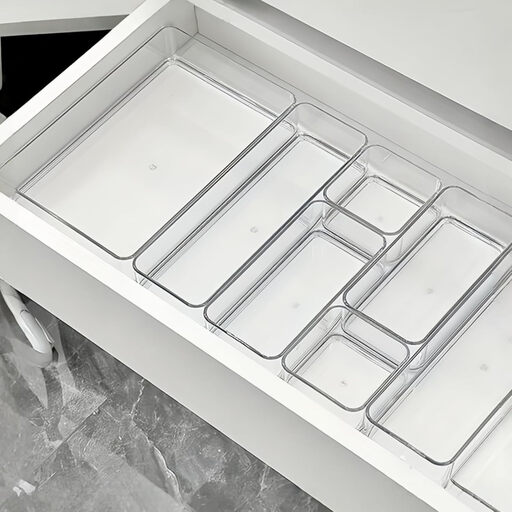
Why this product fits: This set is the perfect addition to any changing table. It creates order in large drawers, ensuring small items like socks, dummies, or care products don't get lost.
It solves the problem of disorganised storage. Instead of putting everything into one drawer, the set allows for clear compartmentalisation and prevents daily searching.
Maximum flexibility with 25 individual containers in four different sizes. The transparent boxes provide a quick overview of the contents.
A well-organised changing table saves time and stress. Discover our selection of practical storage solutions that fit perfectly into drawers and compartments.
A back-friendly changing height for most people is between 90 cm and 95 cm. This allows for an upright posture and prevents strain. If you are particularly tall or short, it's a good idea to measure this against your own body height before buying.
The main advantage is longevity. A dresser with a removable changing topper can continue to be used as a fully functional piece of furniture in the child's room after the nappy-changing phase is over. This is not only cost-effective but also sustainable.
Most high-quality changing tables come with an anti-tip kit. This usually consists of a bracket or a strap that is screwed to the back of the dresser and to the wall. Installation is crucial for safety and should be carried out carefully according to the instructions. Be sure to use wall plugs and screws that are appropriate for your specific wall type.