
Lieferung heute & morgen

Qualitätsgarantie

Willkommens-Angebote freischalten: KOSTENLOSE Lieferung | Bis zu 80 % RABATT | Kostenlose 30-Tage-JoyPlus-Testphase
App herunterladen
A dressing table chair should complement your dressing table, provide comfortable seating and fit into the room with as little fuss as possible. At the same time, dressing chairs, vanity chairs and dressing table stools differ considerably in seat height, padding, weight capacity and cleaning requirements. If you choose based solely on colour or shape, you may overlook important details.
Three common purchasing pitfalls occur particularly often:
Before buying, measure the distance between the floor, seat and tabletop. Seat depth and overall width are also important for a dressing table chair. A compact decorative stool is better suited to small bedrooms or narrow dressing rooms. A comfortable armchair with armrests requires considerably more floor space.
Pay attention to:
A height-adjustable vanity chair can be used flexibly. For example, the HaluPeit model has a stated seat height ranging from 47.5 to 57.5 cm. This makes it easier to adjust the chair to different tabletop heights.
The padding affects how comfortable a chair feels during daily make-up application, hairstyling or work. Thick foam padding can improve seating comfort, but on its own it says nothing about long-term shape retention. The seat construction and base are also relevant.
Different upholstery materials have different requirements:
A removable, machine-washable seat cover is practical for everyday use. This feature should be expressly stated in the product details rather than inferred from the images alone.
The maximum weight capacity is a specific technical specification and should not be exceeded. The eSituro Square Makeup Stool has a stated maximum recommended load of 150 kg. According to the product details, the CHAIRUS model is designed to support up to 120 kg, while the Ckaff stool is intended to support up to 135 kg.
A swivel chair with rocking function can be useful if the seat is also to be used as a home office chair or reading chair. In this case, look for a stable base, smooth-running castors and a secure stance. For a traditional dressing table, however, a stationary upholstered chair or stool without any mechanism is often sufficient.
For a model with storage, the following are also important:

Why this product suits this profile: This compact stool is suitable for use at a dressing table, in the hallway or as a shoe-changing stool. Its dimensions of approximately 42 × 48 × 32 cm make it easy to use in smaller rooms.
The product details specify a maximum recommended load of 150 kg as well as non-slip foot pads. This makes key purchasing information more specific than general claims about stability.
Teddy fabric, extra-thick foam padding, MDF and pinewood construction, plus easy assembly.
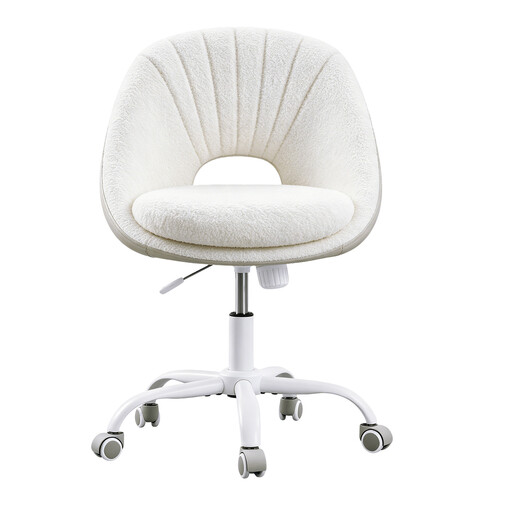
Why this product suits this profile: This swivel dressing table chair is designed for bedrooms, living rooms, studies and home offices. The adjustable backrest and rocking function make it appealing to anyone looking for versatile seating.
The seat height is stated as 47.5 to 57.5 cm. The product details also specify a maximum load of 136 kg, a metal base and a removable, machine-washable seat cover.
360-degree swivel, rocking function, height-adjustable backrest and stated dimensions of 60.5 × 48.5 × 80.5–90.5 cm.

Why this product suits this profile: This two-piece set is suitable for dressing tables, bedrooms and living rooms when you want to combine additional seating with concealed storage.
Alongside the stated load capacity of 135 kg, the product details describe a removable lid, protective feet and use on a level surface. The smaller piece can be stored inside the larger one.
Two stools, storage in the larger model, stackable storage, bouclé velvet upholstery and no assembly required.
We have put together a complete, regularly updated list of products that fully meet these strict selection criteria and the safety regulations applicable in the EU.
The chair should be fully assembled and placed on a level, stable surface. If it has castors, choose a version suitable for the type of flooring. Protective pads can be useful on parquet, laminate or vinyl. A stool should not be used as a step; the stated weight limit must be observed.
For care and maintenance:
There is no single ideal height. Measure the height of the table and consider whether the chair has thick padding or armrests. Height-adjustable models offer greater flexibility. The important thing is that your forearms can rest comfortably on the tabletop when seated.
A dressing chair with a backrest is better suited to longer periods of sitting and provides additional support. A dressing table stool takes up less space and can be pushed more easily under the table. For small rooms or flexible use, a compact stool may be more practical.
Its lifespan depends on the load, construction, flooring and care. Without knowing the individual conditions of use, it is not possible to give a reliable specific lifespan. Look for sturdy connections, a stated maximum load and regular checks of the frame, castors and feet.