Households that eat dried fruit regularly
If you use dried fruit often, you can choose a larger pack based on how much you’ll use and how you’ll store it once opened. EDEKA recommends keeping dried apple rings in a cool, dry place.


A bulk pack of dried fruit can suit a low-fat diet if the nutritional information for the specific product meets your needs and you’ll use it regularly. Fat content alone isn’t enough to make a decision: the German Federal Centre for Nutrition points out that drying concentrates sugar and energy per 100 g. For mixes and products preserved in oil, the ingredients matter too.
If you use dried fruit often, you can choose a larger pack based on how much you’ll use and how you’ll store it once opened. EDEKA recommends keeping dried apple rings in a cool, dry place.
If you’re watching your fat intake, check the fat content per 100 g and the ingredients of the product you’re considering. Dried fruit and dried products preserved in oil aren’t the same, as EDEKA’s product information shows.
If you’re looking for unsulphured fruit or a short ingredients list, check the label on the pack. Allergen information is also important if you have an allergy or intolerance; Lebensmittelklarheit explains how allergens are labelled.
When buying dried fruit in bulk, first check the fat content and ingredients, then consider the pack size in relation to how much you’ll use. Sugar and energy per 100 g, along with storage advice for after opening, will also help you decide.
| What to consider | What to check when buying | Especially relevant for |
|---|---|---|
| Fat and ingredients | Fat per 100 g and the ingredients list for the specific product; for mixes, check for oil, nuts or chocolate too. | If I’m choosing dried fruit for a low-fat diet, I don’t want to overlook ingredients containing oil. This is the main consideration for around 29% of consumers. |
| Pack size and how much you’ll use | Pack size, whether it’s divided into smaller bags, and storage advice for after opening. | If I eat dried fruit regularly, I want to be able to use a larger quantity before its quality declines. This is the main reason for buying for around 36% of consumers. |
| Sugar and portion size | Sugar and energy per 100 g, as well as how much you usually eat at a time. | For a snack, I want to choose my portion carefully because dried fruit contains concentrated sugar and energy per 100 g. This is the first thing around 21% of consumers look for. |
| Additives and storage | Ingredients and allergen information, particularly for sulphur dioxide, as well as storage instructions on the pack. | If I want to avoid certain ingredients or keep an opened bag for longer, I need clear labelling and suitable storage instructions. This is a priority for around 14% of consumers. |
The word “dried” alone doesn’t tell you how much fat a product contains. EDEKA lists 1 g of fat per 100 g for dried mango strips, compared with 15.3 g per 100 g for dried tomatoes in rapeseed oil. Tomatoes in oil aren’t a suitable substitute when comparing plain dried fruit.
Check the fat content per 100 g for each variety, and check the ingredients of any mixes or products preserved in oil.
Dried fruit contains naturally occurring sugar, even when no sugar has been added. The Verbraucherzentrale explains that removing water concentrates sugar and energy per 100 g.
Compare the nutritional information per 100 g and consider how much you actually plan to eat.
Dates, prunes and freeze-dried fruit don’t necessarily serve the same purpose. For example, Seeberger sells classic dried fruit in 500 g packs, while its freeze-dried fruit comes in different pack sizes.
When stocking up, start by comparing similar types of fruit, then check the ingredients, how you plan to use them and how much you’ll eat.
EDEKA’s dried fruit mix lists sulphur dioxide as an ingredient and in the allergen information. A general statement about possible traces isn’t the same as listing it as an ingredient.
If sulphur dioxide or sulphites are relevant to you, check the current ingredients and allergen information on the specific bag before deciding.
Seeberger sells dried fruit such as dates, prunes and sultanas in a range of pack sizes, including 500 g packs.
REWE has an online category for dried fruit and kernels, featuring its own-brand products and other brands.
EDEKA provides product information for items including dried mango strips, dried fruit mixes and dried tomatoes in oil.
ALDI SÜD has a product page for FARMER NATURALS prunes in a 500 g bag.
Lidl sells dried fruit under its Alesto brand. On the Lidl website, Solevita is listed as a drinks brand.
The packs below include dates, prunes and jujubes for your store cupboard. As well as the quantity, check the preparation and consumption instructions for each product: not every pack of jujubes is intended to be eaten raw.
 No image available
A handy option for stocking up, divided into individual 30 g portions. The dates contain stones, so bear this in mind when eating or preparing them.
 No image available
For anyone looking for a 500 g pack of jujubes to eat as they are or use as an ingredient. Follow the storage instructions after opening, and check the nutritional information on the pack if you’re watching your fat intake.
 No image available
For anyone who regularly uses a 500 g bag of prunes. The product information notes that, despite being labelled “pitted”, some fragments of stone may remain; check the current ingredients list when choosing.
 No image available
For anyone who wants to snack on pitted dates or use them in dishes, in a 500 g pack. To check how they fit your usual portion, compare the sugar and energy values per 100 g.
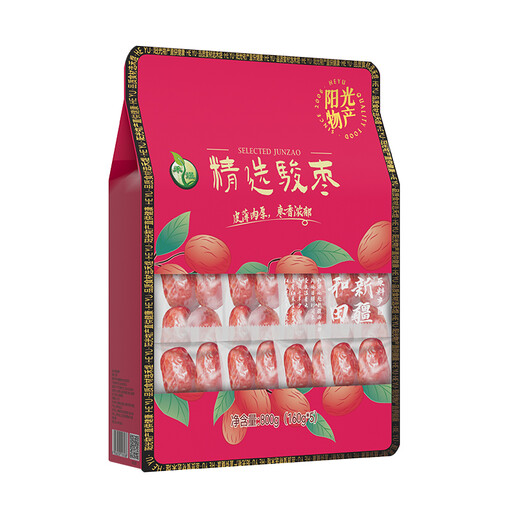 No image available
For anyone who wants to divide jujubes between five bags for use in cooking. According to the product information, wash thoroughly and cook fully before eating; do not eat raw.
No, you need to check the fat content of the specific product. ALDI SÜD lists 0.5 g of fat per 100 g for its prunes; EDEKA lists 1 g per 100 g for its dried mango strips. Other dried products may contain considerably more fat if they’re made with oil.
No, the claim doesn’t tell you how much naturally occurring sugar the product contains. The Verbraucherzentrale explains that removing water concentrates sugar and energy per 100 g, so the nutritional information can help you choose your portion.
Follow the product’s storage instructions and keep opened dried fruit away from moisture. For dried apple rings, EDEKA recommends storing them in a cool, dry place in a tightly sealed, lightproof container. It advises against refrigeration because of the moisture.
Check the ingredients and allergen information on the specific pack. This information is required on the labels of pre-packed foods in the EU. The European Food Safety Authority lists sulphur dioxide and sulphites as allergens that must be declared when present at concentrations above 10 mg/kg or 10 mg/l, expressed as total sulphur dioxide.
Lidl sells Solevita as a drinks brand and uses Alesto for dried fruit. If you’re looking for dried fruit at Lidl, check the relevant Alesto products and the information on their packs.