Families keeping an eye on calories
If several people in your household eat dried fruit, the nutrition information per 100 g makes it easier to compare varieties. The portion size also affects how much you actually eat.


If you’re choosing dried fruit for the family and keeping an eye on calories, compare products using the nutrition information per 100 g rather than looking for a ‘low-calorie’ variety. The prune products listed by REWE contain 237 and 239 kcal per 100 g respectively. For an EU ‘low calorie’ claim, the European Commission sets a limit of no more than 40 kcal per 100 g for solid foods. Ingredients, sugar content and a pack size that suits how much you’ll use are also important.
If several people in your household eat dried fruit, the nutrition information per 100 g makes it easier to compare varieties. The portion size also affects how much you actually eat.
A larger pack can be handy for breakfast, lunchboxes or baking. The key is whether the quantity suits how much you’ll use and the storage instructions.
If you want to avoid added sugar or need to watch out for peanuts and tree nuts, check the ingredients list and allergen information on the specific pack.
Start with the energy value per 100 g. Then check the sugar and ingredients, and whether the pack size suits your family’s needs.
| What to check | What to look for when buying | Who it matters to |
|---|---|---|
| Energy value | Compare kcal and sugar per 100 g, and bear in mind the portion size you choose. | I want to buy dried fruit for several people and identify products with a lower energy value within the category. Around 42% of consumers put this comparison first. |
| Pack size | Check the net weight, storage instructions and, if you’ll use it over a longer period, whether the pack can be resealed. | I need a supply for breakfast and baking, but don’t want to buy a pack we won’t finish. For around 33% of consumers, this is the main consideration. |
| Ingredients and allergens | Read the ingredients list and sugar information together. If you have allergies, check the details on the pack you buy. | If I need to avoid added sugar or choose products because of an allergy, the specific ingredients and allergen labelling are what matter. For around 25% of consumers, this check comes first. |
Dried fruit contains naturally occurring sugars, even without added sugar. Removing the water increases the sugar and energy values per 100 g, as explained by the Verbraucherzentrale.
Compare the nutrition information per 100 g and consider how much you’ll eat. The ingredients information is no substitute for checking the energy value.
EDEKA lists its sweetened GUT&GÜNSTIG cranberries as containing 331 kcal and 67.1 g of sugar per 100 g. EDEKA24 lists a walnut and cranberry mix at 523 kcal per 100 g; its ingredients are different from those of dried fruit on its own.
When comparing products, keep plain fruit, sweetened fruit and mixes separate. Check the ingredients list and nutrition information for each one.
A bulk pack only makes sense for the family shop if you’re likely to use it all while following the stated storage instructions.
Check the pack weight, storage instructions and packaging before opting for a larger size.
If some of it goes unused for a long time or isn’t stored properly, buying a larger quantity could lead to food waste.
REWE says its ja! Soft Prunes may contain traces of tree nuts and peanuts. Nuts may also be an ingredient in nut-and-fruit mixes.
If allergens are a concern in your household, check the ingredients list and trace warnings on the exact pack you’re buying.
Seeberger offers a range of dried fruit and pack sizes, including prunes.
Dried prunes and sweetened cranberries listed by EDEKA show how ingredients and nutrition values can vary within the brand.
REWE sells ja! Soft Prunes in a 250-g pack.
REWE lists Farmer's Snack dried prunes, pitted, in a 500-g pack.
This selection includes two pack sizes of Seeberger pitted soft prunes: 500 g for a larger shop and 200 g if you only need a smaller quantity. To compare calories, check the nutrition information on each pack.
 No image available
The 500-g pack could be a good choice if your household gets through a larger quantity of pitted soft dried prunes.
Before buying, check the nutrition information, ingredients and storage instructions on the specific pack.
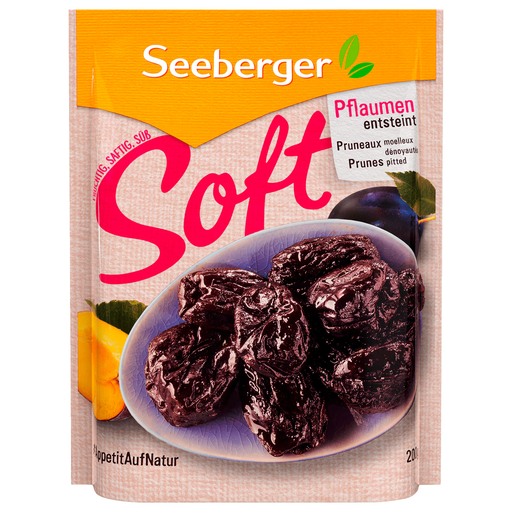 No image available
The 200-g pack is a good fit if a smaller quantity of pitted soft prunes is enough for your planned shop.
Compare the energy and sugar values per 100 g on the pack, and follow the storage instructions.
The dried fruit products compared here don’t meet the EU requirement for a ‘low calorie’ claim. The European Commission sets a limit of no more than 40 kcal per 100 g for solid foods, while REWE lists the prunes mentioned above at 237 and 239 kcal per 100 g respectively. So compare varieties with one another and keep portion size in mind.
No. Dried fruit contains naturally occurring fruit sugars, even without added sugar. As well as checking the ingredients list, look at the sugar value per 100 g in the nutrition table.
A larger pack is handy if the quantity suits how much you plan to use and you can store it as directed on the pack. Check the net weight and, if you’ll use it over several occasions, whether the packaging can be resealed.
Ingredients and allergens are listed on the packaging of the food product; possible traces may be listed separately. If you have allergies, check the information on the specific pack, even when buying plain dried fruit.