Hosts comparing nutritional values
You’re planning a snack bowl for several people and want to consider the energy value and sugars per 100 g, as well as the amount you’ll be serving, rather than assuming dried fruit is always low in calories.


Dried fruit is not automatically low in calories for a Christmas party. Compare the energy value and the ‘of which sugars’ figure per 100 g on the packets, and think about how much you actually plan to serve. Freeze-dried fruit is also concentrated in sugars and energy because the water has been removed, as the consumer advice centre explains. If any guests have a sulphite allergy or intolerance, check the ingredients and allergen information for each variety before serving.
You’re planning a snack bowl for several people and want to consider the energy value and sugars per 100 g, as well as the amount you’ll be serving, rather than assuming dried fruit is always low in calories.
You want to check for added sugar, other ingredients and allergen information on each packet – especially if any guests have a sulphite allergy or intolerance.
You’re looking for soft fruit for a snack bowl or crunchy freeze-dried fruit to top a dessert.
First, decide whether you’ll serve the fruit on its own or use it as a topping. Then compare the nutritional information on the same basis and check the ingredients for each variety.
| Criterion | What to check when buying | Who it matters to |
|---|---|---|
| Energy value and sugars | Compare the energy value in kcal and ‘of which sugars’ per 100 g, and bear in mind how much you plan to serve. | When I’m putting together a snack bowl, I want to compare the nutritional values of different packets clearly. Around 42% of consumers put energy value and sugars at the top of their list when choosing. |
| Ingredients and allergens | Read the ingredients list and allergen information on each packet, especially for sulphur-treated fruit. | If guests need to avoid certain ingredients, I want to know what each variety contains before serving. This check is the main priority for around 33% of consumers. |
| Texture and use | Choose between soft fruit for the bowl and crunchy fruit as a topping, and check the pack size. | For my buffet, I need either fruit for snacking straight from the bowl or a crunchy touch for dessert. How it will be used is the main criterion for around 25% of consumers. |
Dried fruit naturally contains sugars, even when no sugar has been added. According to the consumer advice centre, removing the water concentrates the sugars and energy per 100 g.
As well as reading the ingredients list, check the ‘of which sugars’ figure and energy value per 100 g. Set a serving size for the snack bowl rather than treating the whole open packet as one portion.
EDEKA lists sulphur dioxide as an allergen in its description of sulphur-treated apricots. The Federal Ministry of Agriculture, Food and Regional Identity states that sulphur dioxide and sulphites must be declared at concentrations above 10 mg/kg or 10 mg/l.
If a guest has a known sulphite allergy or intolerance, check the information on the specific packet and have the ingredients details available for guests.
Freeze-dried fruit can work well as a topping. But its crunchy texture doesn’t change the fact that removing the water concentrates the sugars and energy per 100 g, as the consumer advice centre explains.
Here, too, compare the nutritional information per 100 g and decide how much you want to use for dessert or the snack bowl.
EDEKA notes that information on product pages may differ from what’s on the packaging. Ingredients and allergen information are particularly important when choosing fruit to share in a snack bowl.
Before serving, check the details on the actual packet, including the ingredients, allergens and nutritional values.
Seeberger offers classic dried fruit, soft fruit and freeze-dried fruit. Its range is a useful starting point if you want to compare different textures.
EDEKA’s range includes specific products such as soft apricots, prunes and sulphur-treated apricots, each with its own product information.
REWE’s range includes different types of dried fruit, including fruit mixes and freeze-dried berries.
ALDI SÜD stocks dried fruit in a range of varieties, including dates and exotic fruit.
These two dried fruit options could work well in a snack bowl. When choosing between soft prunes and apple rings, pay particular attention to the current ingredients, allergen and nutritional information, as well as the pack size.
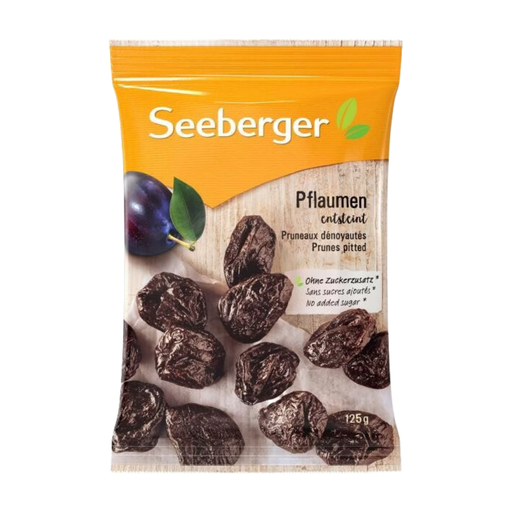 Image unavailable
A soft dried fruit for your snack bowl.
Product information notes that occasional fragments of stone may be present, even in pitted prunes.
 Image unavailable
Dried apple rings add another fruit option to your snack bowl.
The product information lists sodium metabisulphite and identifies sulphur dioxide and sulphites as possible allergens. Check the current labelling on the packet before offering the rings to guests with a relevant allergy or intolerance.
Not necessarily. Removing the water concentrates the sugars and energy in dried fruit per 100 g, as the consumer advice centre explains. Compare the specific packets using the energy value and sugars per 100 g, and bear in mind how much you’ll be serving.
No. Dried fruit can contain natural sugars even when no sugar has been added. So, as well as reading the ingredients list, check the ‘of which sugars’ figure in the nutritional information.
Check the ingredients list and allergen information for the specific dried fruit. According to the Federal Ministry of Agriculture, Food and Regional Identity, sulphur dioxide and sulphites must be declared as allergens at concentrations above 10 mg/kg or 10 mg/l.
Seal the opened bag tightly and store it somewhere dry and away from light. REWE gives these storage instructions for one freeze-dried berry product; follow the guidance on the packet you’re using.