Snackers watching their fat intake
If you’d rather have fruit than a mix with nuts or chocolate during your coffee break, check the product type first, then the fat per 100 g. The specific variety matters, even when you’re choosing dried fruit.


If you’re watching your fat intake during a coffee break, plain dried fruit is an obvious choice if you want to avoid nuts and chocolate in your snack. The fat content on the specific pack is still what matters. Compare the sugar and energy per 100 g too, and decide on a portion, as removing the water concentrates both in dried fruit.
If you’d rather have fruit than a mix with nuts or chocolate during your coffee break, check the product type first, then the fat per 100 g. The specific variety matters, even when you’re choosing dried fruit.
If you fancy something sweet with your coffee, compare the sugar and energy per 100 g and set aside a portion for your break. The Verbraucherzentrale notes that, in freeze-dried fruit, removing the water concentrates these values per 100 g.
It’s worth checking the ingredients list and allergen information carefully, especially for sweetened varieties and mixed fruit. This helps you check whether sugar, oil or sulphur dioxide is relevant to your choice.
First decide whether you’d prefer plain fruit, a mix or a crisp freeze-dried option. Then compare the nutritional information and ingredients on the specific packs you’re considering.
| What matters to you | What to check | Who it matters to |
|---|---|---|
| Fat content | Fat per 100 g, as well as ingredients such as nuts, chocolate or added oil. | I want fruit with my coffee rather than a snack mix, and I want to be able to check the fat content on the pack. Around 33% of consumers put this first. |
| Sugar, energy and portion size | Sugar and energy per 100 g, and how much you plan to set aside for your break. | I like something sweet during my break, but I don’t want to end up eating the whole pack without realising. Portion control is the main concern for around 27% of consumers. |
| Ingredients and allergens | The ingredients list and allergen information, especially for mixed fruit and sweetened varieties. | If I need or want to avoid certain ingredients or sulphites, the labelling on each variety is what matters. This is the main concern for around 20% of consumers. |
| Texture and pack size | Whether the fruit is soft or crunchy, and whether the pack size suits the portion you have in mind. | I want to choose the texture I like for a short break and be able to divide the pack into suitable portions. Around 20% of consumers look at this first. |
A low fat content doesn’t tell you how much sugar or energy a product contains. According to the Verbraucherzentrale, removing the water concentrates the sugar and energy in freeze-dried fruit per 100 g.
Check all three figures in the nutritional information and take a portion out of the pack for your coffee break.
Dried fruit still contains the naturally occurring sugars in the fruit, even when no sugar has been added. The two claims therefore answer different questions.
Check the ingredients list if you want to avoid added sugar, and compare the sugar content per 100 g too.
EDEKA’s dried mixed fruit lists ingredients including sunflower oil and sulphur dioxide alongside the fruit. So you can’t tell whether a mix meets your needs from the category name alone.
Check the full ingredients list and allergen information for every mix. If you only want one type of fruit, choose a product labelled accordingly.
Seeberger offers a range of dried and freeze-dried fruit.
REWE offers various dried fruit products under these own-label ranges.
EDEKA’s own-label dried mixed fruit is one example of a mix containing several types of fruit.
Alesto is a Lidl brand offering dried fruit as well as other types of snacks.
These ALDI SÜD and ALDI Nord own-label brands offer classic dried fruit.
This selection includes jujubes, apple rings, mango strips and prunes as dried fruit snacks for your coffee break. For each option, compare the nutritional information and ingredients, and think about how much you actually want to eat.
 Image unavailable
A jujube option if you’d like to choose a single type of fruit to have with your coffee. Before serving yourself a portion, compare the sugar and energy per 100 g as well as the fat content.
 Image unavailable
Pitted jujubes are worth considering if you prefer this type of fruit for your coffee break. The pack contains 280 g. Set aside a portion for your break and check the sugar and energy in the nutritional information.
 Image unavailable
These apple rings are a good choice if you fancy dried apple with your coffee. This variety lists sodium metabisulphite, so check the ingredients and allergen information if sulphites are relevant to you.
 Image unavailable
These soft mango strips are a good choice if you prefer a chewy texture to a crunchy fruit. This variety lists sodium metabisulphite, so check the allergen information if relevant, and compare the sugar and energy per 100 g.
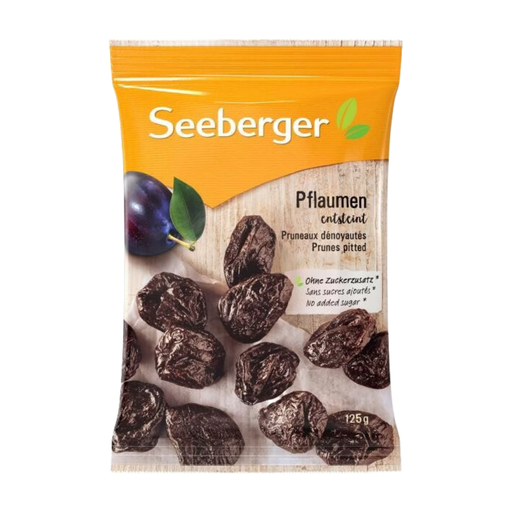 Image unavailable
These soft, pitted prunes are an option if you want a single type of fruit with your coffee. Stone fragments may still be present, despite the prunes being pitted, so take care when eating them and choose your portion mindfully.
No. Check the nutritional information for the specific product. ALDI SÜD states that its FARMER NATURALS dried prunes contain 0.5 g of fat per 100 g; a mix may contain additional ingredients such as oil.
No. The fruit still contains naturally occurring sugar. If you want to avoid added sugar, check the ingredients list and also look at the total sugar per 100 g in the nutritional information.
Take the amount you want out of the pack before your break, rather than eating straight from it. Compare the sugar and energy per 100 g when choosing a product. The German Nutrition Society lists dried fruit as a possible alternative to a portion of fresh fruit.
Check the ingredients list and allergen information for every dried fruit product. EDEKA lists sulphur dioxide in its dried mixed fruit; you can’t assume that the labelling for one variety applies to every product from the same brand.
EDEKA recommends storing dried prunes in a cool, dry place. Also follow the storage instructions on your pack, particularly after opening.