Anyone keeping an eye on fat content
If you’re choosing dried fruit for movie night and want to keep fat to a minimum, compare the per-100 g figures on the specific packs. This is particularly important for mixes with additional ingredients.


If fat content is your main concern for movie night, compare dried fruit using the nutrition information per 100 g and check the ingredients in mixed products too. The fat content listed by ALDI SÜD and EDEKA varies across individual apricot, prune and mixed-fruit products. Added sugar, oil and sulphur dioxide are separate factors to consider.
If you’re choosing dried fruit for movie night and want to keep fat to a minimum, compare the per-100 g figures on the specific packs. This is particularly important for mixes with additional ingredients.
If you want to avoid added sugar or oil, check the ingredients list as well as the nutrition information. The term ‘dried fruit’ alone doesn’t tell you whether these ingredients have been added.
If you’re specifically looking for unsulphured fruit or need to be mindful of sulphites, check the information for the particular variety. Whether it also has the fat and sugar content you’re looking for is a separate question.
Start with what matters most to you: fat content per 100 g, ingredients or sulphur dioxide labelling. Then check the other details too, rather than assuming one figure tells you everything about the product’s composition.
| Criteria | What to check | Who it matters most to |
|---|---|---|
| Fat content | Compare the fat per 100 g shown on each pack; for mixes, check for ingredients containing oil too. | If I’m choosing mainly by fat content for movie night, I need a comparable figure for the specific variety. Around 42% of consumers put this first. |
| Sugar and oil | Read the ingredients list and the sugar per 100 g; look out for added sugar and oil. | If I want a fruit snack without these additions, I need to know what else is in the pack. For around 33% of consumers, ingredients take priority. |
| Sulphur dioxide | Check the ingredients and allergen information; if relevant, look for varieties explicitly labelled as unsulphured. | If I want to avoid sulphur dioxide or sulphites, the labelling determines which pack is right for me. This is the main consideration for around 25% of consumers. |
The stated fat content per 100 g is a more useful way to compare specific dried-fruit products. ALDI SÜD lists 0 g of fat per 100 g for one apricot variety and 0.5 g for one prune variety; EDEKA lists 0.3 g for its Herzstücke mixed fruit.
Read the nutrition information on the pack and check the ingredients list as well for mixed products.
Dried fruit can contain naturally occurring fruit sugars even without added sugar. There are sweetened varieties too: EDEKA lists sugar as an ingredient at 39% for one dried cranberry variety.
Compare the sugar per 100 g and the ingredients. If you’d rather not keep eating straight from the pack while watching TV, you can take out the amount you want beforehand.
This label relates to how the fruit has been treated, not its fat or sugar content. Seeberger describes one apricot variety as unsulphured; EDEKA’s Herzstücke mixed fruit, by contrast, lists sulphur dioxide as an ingredient.
Check the label if sulphur dioxide or sulphites matter to your choice, and compare the nutrition information separately.
For the dried-fruit products mentioned, ALDI SÜD notes that products come from different suppliers and their nutritional information may vary.
Check the ingredients and nutrition information on the pack you’re actually buying.
Seeberger offers a range of dried fruit, including apricots, prunes and dates.
The range includes dried mixed fruit with apricots, prunes, pears, peaches and apple rings.
ALDI SÜD offers dried apricots and prunes under these ranges, among other products.
Lidl’s own-brand range includes nuts and other snacks as well as dried fruit.
This selection includes prunes and dried jujubes as fruit snacks for movie night. For both products, compare the fat, sugar and ingredients information on the specific pack.
 No image available
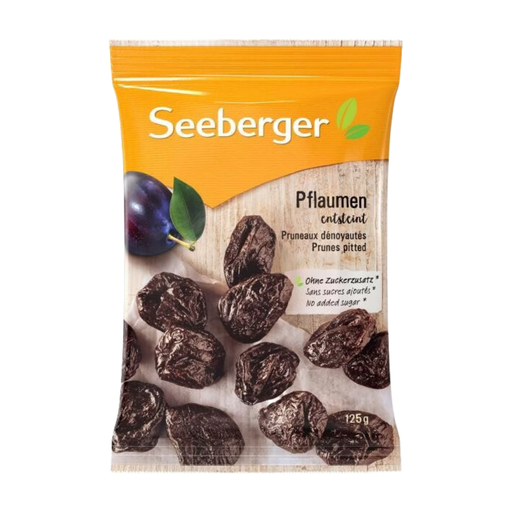
Pitted prunes in a 125 g pack, ideal if you’re looking for one type of fruit rather than a snack mix. Before buying, check the ingredients and nutrition information on the pack. Even with pitted fruit, take care when eating in case any fragments of stone remain.
 No image available
Dried jujubes in a 500 g pack for anyone considering this type of fruit as a TV snack. The ‘No-Wash’ label doesn’t replace the need to read the pack instructions. Also compare the fat and sugar per 100 g.
No. To choose by fat content, compare the nutrition information per 100 g on the specific packs. ALDI SÜD lists 0 g of fat per 100 g for the apricots mentioned and 0.5 g for the prunes; EDEKA lists 0.3 g for its Herzstücke mixed fruit. Check the ingredients too, especially for mixes.
No. Dried fruit contains naturally occurring fruit sugars even without added sugar. If you want to distinguish varieties with added sugar from those without, check both the sugar per 100 g and the ingredients list.
Check the ingredients list and allergen information on the specific pack for sulphur dioxide or sulphites. EDEKA lists sulphur dioxide in the Herzstücke mixed fruit mentioned here; Seeberger labels one of its apricot varieties as unsulphured. Neither label replaces comparing fat and sugar content.