If you want to compare fat content
You’re looking for dried fruit for your gym bag and want to compare the fat content per 100 g with the ingredients list, rather than relying on how light a product seems.


If low fat content is important to you when choosing dried fruit for your gym bag, start by comparing the fat content per 100 g, then check the sugar, ingredients and pack size. EDEKA lists 0 g fat per 100 g for its GUT&GÜNSTIG prunes and 0.3 g fat per 100 g for EDEKA Herzstücke mixed fruit. These figures alone don’t tell you how much sugar a product contains. A resealable pack can be handy if you’re dividing the contents between several training days.
You’re looking for dried fruit for your gym bag and want to compare the fat content per 100 g with the ingredients list, rather than relying on how light a product seems.
Texture and a format that’s easy to carry matter to you. With freeze-dried fruit, it’s also worth checking the sugar and energy content per 100 g.
You’d like a pack with a variety of fruit, but before buying you check in particular for added oil, preservatives and allergen information.
First, compare the nutritional information for dried fruit using the same serving basis. Then decide which ingredients and pack format best suit how you plan to use it.
| What matters | What to check | Who it matters most to |
|---|---|---|
| Fat content | Compare the fat content per 100 g of similar dried fruit and, for mixes, check the ingredients list for oil. | If fat content is my main priority, I need comparable nutritional information rather than a marketing claim. Around 42% of consumers put this first. |
| Sugar and energy | Check ‘of which sugars’ and energy per 100 g; ‘no added sugar’ does not mean sugar-free. | I want to know how much sugar and energy my fruit snack contains, even if no sugar has been added. This is the main consideration for around 33% of consumers. |
| Packaging and ingredients | Check the pack size and whether it can be resealed, and check the ingredients and allergen information for mixes. | For several training days, I want packaging that’s easy to use without overlooking ingredients that matter to me. This is the main priority for around 25% of consumers. |
Fat content doesn’t tell you how much sugar or energy a product contains. The German consumer advice centre points out that removing water from freeze-dried fruit concentrates the sugar and energy per 100 g.
Compare fat, ‘of which sugars’ and energy on the same 100 g basis, rather than focusing on just one figure.
Fruit contains natural sugars, even when no sugar has been added. So a claim on the front of the pack is no substitute for checking the nutritional information.
Check ‘of which sugars’ and take into account how much you’ll actually be carrying with you.
EDEKA says its Herzstücke mixed fruit contains sunflower oil and potassium sorbate as well as fruit; sulphur dioxide and sulphites are listed as allergens.
Check the ingredients list on every mix and, if you have relevant intolerances, read the allergen labelling on the pack.
EDEKA notes that the information on its product pages may differ from what’s on the packaging.
Before eating the product, check the nutritional information, ingredients and allergen details on the pack you receive.
Seeberger offers a range of dried fruit, including apple rings.
EDEKA’s own-brand range includes dried mixed fruit with several types of fruit.
The EDEKA brand includes, among other products, pitted prunes in a 500 g tub.
Lidl Germany sells nuts, dried fruit and other snacks under the Alesto brand.
ALDI SÜD sells FARMER NATURALS prunes in a 500 g pack.
This selection includes dried plums, jujubes and dates to take with you. Pack sizes vary, so for your gym bag, check the pack format as well as how much you want to carry.
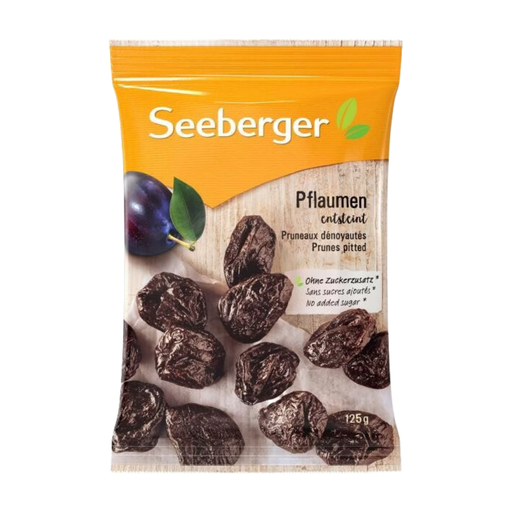 No image available
The 125 g pack is a good option if you want to take a smaller amount of prunes with you.
To help you choose, compare the fat and sugar per 100 g on the pack, and check whether the format works for your gym bag.
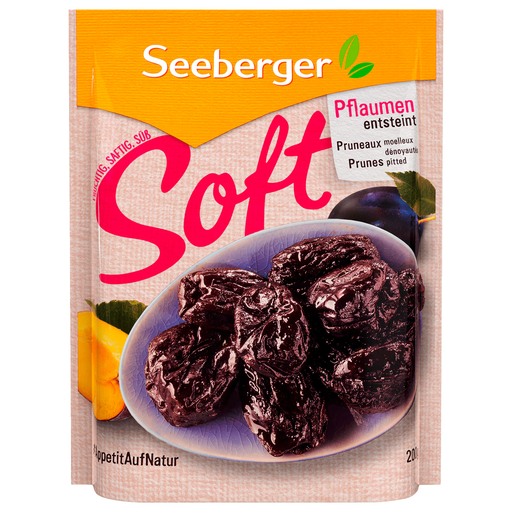 No image available
The 200 g option is a good choice if you want to take more pitted prunes than a smaller pack provides.
Check the fat and sugar per 100 g, as well as the pack format, before choosing between the sizes.
 No image available
The 500 g pack is better suited to planning prunes for several occasions, so you can choose how much to take with you each time.
Check the pack format for your gym bag, and compare the fat and sugar using the nutritional information.
 No image available
If you’d rather take dried jujubes than prunes, this pack contains 500 g.
Check the fat and sugar information, as well as the pack size and closure, to make sure it’s suitable for carrying with you.
 No image available
This 500 g pack is an option if you prefer pitted dates and want to portion out how much you take with you.
Compare the fat and sugar per 100 g on the pack, and check the pack format before taking it with you.
No. Dried fruit contains naturally occurring sugars. ‘No added sugar’ doesn’t mean you can skip checking the ‘of which sugars’ figure in the nutritional information. As the German consumer advice centre explains, removing water from freeze-dried fruit concentrates the sugar per 100 g.
No, the fat figure tells you about just one part of a product’s nutritional profile. When choosing, also compare sugar and energy on the same 100 g basis, and check the ingredients list.
Check the ingredients list and allergen labelling on the pack. EDEKA lists sulphur dioxide and sulphites in the product information for its Herzstücke mixed fruit.
Keep them in a cool, dry place in a sealed, lightproof container. EDEKA advises against storing dried plums in the fridge because of their moisture content.