Dried fruit makes a handy fruit snack to enjoy with your coffee on the train, but it’s not a reliable choice if you’re looking for a snack that provides plenty of protein. The nutrition information for the plain dried fruit considered here shows that protein accounts for only a small proportion of its energy. If protein is your priority, check the nutrition information for any additional food you choose. With dried fruit, also consider portion size, sugar and the ingredients list.
The right choice for you
Sports commuters who prioritise protein
If you want your snack to make a meaningful contribution to your protein intake before or after exercise, don’t rely on the type of fruit alone. Compare the nutrition information for the specific product and, if needed, consider adding another food with a stated protein content.
Commuters looking for a fruit snack
You want to take something with you to enjoy with your coffee on the train, without needing to chop or refrigerate it. Look for a suitable portion size, check the sugar content per 100 g and choose packaging you can reseal for your journey.
Shoppers who check the ingredients
If you want to avoid added sugar or sulphur dioxide, compare the ingredients lists on the specific packs. Remember to check allergen information too: colour alone won’t reliably tell you whether dried fruit has been treated with sulphur dioxide.
What to look for when buying
First decide whether you want a snack that makes a measurable contribution to your protein intake or simply a fruit snack for your journey. Then use portion size and the ingredients list to help you choose a specific pack.
| Criterion |
What to check |
Who it matters to |
| Protein content |
Compare protein and energy per 100 g, then work out the figures for your planned portion. |
If I want to include protein in my snack around a workout, I need figures I can apply to my portion. Around 42% of consumers put this protein contribution first. |
| Snack for the train |
Check the portion size and whether the pack can be resealed; consider sugar and energy per 100 g. |
I want to take a fruit snack on the train that I can eat without any preparation, alongside my coffee. For around 33% of consumers, ease of use is the main consideration. |
| Ingredients and labelling |
Check the ingredients list for added sugars and sulphur dioxide, and look for allergen information. |
If I need or want to avoid certain additives, the pack’s labelling determines what I choose. Around 25% of consumers put this ingredients check first. |
Common pitfalls
-
Assuming dried fruit is high in protein because of your fitness goals
The published nutrition figures highlight the difference between a fruit snack and a meaningful source of protein. REWE lists 4.1 g of protein per 100 g for Seeberger Soft Apricots, while ALDI SÜD lists 3.0 g per 100 g for its figs and EDEKA lists 2.7 g per 100 g for Herzstücke mixed dried fruit. Their energy contents are 234 kcal, 351 kcal and 252 kcal per 100 g respectively.
Compare the protein and energy figures on the specific pack. If your main aim is to get protein from your snack, check the nutrition information for any additional food you choose.
-
Assuming ‘no added sugar’ means low in sugar
Even without added sugar, dried fruit still contains the sugars naturally present in the fruit. The NRW Consumer Advice Centre says dried fruit often contains between 50 and 70% sugar.
Compare the sugar content per 100 g and take a portion with you for your journey, rather than trying to estimate how much you need from a large pack.
-
Trying to tell whether dried fruit contains sulphur dioxide by its colour
You can’t reliably tell from the colour whether a product has been treated with sulphur dioxide. For example, sulphur dioxide is listed in the product information for EDEKA Herzstücke mixed dried fruit, while Seeberger describes its dates as untreated with sulphur dioxide.
Check the ingredients list and allergen information for sulphur dioxide or sulphites. If you’re looking for dried fruit that hasn’t been treated with sulphur dioxide, check the labelling on each product individually.
-
Assuming a product page guarantees availability at your local shop
Whether a particular pack is available in store can vary from one branch to another. ALDI SÜD also notes that the nutrition information for its figs may vary between suppliers.
Check the information for your local shop before you go, then double-check the label on the pack in store.
Brands to consider
Seeberger
Seeberger sells a range of dried fruit, including dates, figs and soft apricots.
- Seeberger describes its dates as untreated with sulphur dioxide and its dried figs as having no added sugar.
- The treated soft apricots listed by REWE contain 4.1 g of protein per 100 g, according to the nutrition information there. Check the ingredients and nutrition information for each product separately.
REWE
REWE sells dried fruit and seeds, including own-brand products and items from other manufacturers.
- Its range gives you the option of choosing fruit and seeds as separate products.
- Check the specific pack and what’s available at your local shop, rather than assuming every product in the category has the same features.
EDEKA Herzstücke
The product considered here is a five-fruit dried fruit mix in a resealable 250-g pouch.
- EDEKA lists 2.7 g of protein and 46 g of sugar per 100 g for the fruit mix, along with packaging information.
- According to EDEKA, the product contains sulphur dioxide. Check the labelling and availability of the specific pack.
NATURLIEBLINGE – KLEINE SCHÄTZ (ALDI SÜD)
ALDI SÜD sells dried figs under this name in a 200-g pack.
- For the figs considered here, ALDI SÜD lists 3.0 g of protein and 55 g of sugar per 100 g.
- ALDI SÜD notes that nutrition values may vary depending on the supplier. So compare the information on the pack in store.
Alesto (Lidl)
Lidl describes Alesto as a range of nuts and dried fruit.
- You can consider the product categories separately if you’d like to pair dried fruit with another snack.
- Check the product’s own nutrition information and ingredients list to see whether a particular pack suits your protein goals or ingredient preferences.
Fruit and nut snack at Joybuy
This selection features a fruit and nut mix for when you’re out and about. If protein is your main priority, check its contribution using the nutrition information. Don’t assume trail mix is the same as plain dried fruit or a product labelled as high in protein.
 No image available
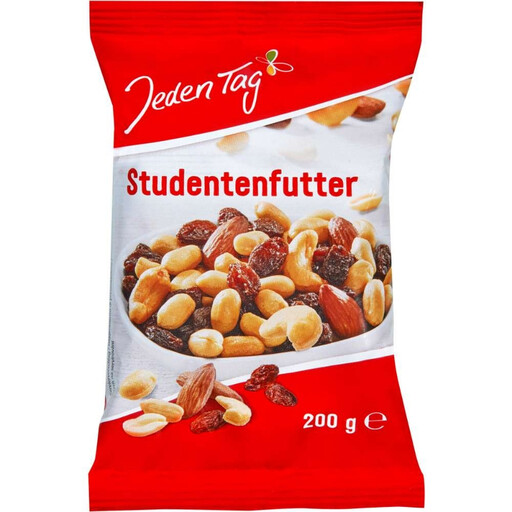
Jeden Tag Nut & Raisin Trail Mix, 200 g
A fruit and nut mix to take with you if you fancy a snack with your coffee on the train. The pack contains 200 g. Check the nutrition information for your planned portion and, if you have any intolerances, the allergen information.
View at Joybuy
Frequently asked questions
Is dried fruit automatically a high-protein snack?
No. You can’t tell from the product category alone. REWE lists 4.1 g of protein per 100 g for Seeberger Soft Apricots, ALDI SÜD lists 3.0 g per 100 g for its figs, and EDEKA lists 2.7 g per 100 g for Herzstücke mixed dried fruit. If protein is important to your choice, compare the nutrition information for the specific pack and the portion you plan to eat.
Does ‘no added sugar’ mean dried fruit is low in sugar?
No. The claim refers to added sugar, not the sugars naturally present in the fruit. The NRW Consumer Advice Centre says dried fruit often contains between 50 and 70% sugar. You can find the figure for each product in its nutrition information.
How can I tell whether dried fruit has been treated with sulphur dioxide?
Check the ingredients list and allergen information instead of relying on the colour. The EDEKA Herzstücke mixed dried fruit considered here lists sulphur dioxide, while Seeberger describes its dates as untreated with sulphur dioxide. Always check the labelling on the specific pack you’re considering.
How should I take dried fruit with me on the train?
A small resealable pack or a pre-portioned container makes it easy to keep track of how much you take for your journey. Once opened, follow the storage and use-by instructions on the specific packaging.


