Regular commuters stocking up
If you regularly eat dried fruit on train journeys or at breakfast, a larger pack could be a good choice, provided it won’t be left open for too long.


A 500 g pack of dried fruit is a good choice if you regularly have coffee on the train, eat the same fruit often and can store the opened pack properly. For occasional journeys, smaller packs or individually wrapped portions are more convenient. Whatever the size, your choice should also take account of the specific fruit, its ingredients and any allergen information.
If you regularly eat dried fruit on train journeys or at breakfast, a larger pack could be a good choice, provided it won’t be left open for too long.
If you need to avoid certain added ingredients or sulphites, check the information on the specific pack. The nutritional information per 100 g can also help you understand the stated total sugar content.
For occasional journeys, a small pack or single portion may be more suitable than carrying a large, opened bag in your bag or keeping it at the office.
First, decide which fruit you want to eat regularly and how much you’ll actually use. Then check the pack size for taking with you, as well as the ingredients and labelling on the specific pack.
| Factor | What to check | Who it matters to |
|---|---|---|
| Pack size and how much you use | Compare pack sizes for the same type of fruit and think about how quickly you’ll finish an opened pack. | If I eat the same dried fruit on many journeys, I’d rather stock up than keep a half-used pack for a long time. Around 50% of consumers prioritise regular use. |
| Portability and portions | Check whether a smaller pack, individual portions or a resealable format will suit your journeys. | For occasional train journeys, I only want to pack the amount I’ll eat on the way. For around 30% of consumers, portability is the top priority. |
| Ingredients and labelling | Read the ingredients list, allergen information and nutritional information per 100 g. For mixes, check the composition of the specific product. | If I need to avoid certain ingredients or sulphites, the description ‘dried fruit’ isn’t enough to help me choose. Checking product information is the top priority for around 20% of consumers. |
Dried fruit contains sugar naturally. The Verbraucherzentrale (German consumer advice centre) notes that dried fruit contributes to a food’s sugar content, so a ‘no added sugar’ claim doesn’t tell you the total sugar content.
As well as checking the ingredients list, look at the sugar figure in the nutritional information per 100 g.
Sultanas, prunes and dates differ in taste and texture. The same pack size doesn’t make them interchangeable snacks.
Choose the fruit that suits how you’ll actually use it, then pick a pack size that matches how much you’ll eat.
A nut and fruit mix isn’t a pack of pure dried fruit and may contain ingredients that affect your choice. Sulphite labelling can also be relevant for individual dried fruits.
Check the ingredients and allergen information for the specific product rather than relying on the brand name or product image.
Seeberger offers a range of dried fruit and pack sizes. For pitted dates, the brand lists a 500 g option, among others.
ALDI SÜD sells, among other things, sultanas and prunes in 500 g packs under the FARMER NATURALS brand.
ALDI Nord’s own brand includes dried fruit, nuts and mixes, including prunes in a 500 g tin.
This selection includes 500 g packs for regular use, as well as individually wrapped red dates for taking with you. The right size depends mainly on your favourite fruit and how often you commute.
 No image available
With 30 individually wrapped portions, you can take just what you need for a train journey.
The red dates contain stones. Take care when eating them, especially if children are sharing them.
 No image available
This 500 g pack could be a good choice if you regularly eat pitted dates as a snack or at breakfast.
Once opened, store the pack in an airtight container and check the nutritional information per 100 g to help you choose.
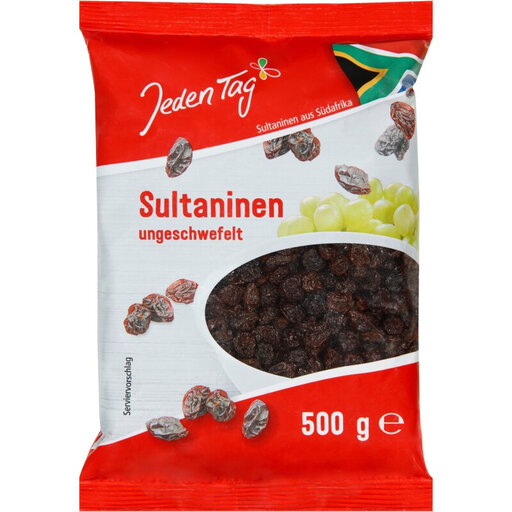 No image available
This larger pack is a good fit if you regularly eat sultanas on the go or at breakfast.
Seal the opened pack airtight and follow the storage instructions on the product.
 No image available
This 500 g pack is a handy option if you regularly enjoy jujubes as a snack.
The product is described as ‘No-Wash’; follow the storage instructions for the opened pack.
 No image available
This 500 g pack is a good choice if you regularly eat soft dried prunes as a snack or at breakfast.
According to the product description, despite being pitted, the prunes may still contain stones or fragments.
No. It’s most suitable if you eat your chosen fruit regularly and can store the pack properly once opened. For occasional journeys, a smaller pack or an individually wrapped portion may better match how much you’ll use.
No, the claim doesn’t mean the product has a low total sugar content. The Verbraucherzentrale (German consumer advice centre) notes that dried fruit itself contributes to sugar content, so check the ingredients list and the sugar figure in the nutritional information per 100 g.
Check the ingredients and allergen information on the specific pack of dried fruit. A variety explicitly labelled as unsulphured may help you choose, but you should still check the full labelling.
A nut and fruit mix contains ingredients other than fruit, so it isn’t the same as a pack of pure dried fruit. Before buying, check the ingredients and allergen information for the specific mix.