Travellers planning a protein snack
You want to include protein on your journey home after a workout and are looking for dried fruit to complement it, rather than as your only source of protein.


Dried fruit makes a convenient, long-lasting snack for train journeys, but it isn’t a reliable choice on its own if you’re specifically looking to include protein. Compare the protein content of your portion and, if needed, add a separately packaged food; the German Nutrition Society lists pulses, dairy products and eggs among sources of protein. When choosing a combination, also consider the ingredients, how much space it takes up in your luggage and whether it needs to be kept chilled.
You want to include protein on your journey home after a workout and are looking for dried fruit to complement it, rather than as your only source of protein.
You want a fruit snack you can eat without cutlery while changing trains or at your seat, and a pack that’s easy to put away afterwards.
You compare ingredients and nutritional information, perhaps because you want to avoid added sugar or need to look out for sulphur dioxide due to a known sensitivity.
First decide whether you want dried fruit simply as a fruit snack or whether you’re specifically planning to include protein for your journey. Then check the portion size, ingredients and packaging of the product you’re considering.
| What you need | What to check when buying | Who it matters to |
|---|---|---|
| Planning your protein intake | Compare the protein content per 100 g and per portion; if needed, choose a separate food with a suitable protein content. | After a workout, I want to know how much protein is in the snack I actually eat. Around 42% of consumers prioritise this protein goal. |
| Easy to eat on the go | Choose a suitable portion size, a resealable pack and packaging that’s easy to stow away. | When changing trains, I want to eat my snack without cutlery and pack it away again quickly. Around 33% of consumers prioritise this convenience. |
| Checking ingredients | Check the ingredients list for added sugar and sulphur dioxide; consider the sugar content per 100 g and the portion you plan to eat. | I want to know what’s been added to the fruit mix before I pack it. Checking ingredients is the main priority for around 25% of consumers. |
The protein content per 100 g doesn’t tell you how much protein is in the portion you eat. The German Nutrition Society lists other food groups, including pulses and dairy products, as sources of protein.
Compare the nutritional information for your portion. If protein is your main goal, choose an additional source of protein based on its own labelling.
REWE describes dried fruit as containing an average of 60 to 70% carbohydrates in the form of sugar. A sweet taste alone won’t tell you whether extra sugar has been added to a mix.
Check the nutritional information and ingredients list on the specific pack, and decide before your journey how much you plan to take with you.
Ingredients can vary between dried fruit products, even when they contain the same type of fruit. If you need to avoid sulphur dioxide, don’t choose an alternative based on appearance alone.
Read the ingredients and allergen information on the specific pack before putting it in your bag.
On a train journey, you also need somewhere safe to put your snack. Deutsche Bahn advises passengers to keep aisles, doors and safety equipment clear.
Pack your snack and any rubbish so you can stow them at your seat or in your luggage without blocking walkways.
Seeberger offers dried fruit in a range of formats, including dates, apricots, mangoes and fruit mixes.
REWE has a dried fruit and kernels category featuring own-brand and branded products.
These two fruit and nut mixes are worth considering if you want to take fruit and nuts along in one pack. Check the nutritional information on the specific pack to see whether a portion fits your protein goal.
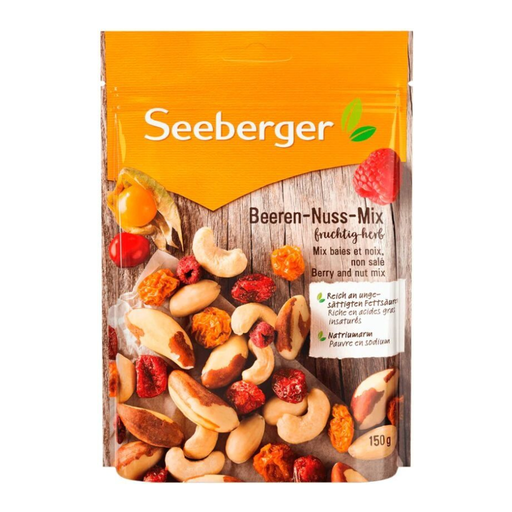 Image unavailable
A fruit and nut mix for your journey if you’d like to take berries and roasted nuts with you.
Pack size: 150 g. To check whether it suits your protein goal, look at the nutritional information for the portion you plan to eat, as well as the ingredients and allergen information if needed.
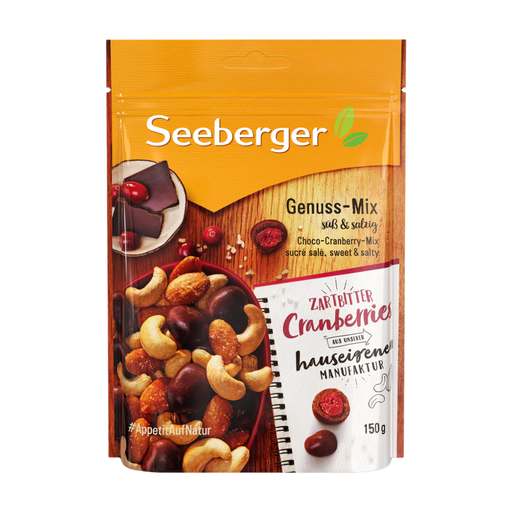 Image unavailable
An option for your journey if you’re looking for a mix of fruit and nuts rather than dried fruit on its own.
Pack size: 150 g. Compare the protein content of your portion and read the ingredients and allergen information on the specific pack.
If you have a specific protein goal, don’t assume dried fruit on its own will meet it. Check the protein content of your portion and add a suitable food if needed; the German Nutrition Society lists pulses, dairy products and eggs among sources of protein.
Read the ingredients and allergen information on the specific pack. The sugar content in the nutritional information shows how much sugar the product contains, but on its own it doesn’t distinguish between naturally occurring fruit sugars and added sugar.
For standard dried fruit, it’s generally more important to follow the storage instructions on the pack than to assume it needs to be kept chilled. If you’re combining it with another food, check that product’s storage instructions separately.