
Lieferung heute & morgen

Qualitätsgarantie

Willkommens-Angebote freischalten: KOSTENLOSE Lieferung | Bis zu 80 % RABATT | Kostenlose 30-Tage-JoyPlus-Testphase
App herunterladen
A drill-free clip-on double roller blind can quickly provide privacy and sun protection in rented homes, offices or hotel rooms without leaving holes in the window frame. But colour isn’t the only thing to consider. Incorrect measurements, unsuitable window frames or unclear descriptions of how much light a blind lets through can all lead to the wrong purchase.
This buying guide explains what to look for in a day and night double roller blind, a zebra blind or a classic drill-free roller blind.
A clip-on blind for windows is usually attached to the window sash using clamp brackets. The frame thickness must fall within the range specified by the manufacturer. Several WOLTU models are designed for frames 13 to 23 mm thick. Other versions have a narrower range, such as 13 to 20 mm or 16 to 22 mm.
Before you buy, measure:
According to their product descriptions, many models aren’t suitable for roof windows, wooden windows, sliding windows or fixed-glazed windows. If there’s a window handle, the blind mustn’t be fitted so close that the fabric or chain gets in the way when you open the window.
For many double roller blinds, the fabric is about 4 to 5 cm narrower than the overall width, including the brackets. For better privacy at the sides, the following is often recommended:
Ordered width = glass width plus around 4 cm
For example, if the glass pane is 46 cm wide, an ordered width of around 50 cm may be suitable, provided the window handle and frame allow it. Also check the specific measurements table for the product you’re considering. A privacy blind that’s too narrow will let light in and leave gaps at the sides.
A classic day and night double roller blind has alternating transparent or light-filtering and opaque stripes. You can move these stripes using the chain mechanism, giving you different levels of light and privacy depending on the setting.
This isn’t the same as a fully blackout blind. A light-filtering blackout blind can reduce the amount of light coming in, but it won’t necessarily block it all. For bedrooms where you need a high level of darkness, a coated blackout blind may be a better choice. The practical advantage of a zebra blind, on the other hand, is that you can adjust the light and privacy levels to suit you.
Many of the models featured here are made from 100% polyester. This material can usually be cleaned with a soft cloth or brush. Some versions are listed as suitable for humid rooms, but you should still follow the care instructions and avoid machine-washing the fabric if this isn’t recommended.
A side-chain roller blind or chain-operated roller blind can have the chain fitted on the left or right, if the model offers this option. In homes with children, secure the chain using the child-safety device provided and keep it out of their reach. Small fitting components should also be kept away from children.
For balcony or patio doors, check that the blind won’t get in the way when opening the door, tilting it or walking through. A blind for windows and doors isn’t automatically suitable for every type of door.
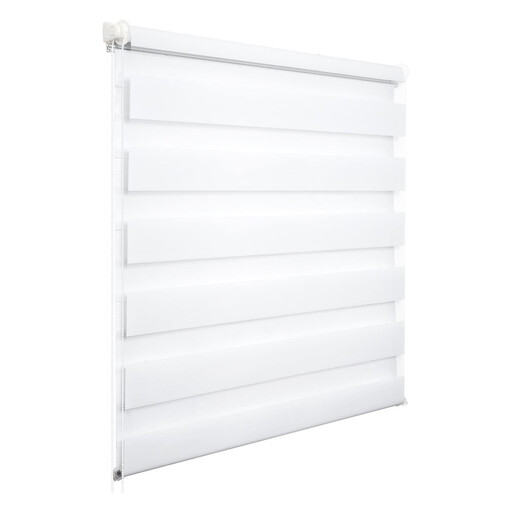
Why it’s a good fit: Its compact size is ideal for smaller indoor windows. The blind clips onto frames 13 to 23 mm thick, and the chain can be fitted on either the left or right.
The stated frame thickness range and narrower fabric width make it easier to check the fit and measurements before you order.
100% polyester fabric, stepless adjustment from light-filtering to opaque, and easy cleaning with a damp cloth or soft brush.

Why it’s a good fit: Its double-layer design lets you adjust the blind smoothly between transparent and opaque settings, making it suitable for living and working spaces.
The product details specify the fitting options and suitable frame thicknesses, as well as exclusions such as roof and wooden windows.
100% polyester, clip and screw fittings included, chain can be fitted on the left or right, and certifications such as OEKO-TEX STANDARD 100 are listed in the product description.

Why it’s a good fit: The coated backing makes this a good alternative to a classic zebra blind for bedrooms, offices or other spaces where you need to block out more light.
The product description clearly states the fabric width, the suitable frame thickness range of 16 to 22 mm and that it isn’t suitable for roof windows.
200 g/m² polyester, according to the product details; clip-on or screw fitting; manual operation using a handle rail instead of a chain; and wipe-clean care.
We’ve put together a complete, regularly updated list of products that meet these strict selection criteria and fully comply with the safety regulations in force in the EU.
How securely it stays in place depends on the frame, fitting, weight and how you use it. A suitable clamp bracket can provide a stable fit. Check it regularly and don’t pull the chain too hard. For heavier blinds or those used particularly often, screw fitting may provide extra stability, according to the product details.
Some models can be fitted to doors, provided they’re specifically designed for both windows and doors. First, check how the door moves, the position of the handle and the frame thickness. Roof windows, wooden frames and sliding doors are often subject to restrictions.
A manual double roller blind with a chain or side-chain mechanism doesn’t need electricity. You adjust the light by moving the transparent and opaque fabric stripes. A blackout blind with a handle rail is also operated manually. When choosing a blind, the main things to consider are its size, fitting method, material and the level of light control you want.