
Lieferung heute & morgen

Qualitätsgarantie

Willkommens-Angebote freischalten: KOSTENLOSE Lieferung | Bis zu 80 % RABATT | Kostenlose 30-Tage-JoyPlus-Testphase
App herunterladen
A pleated blind without drilling can quickly provide privacy and sun protection in rented homes, owner-occupied flats and offices. However, to ensure the fitting stays secure and the blind does not turn out to be a poor purchase, buyers should look beyond colour and price. The key considerations are the measurements, fitting method and desired light effect.
For many pleated blinds and roller blinds, the stated size refers to the entire product, including the brackets. This means the fabric may be narrower. Some models specify a fabric width that is approximately 4 cm less than the overall width in the product details.
You should therefore measure:
For the most complete privacy protection, ordering a greater width than the glass width may be advisable for certain products. However, measurements should always be checked against the relevant fitting instructions.
A clip-fit pleated blind is attached to the window sash using clip-on brackets. This is particularly practical for tenants, but it requires a suitable frame. Other models are pleated blinds for clipping and sticking: the brackets are additionally secured to the frame with adhesive surfaces.
Adhesive fitting requires a smooth, clean and dry surface. Rough, uneven, dusty or damp frames can affect adhesion. The surface should be cleaned and allowed to dry completely before fitting. For sensitive surfaces, you should also follow the manufacturer’s instructions regarding removing the adhesive and checking its suitability.
A light-filtering pleated blind reduces visibility and bright sunlight, while still allowing daylight into the room. This can be suitable for living rooms, kitchens or offices. If you want to keep outside light to a minimum in the bedroom, however, look for a blackout pleated blind or an opaque roller blind instead.
The terms “blackout”, “opaque” and “light-filtering” are not always used consistently by retailers. You should therefore check the specific product description and the images of the material. Even a model described as blackout may allow strips of light through at the sides or along the top edge.
Before buying, check the following:
For example, the WOLTU clip-on roller blind is specified for a frame thickness of 16 to 22 mm. According to the product description, the WOLTU honeycomb pleated blind is suitable for frames measuring 10 to 23 mm. These measurements should be compared with your own window before ordering.
Polyester is a commonly used material among the products listed. It can generally be cleaned with a soft, slightly damp cloth. However, the stated moisture resistance varies: moisture-resistant does not automatically mean waterproof.
The following guidelines can help you choose a blind for each room:
With chain-operated roller blinds, the chain and operating device must be kept out of the reach of young children. Cordless models reduce this specific risk, but do not replace safe fitting and regular checks.
Standard sizes such as pleated blind 60x100 cm, 65x100 cm, 70x120 cm or pleated blind 90x200 cm cover many window and door formats. For unusual dimensions, a made-to-measure pleated blind may be the better choice. Also check whether the colour you want suits the desired light effect: white has a discreet appearance and can distribute daylight more widely throughout the room, while anthracite or beige create a different feel indoors.
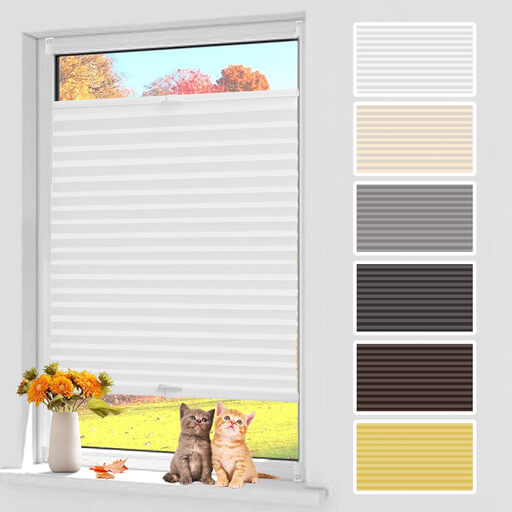
Why this product suits this profile: Its compact size and tool-free clip-on fitting make it suitable for smaller standard windows in rented homes or offices.
The product description states the overall size, clip-fit attachment and suitability for windows and doors. The frame width should nevertheless be checked before buying.
Polyester fabric, white colour, adjustable positioning and fitting without a drill or screws.

Why this product suits this profile: The honeycomb structure and dual-sided operation appeal to households looking to combine light control, privacy and a sturdy construction.
The stated frame compatibility of 10–23 mm helps with pre-purchase checks. According to the product description, this model is not suitable for roof windows.
100% polyester, metal frame, clip-fit installation and upper and lower handles for step-free adjustment.

Why this product suits this profile: This model is designed for rooms requiring enhanced light and privacy protection, such as bedrooms, children’s rooms or work areas exposed to strong sunlight.
The product details specify both clip-on and drill fitting, as well as a required frame thickness of 16–22 mm. These requirements should be checked before ordering.
Anthracite polyester fabric, cordless operation, clip-on fitting and silver-coated backing according to the product description.
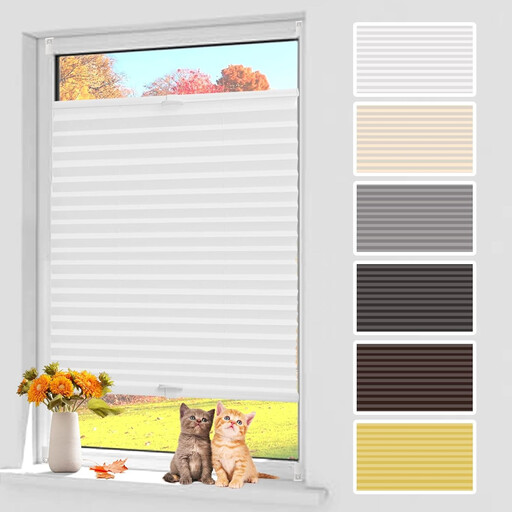
Why this product suits this profile: Its 200 cm height makes it suitable for larger windows and doors where a single pleated blind needs to cover a long expanse of glass.
The description highlights the need to clean smooth surfaces and secure the adhesive fitting correctly. Rough or uneven fitting surfaces are therefore unsuitable.
90 × 200 cm, white colour, adjustable height and use on windows or doors according to the product details.
We have put together a complete, regularly updated list of products that fully meet these strict selection criteria and the safety regulations applicable in the EU.
A pleated blind without drilling is not automatically residue-free: adhesive surfaces may leave marks when removed or affect sensitive coatings. If you want to avoid this risk, choose a model with adjustable clip-on brackets and follow the fitting instructions carefully.
Depending on the model, it is attached using clip-on brackets, clip-fit holders or adhesive pads. Clip-on brackets are fitted to the window sash, while adhesive holders stick to a smooth, dry surface. The permitted frame thickness and suitability for windows or doors must be stated in the product details.
A blackout pleated blind can be made largely opaque. However, side, top or bottom light gaps cannot be completely avoided with many internal fitting methods. For a stronger blackout effect, choose the width carefully and follow the fitting instructions.
Durability depends on factors including the condition of the surface, cleaning, temperature, humidity and the weight of the pleated blind. Smooth, dry surfaces provide a more favourable starting point. Check the adhesion before operating the blind for the first time and inspect the fittings regularly.