
Lieferung heute & morgen

Qualitätsgarantie

Willkommens-Angebote freischalten: KOSTENLOSE Lieferung | Bis zu 80 % RABATT | Kostenlose 30-Tage-JoyPlus-Testphase
App herunterladen
A drip coffee maker should primarily prepare larger quantities of coffee reliably for everyday use. Yet unclear cup measurements, hard-to-reach components or unnecessary extra features often lead to poor purchasing decisions. For households, families, offices and smaller teams, the key factors are therefore not just design or wattage, but also capacity, ease of cleaning, keep-warm duration and safety features.
The specification “10 cups” sounds clear, but depending on the manufacturer, it does not always refer to a large mug of coffee. Smaller serving sizes are often used for these calculations. A 1.25-litre drip coffee maker, for example, may be listed as producing 10 to 15 cups, while another model describes the same volume as yielding up to 10 cups.
For families or offices, you should therefore always check the capacity in litres first. Models with capacities of 1.2 to 1.5 litres are typically suitable for several people. For one person or a small household, a 750 ml machine may take up less space while still providing sufficient capacity.
A coffee maker with a keep-warm function keeps the coffee warm on a hotplate after brewing. The duration varies by model—product data for the models reviewed here lists options such as 30 or 40 minutes, while certain machines offer longer keep-warm periods.
A longer keep-warm period can be useful in offices, but it also increases electricity consumption compared with switching the machine off immediately. Coffee should not be left on a hotplate unnecessarily long, either, as its flavour and aroma may change. An automatic shut-off is therefore a valuable safety and energy-saving feature.
Do not rely solely on marketing language; look for removable components. A swing-out filter holder, a wide carafe opening and a removable water tank make daily maintenance much easier. Machines with an integrated grinder require additional cleaning of the bean container and grinder.
A permanent filter can eliminate the need for paper filters. However, it must be rinsed thoroughly after every use. Paper filters are easier to dispose of, but they involve ongoing costs and need to be purchased regularly.
A coffee maker with a glass carafe allows you to monitor the amount of coffee remaining at a glance. It generally sits on a hotplate and should be handled carefully after brewing, as both the carafe and the plate become hot.
For 10 to 15 cups, a capacity of approximately 1.2 to 1.5 litres is relevant. Also check whether the scale on the water tank and carafe is easy to read. A larger tank is not automatically advantageous if you mainly prepare only one or two cups at a time.
Many classic machines use paper filters, often in a specific size. According to the product data, the Bosch MyMoment TKA2M111, for example, is designed for size 6 paper filters. Other models, such as the Philips HD7411/00, come with a permanent filter.
It is important that the filter holder sits securely and can be removed completely or swung open. A drip stop prevents coffee from running onto the hotplate when the carafe is briefly removed. This is especially useful when someone wants to pour a cup before the brewing cycle has finished.
A coffee maker with a timer can schedule the start of the brewing cycle for a preset time. This is convenient for established morning routines or the start of the working day. However, the timer does not replace regular cleaning and should only be used when the water and coffee grounds have been prepared safely in advance.
An integrated grinder allows you to use both whole beans and ground coffee. However, it also increases the cleaning workload. Check the required counter space as well: machines with grinders are often taller and may not fit beneath every wall-mounted kitchen cabinet.
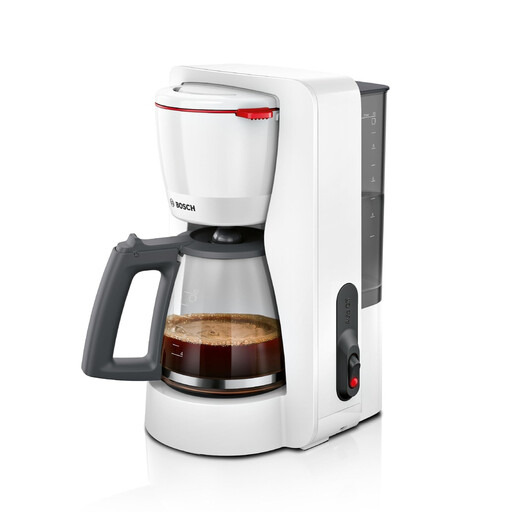
Why is it a good fit for this profile? This drip coffee maker offers a 1.25-litre capacity, a glass carafe and straightforward button controls for everyday household use.
The removable water tank, swing-out filter holder and wide carafe opening make filling and cleaning easier.
1.25-litre glass carafe, drip stop, keep-warm function for up to 40 minutes and automatic shut-off according to the product specifications.
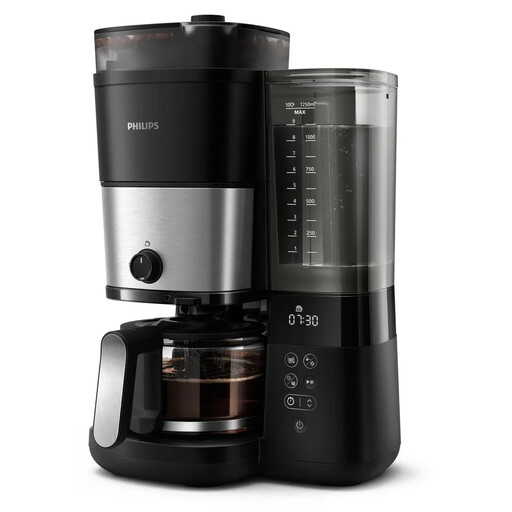
Why is it a good fit for this profile? This model combines drip coffee brewing, a conical grinder, a timer and adjustable coffee parameters for households with different preferences.
The choice between whole beans and pre-ground coffee prevents you from being locked into a single preparation method. The removable bean container makes maintenance easier.
1.25-litre water tank, 24-hour timer, three strength settings, adjustable grind size and glass carafe according to the product description.
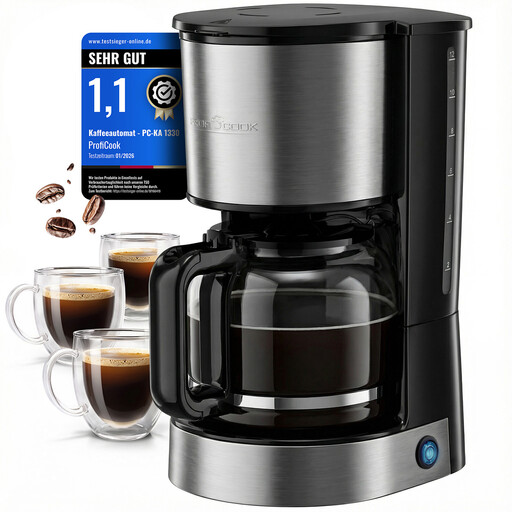
Why is it a good fit for this profile? With a capacity of around 1.5 litres and a stated output of 12 to 14 cups, it is designed for larger coffee gatherings at home or in the office.
The litre capacity and cup count are stated together. The drip stop and hotplate address typical requirements when serving larger quantities.
1.5-litre glass carafe, 800 W heating element, water-level indicator, drip stop and automatic shut-off according to the product data.
Descale the drip coffee maker in accordance with the user manual. The required frequency depends, among other factors, on the water hardness in your area and how intensively the machine is used. In regions with hard water, regular descaling is particularly important to prevent deposits from building up in the heating system.
When planning costs, you should consider three factors:
For households with limited counter space, the compact Philips HD7461/00 may be worth considering. It offers a 1.2-litre capacity, glass carafe, drip stop and automatic shut-off. If you prefer a thermal carafe, consider models such as the Braun PurShine KF1505BK; according to the product description, it features a 1.2-litre thermal carafe and automatic shut-off after 40 minutes.
The full selection includes drip coffee makers with different capacities, filter types, glass carafes, timers and cleaning features.
Smaller machines are often sufficient for one or two people. Families, offices and teams generally benefit from a capacity of 1.2 to 1.5 litres. The deciding factors are how many cups are actually needed at once and how the manufacturer defines a “cup”.
Paper filters can be disposed of quickly after brewing and may retain fine coffee particles. A permanent filter reduces ongoing spending on filter paper, but it must be cleaned regularly. The right choice depends on your preferred level of maintenance, taste preferences and efforts to minimise waste.
There is no reliable standard lifespan that applies to every model. It depends on usage, water hardness, descaling and careful cleaning. Allow the machine to cool completely before cleaning, do not immerse the housing in water and never operate it without a sufficient amount of water.