For large project folders that you regularly take with you and mainly want to store, a portable HDD is an obvious option. If you often work on or copy large files directly from the drive, an external SSD may suit your workflow better; a desktop HDD is another option for a fixed workspace. Plan for a separate, verifiable backup too, and check the connections, file system and requirements of your training provider.
Who are these types of drive suitable for?
Trainees with growing project archives
If your project folders are growing and you take files between training locations, first work out how much storage you’re using and how much more you expect to need. A portable HDD may be suitable if storage space matters more than high data transfer rates.
Trainees with important submission files
If you want to recover your project files after a device failure, plan for an additional copy stored separately. The German Federal Office for Information Security recommends checking that a backup can be restored.
Trainees who often transfer large files
If you often copy large project files or work on them directly from an external drive, the connection, cable and transfer performance of your computer are important factors to consider. Manufacturers’ maximum speed figures don’t guarantee the same performance in your particular workflow.
What should you consider when choosing?
Portable HDD
Suitable if: You take large project folders with you and storage space matters more than the shortest possible transfer times.
Things to consider: The USB-powered models described here don’t need a separate power supply; compared with an SSD, expect lower data rates and/or longer access times.
External SSD
Suitable if: You often copy large files or work on them directly from an external drive, and your computer supports the USB connection you need.
Things to consider: Check that the capacity suits the amount of data you have; a stated maximum speed isn’t a guaranteed speed for your files.
Desktop HDD
Suitable if: You want to keep your large project folders mainly at a fixed workspace.
Things to consider: The documented Seagate One Touch Hub design uses a power supply, so allow for an additional power connection and check the specific model variant.
| What you need |
What to check before buying |
Who it matters to |
| Room for large and growing project folders |
Check the size of your folders and estimate how many additional project versions you’ll need; compare this with the capacity of the specific model. |
If my project folders are growing and I need to take them with me, having enough space comes first. Around 31% of consumers say storage capacity is their top priority. |
| A backup you can restore |
Decide where to keep your working copy and separate backup; check whether you can restore a test file. |
If I don’t want important submission files to be my only copy, I need a separate, verifiable backup. Around 25% of consumers prioritise protection against data loss. |
| Speed with large files |
Consider how often you transfer large files, as well as your computer’s connection and cable; don’t assume maximum speeds are typical in practice. |
If I often copy or work on large files, I want to avoid unnecessary waiting. Around 19% of consumers put transfer speed first. |
| Using the drive with different computers |
Check that the USB connection and file system of the specific model work with the devices you actually use. |
If I switch between different computers, the drive needs to work with my devices before I save files to it. Around 13% of consumers give the greatest weight to compatibility across devices. |
| Protecting confidential files |
Check your training provider’s requirements and find out what security features the specific model offers. |
If project files are confidential or contain business data, I need to check how they’re protected before taking them with me. Around 12% of consumers say confidentiality is their top priority. |
Which buying and usage mistakes should you avoid?
-
Moving your only copy to the new drive
An external drive can fail or get lost. If it then holds the only copy of a project, extra storage space isn’t the same as a backup you can restore.
Keep another copy separately and test whether you can restore files from it. The German Federal Office for Information Security recommends checking that backups can be restored.
-
Assuming a USB specification guarantees copying speed
The connection alone doesn’t tell you how quickly your project files will transfer. Your computer, cable and drive also affect whether a stated data rate is achievable in your workflow.
Consider the host device, cable and drive together. Manufacturer maximum speeds, such as the figure Samsung quotes for the T7, aren’t test results for your computer and files.
-
Not checking the file system before use
A compatible plug doesn’t automatically mean you can write to the drive on every device without preparation. Verbatim says its 4 TB Store ’n’ Go is formatted as NTFS; the manufacturer specifies that reformatting is needed for full Mac compatibility.
Check the file system and target devices before adding files. Back up any existing files before reformatting a drive.
-
Using a personal drive for business data without checking first
A drive’s technical suitability doesn’t mean your training provider has approved it or that its security measures are sufficient for the data stored on it.
Check your organisation’s requirements before transferring any files, and decide what access protection is needed when transporting them. Under the GDPR, data controllers and processors must ensure a level of security appropriate to the risk when handling personal data.
Key brands at a glance
Toshiba
The Canvio Basics range includes portable HDDs; Toshiba lists a capacity of 4 TB for model HDTB540EK3CA.
- Toshiba says Canvio Basics can be used with Windows computers without additional software.
- This doesn’t confirm that other Toshiba models come pre-formatted or are fully compatible with Mac.
Intenso
According to Intenso, the portable Memory Case range includes 4 TB (item 6021512) and 5 TB (item 6021513) models.
- Intenso says the hard drive is powered via the included USB-A cable and doesn’t need a separate power supply.
- Check the connection and file system of the specific model before using it with other devices.
Samsung
The external T7 SSD is an alternative for frequent large file transfers; Samsung lists a blue 2 TB model, MU-PC2T0H/WW.
- Samsung quotes speeds of up to 1,050 MB/s for the T7 over USB 3.2 Gen 2 and lists USB-C-to-C and USB-C-to-A cables.
- The stated maximum isn’t a real-world test or a guaranteed transfer rate for every computer and file.
Verbatim
The Store ’n’ Go range includes, among other models, the 4 TB portable HDD #53223 and the separate 2 TB Secure model #53403.
- Verbatim lists 256-bit AES hardware encryption with keypad access for #53403.
- According to the manufacturer, #53223 is formatted as NTFS and needs to be reformatted for full Mac compatibility. Verbatim advises that #53403 needs a security update; the features of these models aren’t interchangeable.
Seagate
One Touch with Hub is a desktop drive designed for a fixed workspace.
- The Seagate manual documents a power supply, plus additional USB-A and USB-C hub ports.
- Check the specific model and capacity; the documented features don’t confirm that a particular model is available.
Joybuy products for project files
The Joybuy products below include portable external HDDs for project files on the move, as well as a desktop HDD for a fixed workspace. Compare the stated capacity with the amount of data you actually have, and check that the connections and formatting are compatible with your devices.
 No image available
WD Elements Portable 5TB USB-C
For large project folders you want to store on a portable drive and take with you.
5 TB; 2.5-inch format; USB-C. The product description says it comes pre-formatted and can be used with Windows and Mac.
View on Joybuy
No image available
WD Elements Portable 6TB USB-C
For large project folders you want to keep available in different locations.
6 TB; 2.5-inch format; USB-C. The product description says it comes pre-formatted and can be used with Windows and Mac.
View on Joybuy
No image available
WD Elements Portable 4TB USB-C
For project folders you want to take with you, provided 4 TB is enough for your needs.
4 TB; 2.5-inch format; USB-C. The product description says it comes pre-formatted and can be used with Windows and Mac.
View on Joybuy
 No image available
WD Elements 2TB Portable External Hard Drive, USB-C, USB 3.2 Gen 1, 2.5", exFAT, Black
For smaller project archives, if 2 TB suits the amount of data you have and you want to take the drive with you.
2 TB; 2.5-inch format; USB-C; USB 3.2 Gen 1; exFAT. The product description says it can be used with Windows and macOS.
View on Joybuy
 No image available
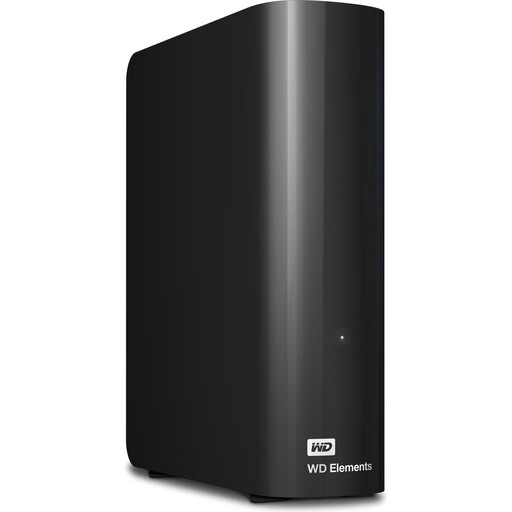
WD Elements 6TB Desktop External Hard Drive, USB 3.0, 3.5", NTFS, Black
For large project folders that are stored mainly at a fixed workspace.
6 TB; 3.5-inch format; USB 3.0; NTFS. The product description says an external power supply is required. It also says the drive needs to be reformatted for use with Mac.
View on Joybuy
Frequently asked questions
How do I work out what capacity I need?
Check the size of your existing project folders and allow for planned new projects and backup versions. Then compare this amount with the capacity of the specific model; there isn’t one TB figure that suits every trainee.
Is an external drive a backup if I move all my projects to it?
No, not if that leaves you with just one copy on the external drive. Keep another copy separately and test whether you can restore files. The German Federal Office for Information Security recommends checking that a backup can be restored.
What should I check before connecting it to Windows or Mac?
Check the cable, device connection and file system of the specific model before transferring files or formatting the drive. Verbatim says its 4 TB Store ’n’ Go comes pre-formatted as NTFS and needs to be reformatted for full Mac compatibility; this doesn’t automatically apply to other drives.
Can I store work-related project files on a hard drive I bought privately?
Check with your training provider first; a drive’s technical suitability alone doesn’t mean you have permission to use it. If personal data is being processed, data controllers and processors must ensure a level of security appropriate to the risk under the GDPR. The security measures required depend on the context in which the data is processed.
What should I do before passing on or disposing of the drive?
Back up any files you need and check that you can restore them. The German Federal Office for Information Security recommends protecting personal data against unauthorised access, or securely deleting it, before passing on, repairing or disposing of a device.


