If you’re editing alone in a quiet room, open-back headphones could be worth considering for critical listening. If you have flatmates, background noise or simultaneous recordings to contend with, a well-fitting closed-back pair is the more obvious starting point. Then check the sound of the specific model using familiar drum passages, make sure it connects to your output and see how it feels during longer editing sessions. Neither the design nor the “studio” label guarantees accurate editing or mixing decisions.
Who are the different designs suited to?
Drum editors in a quiet space
If you’re repeatedly checking hits and edit points in a room without distracting background noise, the tuning of the specific model matters more than the “studio” label. Ableton describes adjusting timing and rhythm when editing audio clips as warping.
Editors sharing a room
If other people are in the room or you’re monitoring during a recording, consider fit, isolation and potential sound leakage. Closed-back models such as the beyerdynamic DT 770 PRO and Sennheiser HD 280 PRO are relevant options for this listening environment, though fit remains crucial.
Students working on long editing sessions
If you wear your headphones for extended periods, check the fit, cable routing and availability of suitable replacement parts. Sennheiser, Yamaha and AKG list model-specific features that you can compare before buying.
What should you look for when buying?
Closed-back design
More suitable if: room noise, other people listening or simultaneous recordings affect your listening environment.
Trade-off: Isolation alone says nothing about neutral tuning or comfort during long sessions.
Open-back design
More suitable if: you mostly edit alone in a quiet environment and sound leakage isn’t an issue.
Trade-off: They offer less isolation from your surroundings; sound leakage from the headphones may matter when recording with a microphone.
| What matters |
What to check when buying |
Who is this important to? |
| Judging hits and edit points |
Listen to familiar drum passages and check the tuning of the specific model. |
When I want to compare edits and hits, I need familiar reference tracks rather than a promise of neutral sound. Around 33% of consumers focus above all on editing and sound monitoring. |
| Isolation in your room |
Check the design and fit of the ear cushions; consider possible sound leakage when recording. |
If other people are in the room or a microphone is recording, I want to take distracting noise and sound reaching the microphone into account. Around 27% of consumers prioritise isolation. |
| Comfort during long sessions |
Assess the cushions, clamping force and fit over a realistic working period for you. |
When I’m editing lots of sections repeatedly, I want my headphones to feel comfortable. Around 20% of consumers prioritise comfort during longer editing sessions. |
| Connection to your editing setup |
Compare your device’s output with the plug and supplied adapter for the specific model. |
When I’m editing on a laptop or audio interface, I want to be able to connect headphones to the output I already have. Around 13% of consumers pay particular attention to device connections. |
| Wear-and-tear parts |
Check whether replacement cushions or a replacement cable are compatible with the exact model version. |
When the cushions or cable wear out, I want to be able to find parts that fit my exact version. Around 7% of consumers pay particular attention to spare parts and repairability. |
Common misconceptions
-
“Closed-back” automatically means “neutral for drum mixing”
Isolation and tuning are different things. HIFI.DE notes a pronounced bass emphasis in the Audio-Technica ATH-M50x; this assessment applies to that model, not to closed-back headphones as a whole.
Choose a design that suits your room, then check its tuning against familiar drum passages.
-
Choosing open-back headphones for recording without considering sound leakage
If you’re monitoring during a microphone recording, sound leaking from the headphones may be an issue. Open-back models provide less isolation from your surroundings than closed-back ones.
For simultaneous recording, first check whether a well-fitting closed-back model suits your situation. Open-back headphones remain an option for quiet editing sessions when you’re on your own.
-
Assuming connections and spare parts from the model name alone
Plugs, adapters and accessories vary by model. The replacement ear-pad set documented by Sennheiser is specifically intended for the HD 280 PRO from 2016 onwards.
Check the full model name against your available audio output and the accessory’s compatibility.
Depending on your device’s output, you may need a suitable adapter; any replacement cushions you need later must be compatible with the relevant model version.
Key brands to consider
beyerdynamic
The DT 770 PRO is a closed-back model, while the DT 990 PRO is open-back. The two designs are therefore suited to different listening environments.
- The range includes both a closed-back and an open-back option.
- HIFI.DE notes that the DT 990 PRO can sometimes have sharp-sounding treble. This is a model-specific assessment.
Audio-Technica
The ATH-M50x is a closed-back monitor headphone with a detachable cable.
- Audio-Technica lists a detachable cable and passive isolation.
- HIFI.DE describes the ATH-M50x as having a pronounced bass emphasis. Check drum passages against familiar reference tracks.
Sennheiser
The closed-back HD 280 PRO is a monitoring option if isolation and compatible replacement cushions matter to you.
- Sennheiser lists ambient noise attenuation of up to 32 dB; actual performance depends on factors including fit.
- The documented replacement ear-pad set is intended for the HD 280 PRO from 2016 onwards. Check the exact model version.
Yamaha
The closed-back, foldable HPH-MT5 is an option if you need headphones for studio work and have limited storage space.
- Yamaha lists a weight of 250 g, a 3-m cable and a 6.3-mm adapter for the HPH-MT5.
- These specifications don’t establish personal comfort or whether the tuning will suit your recordings.
AKG
The closed-back K271 MKII is a monitoring option for working in your room.
- AKG describes an automatic mute function when the headphones are taken off.
- The isolation claims come from the manufacturer and aren’t an independent measurement for your room.
Sony
With the wired MDR-7506, you can check the documented connections against the equipment at your editing station.
- Sony lists a stereo mini-jack plug and a supplied combination plug adapter.
- These technical specifications don’t establish a particular degree of tonal neutrality or personal fit.
Joybuy products
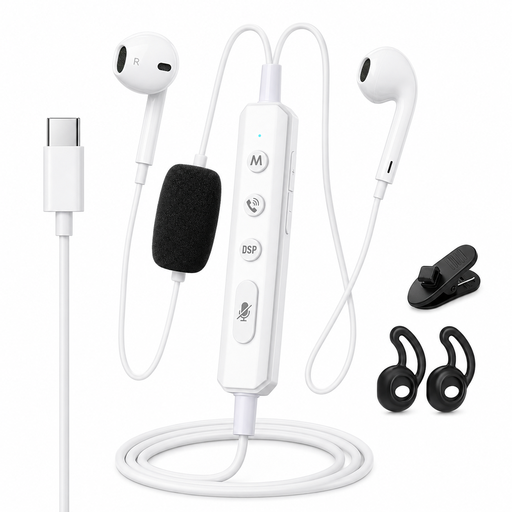
The following Joybuy products are wired headphones for recording and monitoring. For drum editing, check in particular whether the design and sound reproduction suit your editing setup.
 No image available
VoxorAI KM08 White – wired headphones with sound card
The product title mentions recording and real-time monitoring; that alone doesn’t prove they’re suitable for critical drum editing.
The description lists a semi-in-ear design, a 1.2-m cable and an integrated sound card.
The title lists Type-C compatibility. Check that this connection is suitable for your device.
View on Joybuy
Frequently asked questions
Can headphones alone be used to check multitrack drum edits?
No. Compare edited sections with the original material and check the timing and any potential phase issues in your editing project; headphones don’t replace these steps.
Are open-back or closed-back headphones better for drum recording?
If you’re monitoring while recording or other people are in the room, a well-fitting closed-back model is the more obvious starting point. If you’re working alone in a quiet environment and sound leakage isn’t an issue, open-back headphones could also be suitable.
How do I connect headphones to a laptop or audio interface?
First check your device’s socket, then compare it with the plug and adapter supplied with the specific model. Sennheiser lists a 3.5-mm plug with a 6.3-mm adapter for the HD 280 PRO; Sony also documents a mini-jack plug with an adapter for the MDR-7506. Don’t assume these specifications apply to other models.
Can I replace worn headphone cushions?
It depends on the model and generation. Sennheiser specifically documents a replacement ear-pad set for the HD 280 PRO from 2016 onwards; check the exact version before choosing accessories.
What should I bear in mind during long listening sessions?
Keep both volume and listening time in check. The World Health Organization gives 80 dB for up to 40 hours a week as a guideline; the position of the volume control alone doesn’t show the sound level reaching your ears.


