Solo cook with a small kitchen
If you occasionally want to turn a few apples into snacks, look for a suitable tray area and a compact appliance that is easy to set up and store away.


If you only dry a few apple slices now and then, your existing oven may do the job; the Federal Centre for Nutrition describes this method as energy-intensive. For regular small batches, a dehydrator with a suitable usable drying area is an obvious alternative. Consider its footprint, adjustable temperature and timer, and how much cleaning it involves. A larger capacity does not necessarily mean less work or lower electricity consumption.
If you occasionally want to turn a few apples into snacks, look for a suitable tray area and a compact appliance that is easy to set up and store away.
If you dry apple slices regularly, adjustable temperature and running time can help you adapt the process to different batches.
If you plan to dry larger quantities of fruit as well as apple slices, extra drying space can be useful — as long as you have room for the appliance.
| Priority | What to look for | Who is this particularly important to? |
|---|---|---|
| Size and footprint | Overall dimensions and storage space; usable tray area for the batch you want to dry. | If my kitchen is short on space and I only dry a few slices, I want to choose an appliance and tray area that suit my needs. Around 36% of consumers focus mainly on size and footprint. |
| Control over the drying process | Check whether you can adjust the temperature and running time, and easily keep an eye on the slices. | If I dry slices of different thicknesses, I want to adjust the temperature and running time and check on the food as it dries. Around 29% of consumers particularly value having control over the drying process. |
| Cleaning | Check whether the trays and tiers are removable, and what the instructions say about cleaning the specific model. | If I want to clean as few parts as possible after a small batch, the number of tiers I actually need matters to me. Around 21% of consumers put ease of cleaning first. |
| Purchase and running costs | Compare how often you plan to use it with your existing oven; wattage alone does not show how much electricity a batch will use. | If I only want to dry food occasionally, I’ll check whether my existing oven is enough before buying another appliance. Around 14% of consumers prioritise the overall cost. |
The total area alone doesn’t tell you how well the trays will suit a small batch of apple slices. A larger appliance can take up more space and mean more parts to clean.
First, estimate how many slices you want to dry in each batch. Then compare the usable tray area and the appliance’s overall dimensions.
A larger footprint and more parts to clean can mean extra effort day to day.
The rated power alone doesn’t tell you how much electricity a batch of apples will use. Running time and actual power consumption also matter.
If consumption is a key consideration, compare kWh readings for similarly sized batches rather than using wattage as a measure of efficiency.
Your existing oven may be an option if you only want to try drying food now and then. The Federal Centre for Nutrition describes oven-drying as energy-intensive, so a dedicated appliance may be worth considering if you plan to use it more often.
Take how often you’ll use it and the space you have available into account. For an oven, consider the drying method; for a dehydrator, factor in the extra space it will take up.
The KÜCHENminis range includes the “Dörrautomat Snack to go”, a model the manufacturer describes as compact and designed for small kitchens and snacks.
The DA 350 combines stackable tiers with adjustable temperature. It may be worth considering if you sometimes prepare larger batches as well as small portions of apple slices.
The DA510 is a larger, pull-out-tray option for anyone who regularly wants to dry more than a few apple slices for one.
The DR 2751 is a straightforward dehydrator with five stackable tiers for fruit and other foods.
Severin describes the OD 2940 as a dehydrator for fruit, vegetables and herbs.
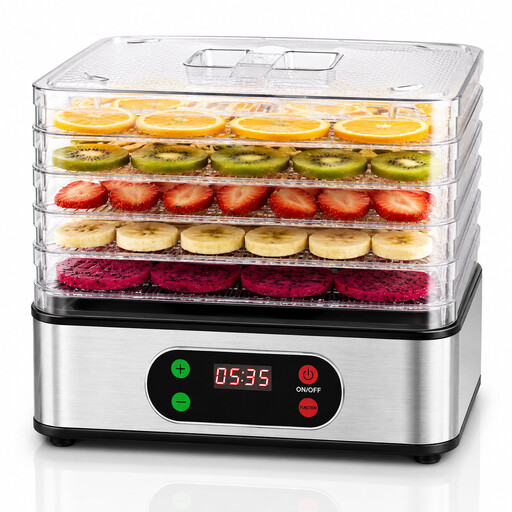
These Joybuy products are listed as suitable for drying fruit and differ in features such as the number of trays and available settings.
 No image available
For fruit and varied batches, when you want to adjust the temperature and running time.
Temperature setting: 35–70 °C. Timer: 0.5–72 hours in 30-minute increments. 350 W.
According to the product description, the removable parts are dishwasher-safe.
 No image available
For fruit and larger batches, when you want to use several trays.
Ten stainless steel trays, variable temperature control, a 48-hour timer and ten programmes. 850 W.
According to the product description, the trays are dishwasher-safe.
 No image available
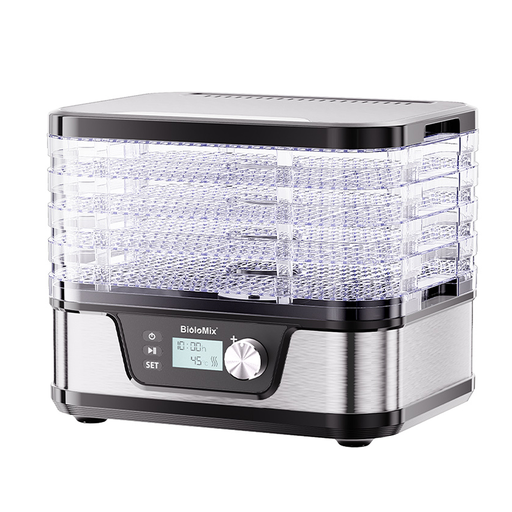
For fruit and fruit crisps, when you want to adjust the temperature and drying time.
Five trays, a temperature setting of 35–75 °C and an adjustable 24-hour timer.
The product name mentions 360° hot air circulation.
Remove the core, cut the apple into thin, even slices and check them as they dry. The Federal Centre for Nutrition says they are ready when they are still slightly pliable and no juice comes out when you press them firmly. Drying time depends on factors including the thickness of the slices.
Leave the slices to cool completely, then store them in an airtight container in a cool, dark, dry place. Dried fruit does not keep indefinitely; if it becomes damp or shows signs of spoilage, you should not keep it.
No. The wattage indicates the rated power, not the measured electricity used for a batch of apple slices. To compare costs, you need similarly sized batches, the actual electricity used in kWh and your electricity tariff.
For your statutory rights under the legal guarantee, you should generally contact the seller. An additional warranty is voluntary and subject to its terms and conditions. The Verbraucherzentrale explains that, under the statutory remedy, a repair or replacement may be offered first.
Electrical appliances must comply with the applicable EU product rules; CE marking is required where the relevant rules specify it. The EU’s guidance on CE marking explains that it is not an independent quality mark. Parts intended to come into contact with food must also comply with EU rules on food contact materials, including Regulation (EC) No 1935/2004. Check the information provided for the specific product listing.