If you need to dry several washable aprons indoors before you leave, a heated airer could be an option – but it won’t guarantee a particular drying time. If you have longer, an unheated airer may also do the job. What matters is following the aprons’ care instructions, leaving enough space between them and ventilating the room so moisture can escape.
Which option is right for you?
Travellers with little time to dry their aprons
If you need to dry washable aprons before a fixed departure date, extra heat could be an option. However, it won’t guarantee a particular drying time. Adler and InnovaGoods offer heated airers for indoor use.
Travellers short on space
If you want to hang several aprons separately and put the airer away afterwards, consider both its size when in use and when folded. Adler and Leifheit list dimensions and, for their respective models, a foldable design.
Travellers with delicate aprons
First, check the care label on the specific apron. Then you can decide whether an appliance with adjustable heat is suitable, or whether unheated drying is a better match for the care instructions. InnovaGoods lists temperature settings, while GINETEX explains care symbols.
What should you look for when buying?
Heated, folding winged airer
A good fit if: you want to hang several aprons before packing and have the option of adding heat.
The trade-off: The appliance needs electricity. The manufacturer’s temperature or heating-element specifications don’t guarantee a drying time for any particular apron.
Unheated winged airer
A good fit if: you have enough time before packing and mainly need separate hanging space.
The trade-off: There’s no option to add heat. Whether the aprons fit without overlapping depends on their size.
Wall- or ceiling-mounted airer with warm air
A good fit if: you want to keep floor space clear permanently and can install it on a suitable ceiling or wall.
The trade-off: Installation and a fixed location make this a less straightforward option for occasional drying before a trip.
When getting ready for a trip, the main things to consider are how much time you have, the space available for hanging, fabric care and electricity use.
| Buying consideration |
What to look for |
Who should consider it? |
| Aprons dry in time |
Check how many aprons will fit on the rails with space between them, and allow extra time for thick seams and ties. |
If several aprons need to be dry before a fixed departure date, I’d focus on having enough time to hang them up and check them. Around 40% of consumers are most concerned about getting their laundry dry in time. |
| Hanging space and floor space |
Measure the space available for using and storing the airer, then compare it with the apron dimensions and usable hanging height. |
If space is limited, I need enough room between the aprons and an airer that I can put away afterwards. Hanging space and floor space are the main considerations for around 30% of consumers. |
| Suitable for the fabric |
Read the care label and, if you want a heated function, check the appliance instructions too. |
For delicate aprons, I want to check what kind of drying the fabric allows rather than relying on general information about the material. Around 20% of consumers focus mainly on fabric care. |
| Electricity and room humidity |
Compare the rated power with the planned running time, and make sure you can ventilate the room when drying indoors. |
If I’m weighing extra heat against electricity use, I want to know whether unheated drying will be enough in the time I have. Electricity use and room humidity are the main concerns for around 10% of consumers. |
Pitfalls when buying an airer for drying aprons
-
Assuming a heated rail guarantees a drying time
How quickly an apron dries depends on factors including the fabric, damp seams, how it’s hung and the conditions in the room. Appliance specifications don’t provide a comparative drying time for aprons.
Allow some extra time before you leave, and check the ties and seams before packing.
-
Looking only at the folded dimensions
A compact folded size doesn’t tell you how much space the airer takes up when it’s in use. For example, Adler lists different dimensions for the AD 7821 when open and folded.
Measure the space you have for using and storing it separately, and allow room to hang the aprons freely.
The airer will take up the required floor space while your laundry is drying.
-
Relying on heat instead of checking the fabric or ventilating the room
Care instructions apply to the specific textile. Moisture also needs to be removed when drying laundry indoors; the Verbraucherzentrale warns that inadequate ventilation increases the risk of mould.
Follow the care label and appliance instructions, and ventilate the room while drying laundry indoors.
Brands to consider
Adler
The heated AD 7821 winged airer could be worth considering if the dimensions when open and folded matter for storage.
- Adler lists 18 heating elements, 220 W and dimensions of 148 × 52.5 × 90 cm when open and 113 × 52.5 × 8 cm when folded.
- The manufacturer’s specifications don’t provide a measured drying time for aprons.
InnovaGoods
Warmmat is designed for buyers who want to set the temperature and running time.
- InnovaGoods lists 20 heated rails, six temperature settings from 35–60 °C and a timer of up to 12 hours.
- General claims that it’s suitable for various types of clothing don’t replace the care instructions for the specific apron.
Foxydry
Foxydry Pro is a mounted alternative if you want to keep floor space clear permanently.
- The manufacturer lists two fans, as well as room-air and warm-air modes.
- Ceiling or wall mounting takes extra work, and the listed operating modes don’t guarantee a particular drying time for aprons.
Leifheit
Pegasus Family Plus is an unheated alternative to consider if hanging space matters more than the option of adding heat.
- Leifheit lists 18 m of drying length and 105 cm-high wings; the airer folds flat.
- Whether the aprons dry before you leave depends on the fabric, how they’re hung and how much time you have.
Product options at Joybuy
These product options are for hanging and drying aprons before a trip, and include a heated folding airer and a freestanding clothes airer.
 No image available
Heated clothes airer, 45–55 °C, 144 × 53 × 96 cm
The heated rails and fold-out side wings are suitable for aprons that need to be hung with space between them.
The product specifications list 45–55 °C, 230 W, a load capacity of up to 10 kg and a foldable design.
Before buying, check the rated voltage, CE marking, and German safety and usage instructions.
Joybuy
 No image available
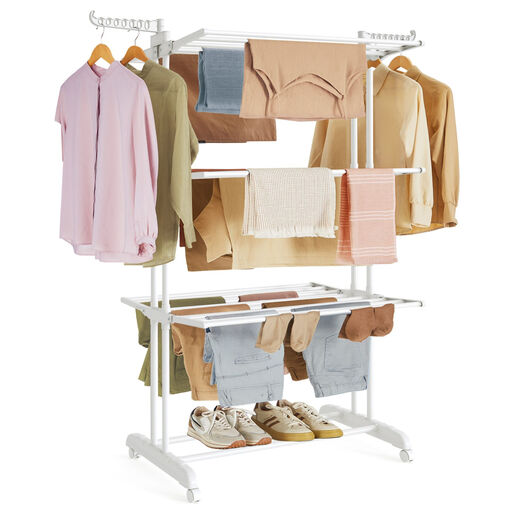
SONGMICS freestanding clothes airer, 4 tiers
The multiple tiers and extra hanging spaces can be useful when you need to hang several items of laundry separately.
The product specifications list four tiers, 14 extra hanging spaces, a static load capacity of 35 kg and open dimensions of 64,2 × 126,6 × 169,2 cm.
The airer is described as foldable and fitted with wheels; check whether the aprons can hang freely on the available tiers.
Joybuy
Frequently asked questions
How can I check whether my apron can be hung on a heated airer?
Check the apron’s care label and the appliance instructions. A symbol showing that tumble drying is unsuitable doesn’t automatically answer whether the apron can be hung on heated rails; a general statement from the manufacturer doesn’t mean every textile is suitable either.
Does a heated clothes airer mean I don’t need to ventilate the room?
No. Moisture needs to be removed from the air in the room. The Verbraucherzentrale recommends opening the windows wide or creating a cross-draught regularly to reduce the risk of mould.
What should I check when buying a new electric clothes airer in Germany?
For new electrical appliances covered by the 1. ProdSV, the manufacturer must issue an EU declaration of conformity and apply the CE marking once a conformity assessment has been successfully completed. Also check the appliance’s identity, manufacturer’s information, and German safety and usage instructions. A CE marking doesn’t guarantee a particular drying performance.
What happens if the appliance develops a fault after I buy it?
Your statutory rights are against the seller; a guarantee is an additional service offered voluntarily. If the appliance is faulty, the first step may be for the seller to repair or replace it. Check separately what’s covered by any manufacturer’s guarantee on offer.


