For a single small batch, the oven you already have may be enough. If you plan to dehydrate food regularly, buying a dedicated appliance is likely to make sense, provided you have room to use and store it. The consumer advice centre Verbraucherzentrale considers an oven suitable for a one-off drying session, but warns that it uses a lot of energy. Choose an appliance based on its usable drying area, footprint and ease of use, rather than wattage alone. Drying time and results also depend on slice thickness and how fully the trays are loaded.
Who might find a food dehydrator useful?
Occasional holiday-cottage dehydrators
If you only want to dry banana slices now and then, first check whether the oven you already have will do the job for a one-off batch. The consumer advice centre Verbraucherzentrale considers this method suitable for occasional use, but warns that it uses a lot of energy.
Snack makers with limited kitchen space
If you often prepare small batches but have little room for appliances and storage, take a close look at the appliance dimensions and whether the trays can be stacked. WMF lists five stackable trays for its KÜCHENminis model.
Batch preparers drying larger quantities
If you want to dry more bananas or other foods too, usable drying area and the ease of handling multiple trays are important factors. The Federal Centre for Nutrition recommends good ventilation and using relatively small quantities.
What should you look for when buying one?
Oven you already own
A good fit if: You only dry banana slices once or occasionally and don’t want another appliance to store.
The trade-off: The consumer advice centre Verbraucherzentrale considers an oven suitable for a one-off drying session, but describes the method as energy-intensive.
Compact food dehydrator
A good fit if: You regularly dry smaller batches and have limited worktop space.
The trade-off: Stackable trays can let you dry several layers at once, but you’ll still need to compare the appliance’s overall dimensions and usable drying area.
Food dehydrator with more drying space
A good fit if: You want to dry larger quantities or different foods regularly, and have room for the appliance and storage.
The trade-off: A higher number of trays alone tells you neither how much usable space there is nor how quickly or evenly food will dry.
| What matters |
What to check when buying |
Who is this particularly important to? |
| Do I need a separate appliance? |
How often you plan to dehydrate food and whether there’s a suitable oven available. |
If I only want to dry a small batch occasionally, I’ll check whether the oven is enough before buying another appliance. Around 22% of consumers are likely to focus mainly on whether they need another appliance when making this decision. |
| Worktop and storage space |
Overall dimensions, height with the trays you need, and room for the usable trays. |
In a holiday cottage, there needs to be room to set up the appliance while it’s running and put it away afterwards, so the actual footprint matters to me. Around 34% of consumers are likely to put space requirements first. |
| Space for each batch |
Check the stated drying area or tray dimensions, not just the number of trays. |
If I want to dry more banana slices in one go, I need enough usable space and good ventilation. Around 22% of consumers are likely to focus mainly on batch size. |
| Controls and cleaning |
Compare temperature settings, timer, automatic shut-off, removable parts and care instructions. |
It’s important to me to be able to set a drying session that lasts several hours and clean the parts afterwards. Around 22% of consumers are likely to consider ease of use and care their main priorities. |
Common buying mistakes
-
Assuming wattage equals energy use per batch
The 350 W rated power listed for the Rommelsbacher DA 350 isn’t a measure of how much energy it uses to dry a batch of bananas.
Only compare energy use using drying sessions measured on a like-for-like basis, and take the quantity being dried into account.
Actual electricity use also depends on running time and your electricity tariff.
-
Choosing based only on the number of trays
The number of trays and the usable drying area are different things. The Federal Centre for Nutrition recommends good ventilation and using relatively small quantities.
Check the tray dimensions or stated drying area alongside the appliance’s overall dimensions.
If the usable area is too small, you may need to run extra drying sessions for larger quantities.
-
Buying an appliance for a one-off try
The consumer advice centre Verbraucherzentrale considers an oven suitable for a one-off drying session, but warns that it uses a lot of energy. Its specific guidance refers to apple and pear rings, not bananas.
Weigh up how often you plan to use a dehydrator against the space it will take up and the cost of running the oven you already have.
An extra appliance needs storage space, even if you only use it occasionally.
Food dehydrator brands to consider
WMF
The KÜCHENminis model is a compact option worth considering if you plan to dry smaller batches regularly.
- WMF lists five stackable trays, a temperature range of 30–70 °C and a timer of up to 24 hours.
- “Quiet operation” is the manufacturer’s description, not an independently measured noise level. Also check that the dimensions suit your available worktop and storage space.
Rommelsbacher
The DA 350 is worth comparing if you’re looking at stated drying area and adjustable tray spacing.
- According to the manufacturer, the model has five trays, 0.42 m² of drying area, two adjustable tray heights and a 36-hour timer.
- Check that its overall dimensions suit the space available in your holiday cottage. Manufacturer specifications aren’t a substitute for an independent drying test.
Severin
The OD 2940 is an option to consider if you’re looking for a model specifically listed for making banana chips.
- In its FAQs, Severin confirms that the OD 2940 is suitable for banana chips.
- This statement alone doesn’t confirm drying time or capacity, or how the results compare with other appliances.
COSORI
The stainless steel food dehydrator with six trays is worth considering if multiple layers and the manufacturer’s stated materials are important to you.
- COSORI describes the appliance and its six trays as being made from food-grade stainless steel.
- The manufacturer’s statement alone doesn’t confirm any safety or health benefits. Nor do six trays prove that it has more usable space than another model.
Stöckli
The Dörrex 0076.72M is worth comparing if you want to consider an independent test report as well as the manufacturer’s specifications.
- In its overview, updated on 9 October 2026, the F.A.Z. Kaufkompass reported that this model dries food evenly.
- The report doesn’t confirm that it has been tested in a specific holiday-cottage kitchen or that it’s available at Joybuy.
Food dehydrators at Joybuy
The following Joybuy models are suitable for drying fruit and making fruit chips. When comparing them, pay particular attention to the number of trays, temperature range, timer and space requirements for the quantity of bananas you plan to dry.
 No image available
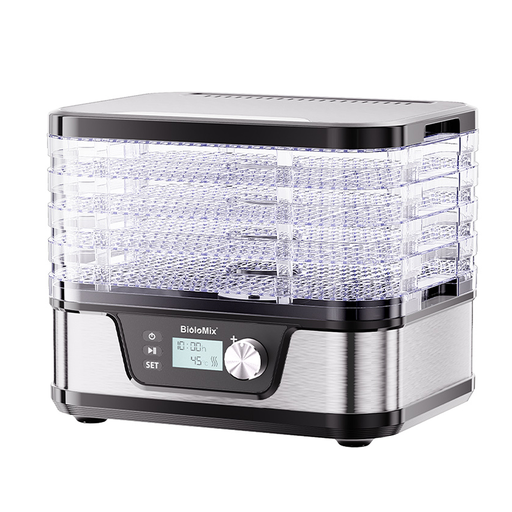
BioloMix BFD1300 food dehydrator, five trays
The five trays and adjustable timer are useful for drying food in multiple layers.
The title lists a temperature range of 35–75 °C, an adjustable 24-hour timer and 360° hot-air circulation.
The product description lists fruit chips as one of its uses.
View at Joybuy
 No image available
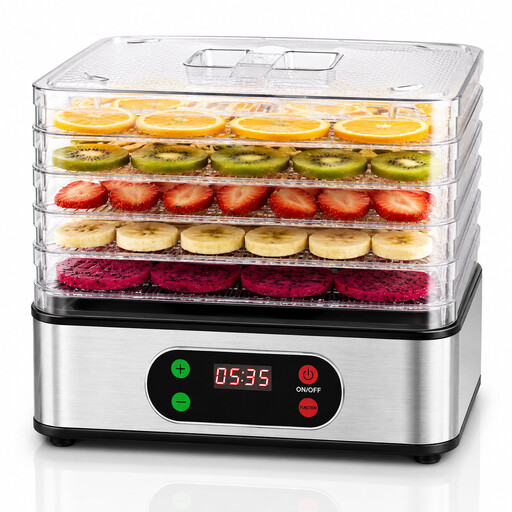
Food dehydrator with LED display, 35–70 °C
The product description specifically lists banana chips as one of its uses; according to the title, both the timer and temperature are adjustable.
The title lists a temperature range of 35–70 °C and a timer of 0.5–72 hours. It also lists 350 W.
The description lists removable, dishwasher-safe parts.
View at Joybuy
 No image available
Havenwell food dehydrator, ten stainless steel trays
The ten trays are useful for drying food in multiple layers, provided you have enough space to set up and store the appliance.
The title lists a 48-hour timer, variable temperature control, ten presets and 850 W.
Check the tray dimensions to see whether the usable area suits the quantity of bananas you want to dry.
View at Joybuy
Frequently asked questions
How should I prepare banana slices for drying, and how long does it take?
Utah State University Extension recommends using firm, yellow bananas or bananas with a few brown speckles, rather than bruised or overripe fruit, and cutting them into slices about 6–10 mm thick. It gives 8–10 hours as a general guide; the actual time depends on the appliance. Follow its instructions and check the results.
When are banana slices dry enough, and how should I store them?
According to the Federal Centre for Nutrition, dried food is ready when it’s still slightly pliable and no juice comes out when you press it firmly. Size, thickness and ventilation all affect drying time. Clean worktops and appliance parts according to their instructions, then pack the cooled slices in clean, dry packaging. This doesn’t allow a general shelf life to be stated.
What should I know about electricity use and warranty cover?
A drying session lasting several hours uses electricity, but the rated power in watts isn’t a measure of energy use per batch of bananas. If you buy from a retailer in Germany, distinguish your statutory consumer rights from a voluntary manufacturer’s guarantee. The consumer advice centre Verbraucherzentrale says that for purchases made from 31 July 2026, the statutory warranty period is extended to three years if a fault is repaired within the original two-year period.
Which product regulations are relevant when buying in Germany?
For relevant electrical appliances, the European Union explains that the CE mark is the manufacturer’s declaration that the product meets applicable EU requirements; it isn’t an independent quality mark. Materials and articles that come into contact with food are covered by Regulation (EC) No 1935/2004. Check the information provided for the specific appliance and its drying trays.


