If you regularly dry several layers of citrus slices, choose a dehydrator based on its footprint, usable drying area, temperature control and ease of cleaning. For the occasional small batch, a method you already have may be enough. The Federal Centre for Nutrition (BZfE) describes a dehydrator as less effort than using an oven, but points out that it takes up space and uses electricity, and that the food needs to be checked.
Who is a dehydrator suitable for?
Holiday-home guests with limited kitchen space
If you only want to dry a few citrus slices, consider how much worktop space the appliance needs when in use and where you’ll store it. WMF and Rommelsbacher list features that can help you compare their designs and number of tiers.
Hosts drying several batches
If you plan to dry larger quantities or make repeated batches, the stated drying area, adjustable temperature and timer are useful points of comparison. The BZfE notes that drying time depends, among other things, on the size and thickness of the food. Rommelsbacher specifies the drying area of its DA 350.
Anyone using the citrus peel as well
If you plan to use the peel, thorough washing and the suitability of the parts that come into contact with food are important when choosing and preparing your appliance. The BZfE recommends washing citrus fruit in hot water and drying it thoroughly before processing. The European Commission explains the EU requirements for food-contact materials.
What should you look for when buying?
Compact dehydrator
Suitable if: Your holiday home has limited worktop and storage space, and you’re likely to dry small batches.
Things to weigh up: Five stackable trays don’t automatically mean a large usable drying area. Compare the dimensions and tray area of the specific appliance.
Dehydrator with a stated drying area
Suitable if: You want to dry several layers of citrus slices and estimate the usable area in advance.
Things to weigh up: Rommelsbacher specifies a drying area of 0,42 m² and five height-adjustable tiers for the DA 350. You’ll still need to make sure the appliance fits in your kitchen.
A drying method you already have
Suitable if: You only dry small quantities occasionally and don’t want to find space for another kitchen appliance.
Things to weigh up: According to the BZfE, air-drying needs suitable warm conditions and takes time; dried food can spoil. An oven is another option, but the BZfE describes it as energy-intensive.
| What matters |
What to check before buying |
Who is it most important for? |
| Footprint and storage |
Compare the appliance’s dimensions when in use with the space available on your worktop. Also check where you’ll store it. |
If I have limited worktop space in my holiday home, the appliance needs to fit in the kitchen and have somewhere to be stored; around 30% of consumers put space requirements first. |
| Drying area for each batch |
Compare the usable area and tray shape with the quantity you want to dry. The number of tiers alone doesn’t tell you how many slices will fit. |
If I want to dry several slices at once, I look for enough space and room between the slices; around 20% of consumers prioritise batch size. |
| Temperature and timer |
Compare the temperature range and timer on the specific model. The BZfE notes that the size and thickness of the food affect drying time. |
If I want to set and keep an eye on the drying process, ease of use and monitoring are key; around 20% of consumers put this first. |
| Food contact and cleaning |
Check the materials and cleaning instructions for all relevant parts. A material description alone doesn’t prove that the specific appliance meets food-contact requirements. |
If I’m using both the peel and the flesh, I want suitable food-contact surfaces and parts that are easy to clean; around 20% of consumers prioritise food contact and hygiene. |
| Upfront and ongoing costs |
Consider the methods you already have. To estimate electricity costs, use the actual consumption for a comparable batch and your own tariff, rather than relying on the wattage alone. |
If I only dry citrus slices occasionally, I want to know whether another appliance is worth buying; around 10% of consumers focus on the effort involved and ongoing use. |
Pitfalls to avoid when buying a dehydrator
-
Assuming the number of tiers equals the usable drying area
The number of trays, the appliance’s dimensions and its stated drying area each tell you something different. Five tiers alone don’t show how many citrus slices will fit at once.
Compare the tray area with the batch size you have in mind, and check that the appliance will fit on your worktop and in your storage space.
If the usable area isn’t large enough for the quantity you want to dry, you may need to run extra batches.
-
Assuming the timer means the food is fully dried
According to the BZfE, the time needed depends, among other things, on the size and thickness of the food. Setting a running time doesn’t, by itself, confirm that the food is fully dried.
Cut the slices as evenly as possible, check the food while it dries, and inspect it before storing.
-
Confusing wattage with the electricity cost per batch
The stated rated power isn’t the same as the measured electricity used for a complete drying cycle.
To compare costs, you’ll need the actual consumption for comparable batches and the same electricity tariff.
Brands and model ranges to consider
WMF
The KÜCHENminis Snack to go dehydrator is described as a compact, stackable option for kitchens with limited space.
- WMF specifies five trays, a temperature range of 30–70 °C and a timer of up to 24 hours.
- The number of trays doesn’t automatically mean the usable area will be large enough for your batch. Check the appliance’s dimensions too.
Rommelsbacher
The DA 350 is aimed at buyers who want to compare stated drying areas and height-adjustable tiers.
- Rommelsbacher specifies a drying area of 0,42 m², five height-adjustable tiers, 35–75 °C and a timer of up to 36 hours.
- The stated dimensions of 31,50 × 33,70 × 25,30 cm need to fit in your holiday-home kitchen; these specifications aren’t the result of a citrus-specific test.
COSORI
The 5-tray dehydrator is another option with adjustable temperature and a timer.
- COSORI Deutschland specifies five trays and a temperature range of 35–75 °C.
- Also compare the specific appliance’s usable drying area and external dimensions with the space you have available.
Severin
Severin describes the OD 2940 as suitable for drying fruit, vegetables and herbs.
- Its stated uses include several food groups, including fruit.
- Check that the specific model’s drying area, temperature control and cleaning options suit your batch.
Dehydrators at Joybuy
The appliances below are dehydrators described as suitable for drying foods such as fruit. If you want to dry citrus slices for eating, check that the food-contact parts of the specific appliance are suitable before use. Material descriptions alone don’t prove that the relevant requirements are met.
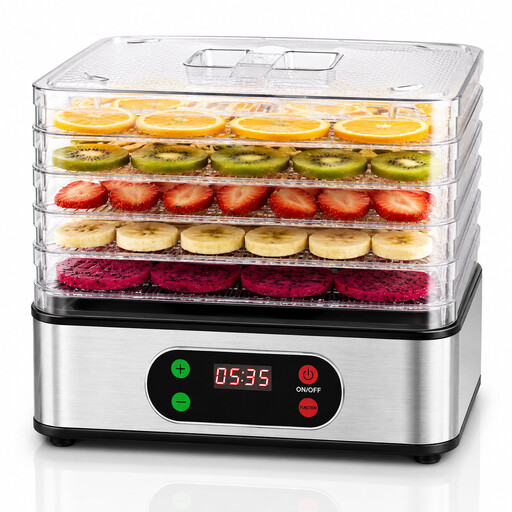 Image unavailable
Dehydrator with LED display, 35–70 °C and timer
This appliance may suit a holiday home with limited storage if you want to set the temperature and running time; the product description calls it compact.
Specifications include 35–70 °C, a timer from 0,5 to 72 hours in 30-minute increments, and 350 W.
If you’re drying citrus slices to eat, check that the parts intended to come into contact with food on this specific appliance are suitable before use.
View product at Joybuy
 Image unavailable
Havenwell stainless steel dehydrator, 10 trays
If you want to dry several layers at once, this appliance comes with ten stainless steel trays. Check that its dimensions suit your worktop and storage space.
Specifications include variable temperature control, a 48-hour timer, ten programmes and 850 W.
If you’re drying citrus slices to eat, check that the parts intended to come into contact with food on this specific appliance are suitable before use.
View product at Joybuy
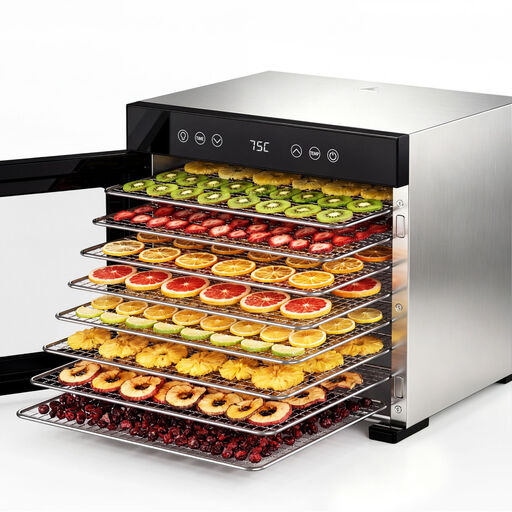 Image unavailable
Havenwell dehydrator, 8 stainless steel drying trays
It has eight drying trays for working with several layers. Check that the appliance and its storage space will fit in your holiday-home kitchen.
The product title specifies 35–85 °C, a 48-hour timer and 650 W.
If you’re drying citrus slices to eat, check that the parts intended to come into contact with food on this specific appliance are suitable before use.
View product at Joybuy
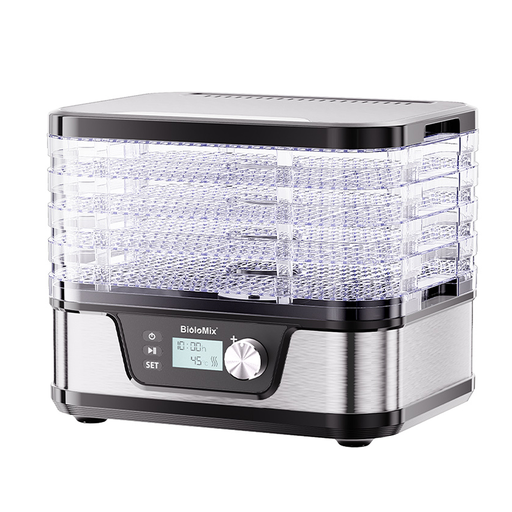 Image unavailable
BioloMix BFD1300 dehydrator, 5 trays
If you want to set the temperature and running time and use several layers, the product title specifies five trays and corresponding controls.
Specifications include 35–75 °C and a 24-hour timer.
If you’re drying citrus slices to eat, check that the parts intended to come into contact with food on this specific appliance are suitable before use.
View product at Joybuy
Frequently asked questions
How should I prepare citrus slices before drying them?
If you plan to use the peel, the BZfE recommends choosing organic fruit for zest, washing it thoroughly in hot water and drying it afterwards. Cut the slices as evenly as possible and check them while they dry; drying time depends, among other things, on their size and thickness.
How can I tell if the slices are dry enough?
Check how dry the slices are before storing them. According to the BZfE, pressing firmly should not release any juice; food can spoil if it hasn’t been dried properly. This doesn’t provide a general shelf life for home-dried citrus slices.
How can I compare the electricity use of two dehydrators?
Compare the actual electricity used for batches of the same size and factor in your electricity tariff. A rated power such as the 350 W specified by the manufacturer for the Rommelsbacher DA 350 doesn’t, on its own, tell you the electricity used per batch or its cost.
What return and warranty rights apply when buying?
For a distance purchase from a trader, you generally have 14 days from delivery to cancel the contract. Check the specific terms for return costs and any exceptions. Your Europe, the European Union’s information portal, distinguishes this right to cancel from the seller’s statutory two-year legal guarantee; any additional manufacturer’s guarantee is separate.
What requirements apply to drying trays that touch citrus slices?
Materials that come into contact with food during their intended use in the EU are covered by Regulation (EC) No 1935/2004. Check whether the relevant parts of the specific appliance meet the applicable requirements; a material description alone isn’t proof.


