Hosts catering for a crowd
If you’re serving several guests, the usable tray area, the option to dry further batches and the space for the appliance all matter.


For a small batch made once, your existing oven may be enough; if you plan to make larger batches or use it regularly, a dehydrator is worth considering. The key factors are the usable area of each tray, the space you have for the appliance and allowing enough time to check the slices: a timer doesn’t prove that they’re dry. The BZfE describes oven drying as energy-intensive, while the Verbraucherzentrale recommends using organic citrus fruit if you plan to use the peel.
If you’re serving several guests, the usable tray area, the option to dry further batches and the space for the appliance all matter.
If you want to prepare the slices for a particular evening, treat the timer and temperature control as planning aids, and allow time to check on them.
If you only plan to make a small batch now and then, consider whether your existing oven will do the job before buying and storing another appliance.
A good fit if: You’re planning several small or medium batches and have limited worktop space. Rommelsbacher lists five tiers and a total drying area of 0.42 m² for the DA 350.
Consider: The total area is spread across several tiers; it isn’t the area of a single tray.
A good fit if: You need to prepare plenty of slices for guests and have room for a larger appliance. Rommelsbacher lists seven trays and a total area of 0.5 m² for the DA 650; GRAEF offers models with six or ten shelves.
Consider: More shelves don’t guarantee faster or more even results. Compare tray dimensions, the appliance’s external dimensions, what’s included and how easy it is to clean.
A good fit if: You only want to dry a small amount occasionally and have plenty of time to spare.
Consider: The BZfE describes oven drying as energy-intensive, and you’ll still need to check the slices as they dry.
| What you need | What to check before buying | Who is it important to? |
|---|---|---|
| Enough area for the quantity | Compare the dimensions of each tray, the number of trays and the total area separately; also check the appliance’s external dimensions. | If I’m planning for lots of guests, I need enough room to spread the slices out in a single layer; around 36% of consumers put available space first. |
| Planning and checking the drying time | Check the temperature settings and timer range for the specific model; allow time to check on the slices. | If the evening is already set, I need time for drying and checking, rather than relying on the timer alone; around 29% of consumers prioritise planning their time. |
| Peel and drying | If you plan to use the peel, bear in mind the Verbraucherzentrale’s recommendation to choose organic fruit; dry the slices in a single layer. | If I’m going to eat the peel, I want to choose suitable fruit and dry the slices thoroughly; around 21% of consumers put peel choice and a dry result first. |
| Buying and future use | Consider how often you’ll use the specific model, where you’ll store it, how much cleaning it needs and whether spare parts are available. | If I only want to dry a small amount occasionally, I want to weigh up the cost and storage space against using my existing oven; around 14% of consumers prioritise future use. |
Manufacturers’ total area figures cover several tiers. Citrus slices should be spaced out in a single layer so air can circulate.
Compare the dimensions of an individual tray with the size of your slices, and check how many tiers are included.
The BZfE notes that drying time depends on size and thickness. The BfR says inadequate drying and incorrect storage can encourage mould.
Allow extra time, check the texture and only pack the slices once they’re sufficiently dry and have cooled.
When you dry whole citrus slices, you use the peel too. The Verbraucherzentrale warns that conventionally grown citrus fruit may have residues on the peel.
If you want to use the peel, follow the Verbraucherzentrale’s recommendation to choose organic fruit, and wash the fruit before preparing it.
Your existing oven may be an alternative for a small batch made occasionally. Another appliance will need space both on the worktop and in storage.
Think about how often you’d use the dehydrator after the bring-and-share evening, and whether your oven will be enough for this one batch.
The models mentioned include both stackable and shelf-style dehydrators.
The ED 5 is a stackable model with trays that can also be used individually.
The manufacturer’s range includes a five-tray model and a separate stainless-steel appliance with six shelves.
The manufacturer lists the OD 2940 for fruit, vegetables and herbs.
The manufacturer’s range includes shelf-style dehydrators with different numbers of shelves.
This selection of dehydrators from Joybuy includes models for fruit and for planning a batch ahead of a get-together.
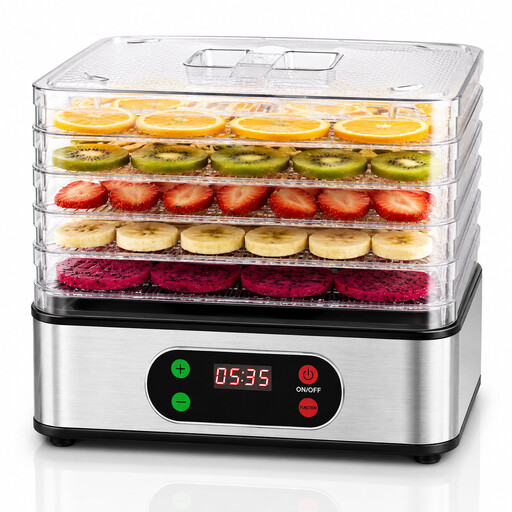 No image available
Adjustable temperature and a timer give you settings to help plan a drying cycle.
Temperature: 35–70 °C; timer: 0.5–72 hours in 30-minute increments; power: 350 W.
 No image available
The stated number of trays may help when planning several layers, but the slices still need to be spaced out.
10 stainless-steel trays; adjustable temperature; 48-hour timer; power: 850 W.
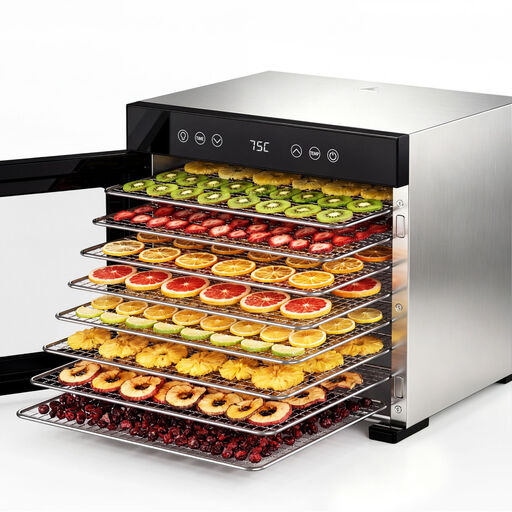 No image available
The stated temperature range and timer help you plan when to dry a batch; you should still check the food as it dries.
8 stainless-steel drying racks; 35–85 °C; 48-hour timer; power: 650 W.
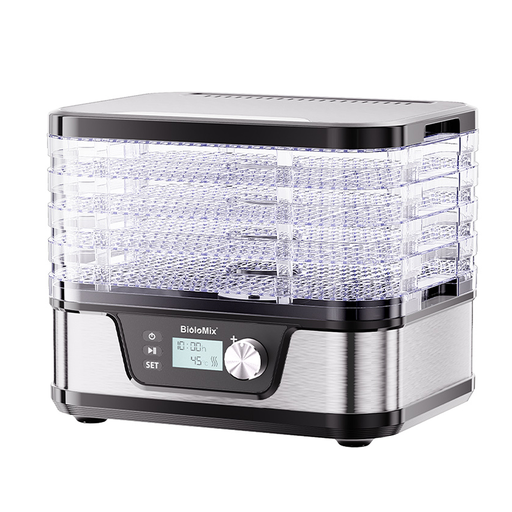 No image available
Adjustable temperature and a timer let you plan how long to run a drying cycle.
5 trays; 35–75 °C; 24-hour timer.
Wash the fruit, cut it into slices that are as even as possible, and arrange them in a single layer with space between them. The BZfE says dried food is ready when it’s still slightly pliable and no juice comes out when you press it firmly; this doesn’t give you a set drying time for citrus slices.
If you want to use the peel, the Verbraucherzentrale recommends organic citrus fruit for culinary uses. The label ‘untreated’ alone doesn’t rule out treatment while the fruit was growing; wash the fruit before preparing it.
Leave thoroughly dried slices to cool, then pack them in clean, airtight containers. Check for moisture or mould; the BfR says inadequate drying and incorrect storage can encourage mould.
When you buy from a business seller in the EU, EU consumer information states that you have at least two years of statutory legal guarantee rights from the date you receive the goods. These are separate from any additional manufacturer’s guarantee; if there’s a fault, the seller is generally your point of contact.
No. The European Commission describes the CE mark as the manufacturer’s declaration that the relevant requirements have been met, not as a blanket official approval. New electrical equipment sold on the German market is covered by the Low Voltage Ordinance within its rated voltage limits of 50 to 1,000 V AC or 75 to 1,500 V DC; check the information and markings on the specific appliance.