Students with a tight laundry schedule
You need your cotton shirts dry between shared laundry slots. Extra heat is only an option if there’s enough floor space, a suitable power socket and good ventilation.


A heated clothes airer can be a good option if you need your cotton shirts at short notice and have room for the appliance and a suitable power socket. Manufacturers’ claims about shorter drying times are not independent test results for cotton shirts. If you have more time or need to share the drying space, consider a non-electric airer; when drying clothes indoors, ventilation remains important.
You need your cotton shirts dry between shared laundry slots. Extra heat is only an option if there’s enough floor space, a suitable power socket and good ventilation.
Several people share a small drying area. Key considerations include the airer’s footprint, the number of practical hanging spaces and where to store it when folded.
You can leave shirts to dry for longer and want to weigh up the electricity used against any potential time saving.
A good fit if: You need your shirts at short notice and have room to set up the airer and a suitable power socket.
The trade-off: It uses electricity while in operation; this does not guarantee a particular drying time for cotton shirts.
A good fit if: Floor space is limited and the height of the airer won’t be a problem where you plan to put it.
The trade-off: A compact footprint doesn’t tell you how freely shirts can hang; check that the height and usable spacing work for you.
A good fit if: You need more drying space or want to share the airer, and extra heat is less important.
The trade-off: Without heated bars, you may need to allow more time for clothes to dry; the airer still takes up space.
| What matters | What to check before buying | Who is most likely to value it |
|---|---|---|
| Drying time between laundry slots | Check the heated area, space for shirts and the care label. Adler Europe lists 18 heated elements for the AD 7821 and 30 for the AD 7831; this doesn’t establish which model dries clothes faster. | If I need my shirts before the next laundry slot, time is what matters most to me. Around 29 % of consumers put this need first. |
| Floor space and hanging room | Measure the floor space, walkways and storage space when folded; also check whether shirts can hang with enough room between them. Leifheit lists a drying length of 18 m for the Pegasus Family 18m, while Vileda lists 30 m for the Mixer 3. These figures don’t tell you how many shirts will fit with space between them. | If there’s little free space, I don’t want to block walkways, but I still want to hang shirts with room between them. Around 29 % of consumers say usable space matters most to them. |
| Electricity use | Compare the rated power of the exact model and calculate the cost based on actual running time and your electricity tariff. Adler Europe lists 220 W for the AD 7821 and 298 W for the AD 7831; wattage alone doesn’t show how much electricity is used per shirt. | If I can wait longer, I’d rather avoid the ongoing cost of heating. Around 21 % of consumers put electricity use first. |
| Humidity when drying indoors | Choose a well-ventilated drying spot and consider how moisture can be removed from the room. The German Environment Agency recommends airing the room more when drying wet laundry indoors; the consumer advice centre recommends monitoring humidity with a thermo-hygrometer. | When drying clothes in a flatshare, I don’t want the moisture simply to stay in the room. Around 21 % of consumers say indoor humidity is their main concern. |
Manufacturers’ drying-time claims aren’t based on comparable tests using cotton shirts and conditions like those in your flatshare.
Make your decision based on the design, spacing for shirts and electricity use. Don’t plan around a fixed drying time based on an advertising claim.
If the expected time saving doesn’t materialise, running the airer for longer could mean using more electricity.
The total length or number of tiers doesn’t tell you how many shirts can hang freely with enough space between them.
Compare the usable bars and tiers with the length of your shirts, and measure the airer when fully open in the space where you plan to use it.
Even a heated airer won’t remove the moisture from wet laundry from your home.
Dry clothes somewhere you can ventilate, and regularly let the moisture out of the room. If needed, use a hygrometer to check indoor humidity.
Heated folding and tower airers with different set-up and folded dimensions.
The DO7117DR is described as a narrow heated airer for a small number of items.
Non-electric freestanding airers are worth considering if shared drying space matters more than extra heat.
Non-electric tower airers are worth considering if floor space is limited and several people share the drying area.
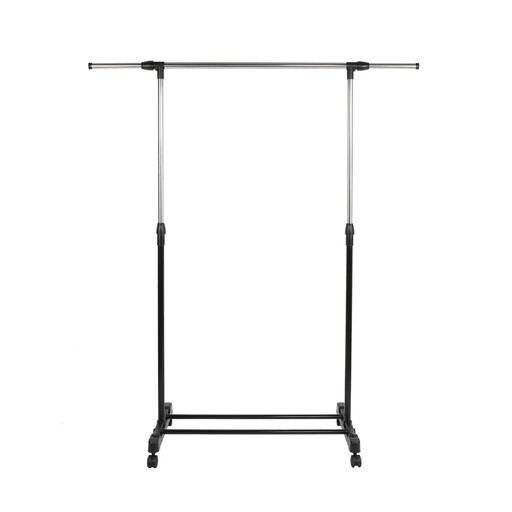
This selection includes a heated folding airer and a mobile clothes rail with a single bar. For both, check that shirts can hang with enough space between them where you plan to dry them.
 No image available
The heating function may suit you if you’re considering extra warmth; it doesn’t guarantee a particular drying time for cotton shirts.
The product description lists 230 W, a central drying area and two fold-out wings. Before buying, check that shirts can hang with enough space between them and that the location is suitable.
For an appliance rated at 220–240 V~, check the relevant compliance requirements and CE marking for the specific item on offer.
 No image available
A single top bar could work if you want to hang clothes on a rail; check whether it has enough room for your shirts.
The product description lists an adjustable width of 80 to 145 cm, wheels and a foldable design.
No. Ventilation is still important when drying laundry indoors, as a heated airer won’t carry moisture outside. The German Environment Agency recommends airing the room more when drying wet laundry indoors.
Multiply the power in kilowatts by the actual running time and your electricity price per kilowatt-hour. At 220 W, continuous operation uses 0,22 kWh per hour; the cost also depends on how long you run it and your tariff.
Don’t decide based on the fibre content alone. Check the care label on the shirt and the airer’s instructions; care symbols distinguish, for example, between hanging and flat drying.
Electrical equipment covered by Directive 2014/35/EU must meet requirements for conformity and CE marking. The European Union explains that the CE marking is a declaration by the manufacturer; check the details for the specific item on offer.
If the product is faulty, your statutory rights are generally against the seller; any additional guarantee is voluntary. The consumer advice centre explains that the first step may be to ask for the fault to be put right through repair or replacement.