If you regularly dry cotton shirts indoors, first compare how much space the airer takes up when in use and whether you can hang shirts on hangers with enough room between them. Heated rails or warm-air drying are options if you’re happy to use extra heat and electricity. If space is tight and you’d rather avoid active heating, a compact, unheated clothes airer may be a better fit. Bear in mind that even a heated airer won’t replace ventilation: moisture still needs to be removed from the room.
Which option suits you?
If you have limited space for drying
If you need to put the airer away between washes or keep the floor clear, compare its dimensions when set up with the space you have available, as well as its folded dimensions. A wall- or ceiling-mounted option will need a suitable fixing point.
If you wear shirts regularly
If you want to hang several cotton shirts separately, ideally on hangers, look at the usable hanger positions, the available hanging height and the layout of the tiers. The total drying length alone won’t tell you how many shirts will fit with enough space between them.
If you need to dry clothes indoors
When drying laundry at home, heating, electricity use and ventilation all go hand in hand. The German Environment Agency recommends paying particular attention to regular ventilation when drying wet laundry indoors. A heated airer won’t remove moisture from the room by itself.
What to look for when buying
Measure the space available for the airer when it’s set up, then consider how you want to hang your shirts. Finally, decide whether active heating is worth the extra electricity use and, if necessary, the effort of installation.
| What matters when buying |
What to check |
Who it matters most to |
| Space and storage |
Measure the space while the airer is in use and the storage space you’ll need afterwards. For wall- or ceiling-mounted models, check the type of fixing required. |
If I can only use the floor space some of the time, I want to know whether the airer will fit when in use and can be stored away afterwards. Around 33% of shoppers prioritise space and storage. |
| Hanging shirts |
Check the usable hanger positions and available hanging height for the specific version. |
If I want to hang several shirts separately on hangers, I need enough hooks or rails, without the tiers below getting in the way. Around 27% of shoppers prioritise suitable hanging space for shirts. |
| Moisture in the room |
Choose a suitable place to dry your laundry and plan to ventilate regularly; don’t expect the heating function to dehumidify the room. |
If I need to dry clothes indoors, I want to be able to ventilate the drying area properly and not confuse heat from the airer with removing moisture. Around 20% of shoppers prioritise managing moisture in the room. |
| Electricity use |
Compare the power rating, actual usage time and electricity price on the same basis. Don’t assume different designs have the same running time without evidence. |
If I’m choosing between active heating and an unheated airer, I want to take the additional electricity use into account. Around 20% of shoppers focus mainly on electricity use and ongoing costs. |
Common buying and usage mistakes
-
Assuming heated rails dehumidify the room
Wet laundry still adds moisture to your home. Heat from the airer won’t automatically carry that moisture outside.
Choose a suitable place to dry your laundry and make sure you ventilate regularly. The German Environment Agency recommends paying particular attention to regular ventilation when drying wet laundry indoors.
-
Taking the total drying length as a measure of shirt capacity
The total drying length doesn’t tell you how many shirts can be hung with space between them or on hangers. Extra tiers can also reduce the clearance available for longer items.
Check the usable hook positions, available hanging height and tier layout for the specific version.
-
Comparing rated power as the cost of drying a load of shirts
The stated power rating doesn’t measure how much electricity it takes to dry a full load of shirts. With warm-air models, the selected setting also affects usage.
Use the power rating to work out costs only alongside a realistic usage time and your electricity price; don’t assume different designs will run for the same length of time.
-
Choosing a floor-free model without checking the installation requirements
The space-saving benefit of a wall- or ceiling-mounted model depends on having a suitable fixing point and power supply.
Decide where it will be installed and check the manufacturer’s instructions before choosing this type of airer.
When planning for a wall- or ceiling-mounted model, remember to allow for the extra installation work.
Brands and designs at a glance
Adler
The AD 7821 is a freestanding, foldable clothes airer with heated rails, designed for homes where floor space is only available some of the time.
- The manufacturer lists 18 heated elements and 220 W. For the AD 7821, it gives dimensions of 148 × 52,5 × 90 cm when open and 113 × 52,5 × 8 cm when folded.
- The rated power isn’t a measured figure for the electricity used to dry a load of shirts. The manufacturer’s claims about faster drying aren’t an independent comparison for cotton shirts.
DOMO
The DO7117DR is a compact heated airer which, according to the manufacturer, can be freestanding or wall-mounted.
- The manufacturer lists a timer, IPX4, 150 W and mounting accessories. DOMO also says it has its own repair workshop.
- The manufacturer’s dimensions of 52,5 × 36,5 × 90 cm and the short hanging area don’t establish that it can hold several shirts. Check the instructions and intended installation location; IPX4 doesn’t mean it’s suitable for every spot in the bathroom.
Foxydry
The Pro series is designed for ceiling or wall installation and, according to the manufacturer, offers room-air or warm-air ventilation.
- For Foxydry Pro, the manufacturer lists 18 to 24 hook positions. The model also has extendable rails and a load capacity of up to 35 kg.
- The specific version, fixing and power supply must suit the installation location. The manufacturer’s claims about airflow aren’t an independent measurement of drying time.
Leifheit
The Pegasus Slim is an unheated alternative to consider if a narrow footprint matters more to you than active heating.
- For this model, the manufacturer lists a width of 55 cm and a drying length of 15 m.
- The Pegasus Slim has no heating function. These dimensions apply to this model and not necessarily to other clothes airers from the brand.
Brabantia
The HangOn tower is an unheated option with foldable tiers and holders for clothes hangers.
- For the 23-m version, the manufacturer lists three foldable tiers and hanger holders.
- The model has no heating function. The manufacturer’s five-year warranty is subject to its warranty terms, which you should check before buying.
Joybuy products for limited drying space
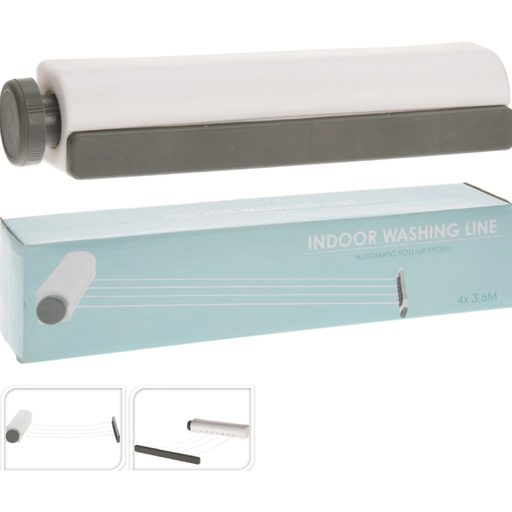
The products below include a foldable heated clothes airer and a retractable indoor washing line. The washing line is an unheated alternative if keeping floor space clear is important.
 No image available
Foldable heated clothes airer, 45–55 °C, 144 × 53 × 96 cm
The foldable design may suit you if you want to put the airer away after drying and have enough space for it when it’s in use.
The product title lists a heating function of 45–55 °C and dimensions of 144 × 53 × 96 cm when in use. The product description lists 230 W and a load capacity of up to 10 kg.
Joybuy
 No image available
Retractable indoor washing line, 4 × 3.6 m
This unheated option may suit you if you can keep floor space clear and have two suitable walls for installation.
The product description lists four lines, each 3.6 m long, giving a total of 14.4 m, as well as an automatic retraction mechanism. According to the description, the distance between the walls must not exceed 360 cm.
Joybuy
Frequently asked questions
How can I check whether my cotton shirts will fit on the airer?
Measure the footprint and available hanging height where you plan to put it. If you want to use hangers, check the usable hooks or rails on the specific version rather than comparing only the total drying length.
Do I still need to ventilate if I use a heated clothes airer?
Yes. The German Environment Agency recommends paying particular attention to regular ventilation when drying wet laundry indoors. The airer’s heating function won’t carry moisture outside.
Can I put any heated clothes airer in the bathroom?
There’s no blanket answer. DOMO lists IPX4 for the DO7117DR, but this specification applies to that model and doesn’t automatically cover other appliances or every location for use or installation. Check the instructions for the specific appliance and the local electrical connection requirements.
How can I work out the electricity use of a heated clothes airer?
Multiply the power in kilowatts by the running time in hours to calculate consumption in kilowatt-hours. At a constant 220 W, the 220 W listed by the manufacturer for the Adler AD 7821 would amount to 0.88 kWh over four hours. This isn’t a measured drying time or a measured figure for the electricity used to dry a load of shirts.
If something goes wrong, what’s the difference between statutory rights and a warranty?
Statutory rights in relation to faulty goods are generally against the seller; a warranty is an additional voluntary promise. The consumer advice centre clearly distinguishes between these rights. Check any warranty or repair promise for the specific model separately.


