For regular towel drying
If you often bring damp towels home, check whether you can hang them separately and have enough room to ventilate. Also check the care instructions on your textiles.


If you regularly dry damp towels indoors after a wet commute and have room to spare, a folding airer with heated rails is an obvious choice. If you only need one occasionally and want to keep extra electricity use for heating to a minimum, an unheated airer is a better option. A permanently installed warm-air solution is worth considering if you want to keep the floor clear and can arrange installation and a power supply. Heat is no substitute for ventilation: the German Environment Agency recommends taking particular care to ventilate regularly when drying damp laundry indoors.
If you often bring damp towels home, check whether you can hang them separately and have enough room to ventilate. Also check the care instructions on your textiles.
If you don’t want the airer permanently in the way once your laundry is dry, compare how much room a folding model takes up in storage with the installation requirements of a fixed solution.
If a towel only gets damp occasionally and you can wait for it to dry, an unheated airer or washing line is an option that doesn’t use electricity for heating.
A good fit if: you regularly hang several damp towels indoors and have room for the airer while it’s in use.
Things to consider: You’ll need floor space and electricity for heating; manufacturers’ claims are not backed by independently measured drying times.
A good fit if: damp towels are an occasional occurrence, you have a suitable place to dry them and you’d rather avoid extra heat.
Things to consider: Drying may take longer without active heat, depending on the conditions; the German Environment Agency describes an airer or washing line as the most energy-efficient way to dry laundry.
A good fit if: you want to keep the floor permanently clear and have a suitable installation location with a power supply.
Things to consider: Installation and an electrical connection are additional requirements; a warm-air solution is not directly comparable with a heated-rail model.
For this comparison, each option is assessed against the main priority in your own buying decision; other factors may also matter in everyday use.
| Priority | What to check when buying | Who is it important to? |
|---|---|---|
| Drying towels regularly | Usable rails, dimensions when in use, care instructions and ventilation options. | If I regularly dry several damp towels indoors, I need enough room to hang them up and ventilate. This is the main priority for around 40% of consumers. |
| Drying space in a small home | Floor space needed when in use and storage dimensions, or the requirements for fixed installation. | If I have limited floor space, I want to put the airer away after use or consider a fixed installation. This is the main priority for around 30% of consumers. |
| Avoiding extra electricity for heating | Rated power in watts and planned running time; running at 220 W for two hours uses a calculated 0.44 kWh if it draws its full rated power continuously. | If a towel only gets damp occasionally, I can afford to wait rather than use extra heat every time. This is the main priority for around 20% of consumers. |
| Room humidity and safe use | Ventilation options, the instruction manual and whether the specific model is suitable for the intended location. | If I dry laundry in a living space, I want to be able to ventilate and use the appliance as instructed in its intended location. This is the main priority for around 10% of consumers. |
Damp laundry releases water into the air. A heated airer does not remove this moisture from the room.
Choose a drying spot with a practical way to ventilate. The German Environment Agency advises taking particular care to ventilate regularly when drying damp laundry indoors.
A folding airer takes up floor space while in use, and you’ll also need to clear the moisture it releases into the room.
A folding airer needs floor space while it’s in use. A ceiling-mounted option can keep the floor clear, but it requires a suitable fixing point and electrical connection.
Measure both the space needed in use and the storage space. For a fixed solution, check that the installation location and connection meet the requirements in the instructions.
Depending on the design, you may need to allow for floor space while drying or extra installation work.
The 220 W specified for the Adler AD 7821 and the 750 W quoted for Foxydry Pro in warm-air mode relate to different appliances and operating methods. They are not measured drying times for the same towel.
Compare the heating method, hanging space and planned running time. To work out your electricity costs, you’ll need a consistent unit of consumption and your own tariff.
An unsuitable design or long running time may mean higher electricity use.
The AD 7821 is a folding, electrically heated airer for indoor use.
Clarsen is included here as an example of a folding airer with heated rails.
Foxydry Pro is a permanently installed, motorised solution with air circulation and optional warm air.
The selection includes a folding airer with a heating function, as well as permanently installed bathroom radiators which, according to their product details, are designed to warm or dry towels.
 No image available
Suitable for regularly hanging damp towels if you have room for a folding airer.
Specifications include 230 W, 45–55 °C and dimensions of 144 × 53 × 96 cm; the airer folds away for storage.
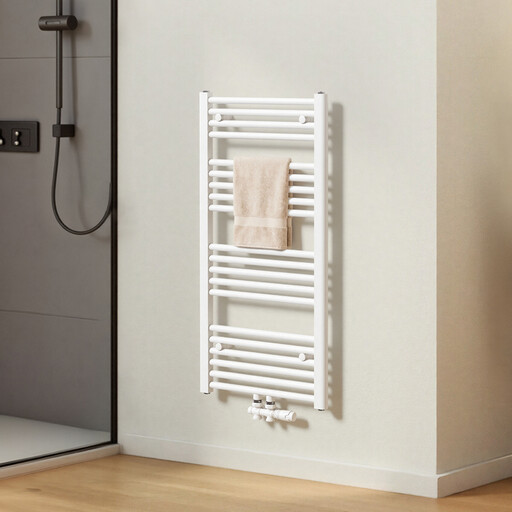 No image available
An option if you want a permanently installed place to dry towels using your existing central heating system.
Specifications include 427 W, dimensions of 1000 × 500 mm and G1/2 inlets. According to the product description, an existing hot-water heating system is required.
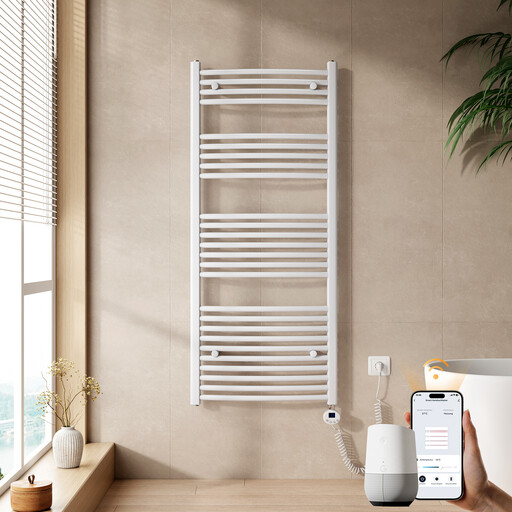 No image available
Suitable for a permanent drying spot if wall mounting and a mains connection are possible.
The title specifies 600 W; the description lists Wi-Fi control and timer functions. A permanent installation location is required.
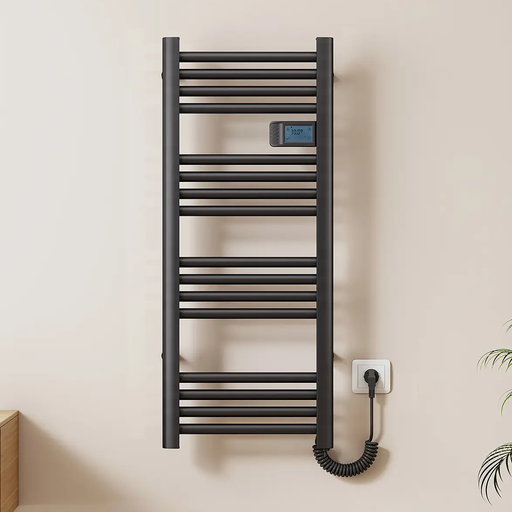 No image available
A fixed alternative if you want to warm and dry towels electrically in the bathroom.
Specifications include 300 W and 960 × 400 mm. The product name and description also mention touch controls, a timer and permanent installation as a bathroom radiator.
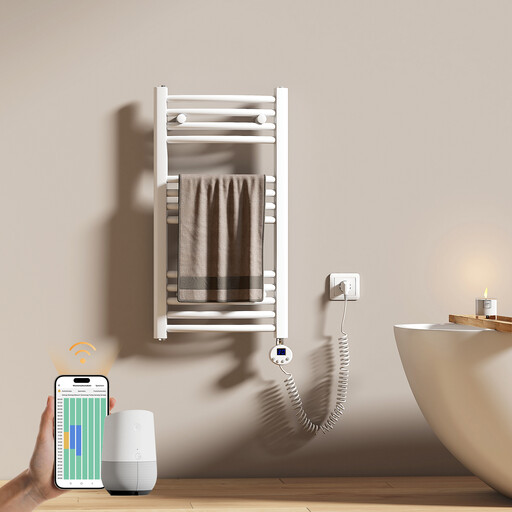 No image available
Suitable for a permanent drying spot in the bathroom if wall mounting is planned and possible.
The description lists Wi-Fi control, a thermostat, a timer and IP44. Check the instructions and make sure the specific location is suitable before installation.
No. The airer’s heating function does not remove moisture from the room. The German Environment Agency recommends taking particular care to ventilate regularly when drying damp laundry indoors.
That depends on the model and its instructions. The Adler AD 7821 measures 113 × 52,5 × 8 cm when folded, so allow room to store it and follow the appliance instructions when folding it away.
Together with the running time, wattage lets you calculate energy use, but not a fixed cost. Running continuously at 220 W for two hours uses a calculated 0.44 kWh; to work out the cost, multiply this figure by your electricity price per kWh.
For electrical products covered by the German Electrical Equipment Ordinance or the Low Voltage Directive, the Federal Institute for Occupational Safety and Health says they must carry CE marking before being made available. Check the marking and the manufacturer’s documentation for the specific appliance. The marking is not an independent test result and does not automatically confirm that every model on sale complies.