Cloths needed by Monday
If you wash your face cloths before the working week, usable hanging space and the time available to dry them matter more than a high wattage alone. Wattage doesn’t reliably tell you how long drying will take.


If you only have a few face cloths to dry before the working week begins, an unheated clothes airer is the lower-energy starting point, in line with the German Environment Agency’s advice on drying laundry. Heat may be worth considering if you’re short on time and the airer has enough usable hanging space, but it uses electricity and doesn’t guarantee a particular drying time. When drying laundry indoors, you’ll still need to ventilate the room to remove moisture.
If you wash your face cloths before the working week, usable hanging space and the time available to dry them matter more than a high wattage alone. Wattage doesn’t reliably tell you how long drying will take.
If you can’t leave an airer set up all the time, compare its dimensions both in use and when folded away. For wall or ceiling-mounted models, make sure the fixing and electrical connection are suitable for the intended location.
If you dry laundry indoors, check the care symbols on each cloth and make sure you can ventilate the room. The German Environment Agency recommends regular ventilation when there are additional sources of moisture, such as damp laundry; GINETEX Germany explains what care symbols mean.
A good fit if: you have enough time before you need to use the cloths and want to avoid the airer using electricity.
The trade-off: there’s no electric heat to help if you’re running short on time.
A good fit if: you need to dry a few cloths in a narrow or fixed space.
The trade-off: usable hanging width may be limited, and wall mounting requires a suitable location.
A good fit if: you want to hang several cloths side by side with space between them and have room to set up the airer while they dry.
The trade-off: the wings need floor space when open; the number of bars and the heat don’t guarantee a particular drying time.
A good fit if: you want to keep the floor clear, regularly have more laundry to dry and have a suitable place for installation and connection.
The trade-off: installation and connection take extra effort; a warm-air dryer isn’t the same as a small airer with heated bars.
| Priority | What to check before buying | Who it matters to |
|---|---|---|
| Dry cloths in time | Usable bar length and layout; a timer if you want to limit the running time. | If I need my cloths ready by the start of the week, I make sure there’s enough hanging space and allow extra time. Around 36% of consumers put this deadline first. |
| Floor space and hanging space | Dimensions when open and folded away; for wall-mounted models, the installation location and connection. | When space is limited, I measure the airer both in use and when stored before choosing a style. About 29% of consumers prioritise space and hanging options. |
| Fabric care and room humidity | Care label and appliance instructions; whether you can ventilate the room where it will stand. | If I’m drying delicate cloths or want to avoid damp in the home, I check the care instructions and ventilation first. Around 21% of consumers prioritise these points. |
| Electricity use | Rated power and intended running time; on appliances with controls, actual power consumption may vary. | If the cloths can dry in time without heat, I want to avoid using extra electricity. Around 14% of consumers prioritise the running costs of heating. |
The number of bars alone doesn’t tell you how many face cloths you can actually hang with enough space between them.
Check the usable bar length and layout against the number of cloths you usually dry. Also measure the floor space needed when the airer is open.
Drying still releases moisture into the air. Heat from the airer won’t remove it from the room.
Choose a suitable place to dry your laundry and ventilate the room to remove the moisture. The German Environment Agency recommends regular ventilation when drying damp laundry indoors.
The wattages given are rated power figures; they don’t guarantee a particular drying time for your face cloths.
Allow extra time before you need to use the cloths. To estimate electricity use, multiply the power in kilowatts by the expected running time in hours.
Your actual electricity costs depend on how long you run the airer and your electricity tariff.
According to DOMO, the DO7117DR is a slim heated airer that can be used freestanding or mounted on a wall.
According to Adler, the AD 7821 is a folding airer with heated bars that can be put away after use.
According to InnovaGoods, the Warmmat is a folding heated winged airer with adjustable temperature and a timer.
According to Foxydry, the Foxydry Pro is a fixed ceiling- or wall-mounted airer with warm-air drying.
This selection from Joybuy includes heated towel rails and heated clothes airers for fabrics. Compare the hanging space, dimensions and installation requirements with the space you have and the number of cloths you need to dry.
 No image available
Wall mounting may suit a permanent drying spot, but you’ll need a suitable place to install it.
The product details list touch controls, a digital temperature display, a top shelf and dimensions of 58,5 × 55 cm.
 No image available
The folding design, with a central section and two side wings, offers several hanging areas but needs floor space when in use.
The product details list a temperature setting of 45–55 °C and dimensions of 144 × 53 × 96 cm.
 No image available
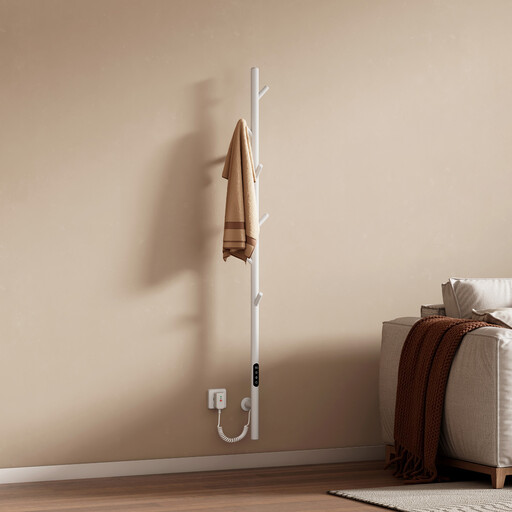
A rail with six hooks gives you several hanging options for small items; check that they’re suitable for your cloths.
The product details list a height of 150 cm, temperature settings of 30–70 °C and a timer from 1–9 hours.
Yes. If the cloths can dry without extra heat before you need to use them, an unheated airer is the lower-energy starting point. The German Environment Agency recommends regular ventilation when drying laundry indoors.
Not necessarily. DOMO lists IPX4 and bathroom suitability for the DO7117DR, but that information doesn’t automatically apply to other airers. Check the instructions, connection requirements and intended location for the specific appliance.
Yes. The German Environment Agency recommends regular ventilation when drying laundry indoors, as otherwise moisture remains in the air. Heat from the airer won’t remove it from the room.
Multiply the power in kilowatts by the expected running time in hours. At 220 W, two hours of operation at full rated power would work out to 0,44 kWh; actual power consumption and running time may differ.
The EU Low Voltage Directive applies to appliances within the 50 to 1.000 V AC range, as explained by the European Commission. Where applicable EU product rules require CE marking, the manufacturer uses it to declare conformity; it isn’t an independent safety approval mark. Also check the specific product listing for the model identity and German safety information.