Gardeners with larger harvests
If you regularly harvest herbs for several batches of cooking, make sure there’s enough usable space to spread them out in a single layer. Rommelsbacher lists different drying areas for its DA 350 and DA 650 models.


A dehydrator can be a good choice if you regularly harvest larger quantities or want to dry leafier herbs with a higher moisture content, provided its capacity, air circulation and temperature controls suit the amount of herbs you have. For smaller quantities of hardier herbs, air-drying in a well-ventilated area with low humidity may be enough. Freezing is another option if you want to use herbs in portions. Manufacturer specifications do not provide independent evidence of drying performance.
If you regularly harvest herbs for several batches of cooking, make sure there’s enough usable space to spread them out in a single layer. Rommelsbacher lists different drying areas for its DA 350 and DA 650 models.
Basil, mint and other leafy herbs with a higher moisture content need to dry quickly. Penn State Extension notes that delicate, moist herbs can go mouldy if they dry too slowly. Freezing them in portions is an alternative described by the Federal Centre for Nutrition.
If you tend to dry smaller quantities, consider the appliance’s dimensions alongside the usable space on each tray. A large number of tiers alone won’t tell you whether it will fit in your kitchen or cope with your harvest.
A dehydrator is particularly useful if you regularly harvest larger quantities or need to dry delicate leafy herbs quickly. Penn State Extension highlights the risk of mould when moist herbs dry too slowly. For small quantities of hardier herbs, air-drying in a well-ventilated area with low humidity may be enough. If you want to use herbs in portions while keeping them as fresh as possible, the Federal Centre for Nutrition suggests freezing them as an alternative.
| Consideration | What to check when buying | Who it matters to |
|---|---|---|
| Usable drying area | Check the total area, the number and shape of the trays, and whether there’s enough space between the herbs. | If I dry regular harvests for several batches of cooking, I need enough room to spread the herbs out. That’s why around 36% of consumers prioritise usable drying area. |
| Delicate herbs | Check the temperature controls and whether the trays are suitable. Choose settings to suit the type of herb and the appliance instructions. | When drying leafy herbs with a higher moisture content, I want to avoid them drying slowly in crowded layers. Around 29% of consumers focus on drying delicate herbs promptly and appropriately. |
| Space requirements | Compare the external dimensions and storage space with the area of each tray, rather than looking at the number of tiers alone. | If my kitchen has limited worktop space and I dry smaller quantities, the appliance needs to be easy to store. Around 21% of consumers prioritise space requirements. |
| Running costs | Consider how often you’ll use it. To compare costs, use the actual energy consumption per batch and your electricity tariff on the same basis. | If I only have small harvests now and then, I want to know whether an electric appliance offers a practical advantage over air-drying or freezing. Around 14% of consumers focus on the purchase and running costs. |
Trays, total drying area and additional fine-mesh inserts serve different purposes. Small leaves also need enough room and airflow between layers.
Check the drying area, mesh size and inserts separately to make sure they suit your herbs and harvest.
The DA 350 and DA 650 models may suit different space and tier requirements.
The KÜCHENminis Snack to go is an option for buyers looking for a compact appliance for smaller batches.
The 5-Tray Dehydrator is another option with adjustable temperature controls.
Severin also describes the OD 2940 as suitable for drying herbs. Availability of spare parts may be worth considering when choosing a model.
The following Joybuy products are listed as dehydrators suitable for herbs. Choose the number of trays to suit the size of your harvest, and check which settings are important for the herbs you’re drying.
 No image available
For drying several layers of herbs; the product title lists herbs as suitable for drying.
10 stainless steel trays, adjustable temperature, 48-hour timer, 10 programmes and 850 W.
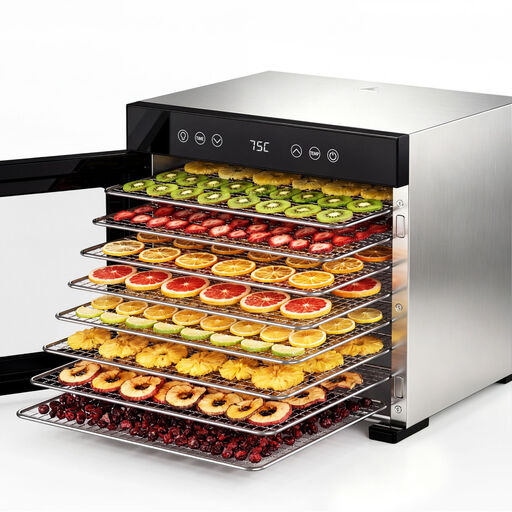 No image available
For drying herbs on several racks; the product title lists herbs as suitable for drying.
8 stainless steel drying racks, temperature control from 35 to 85 °C, 48-hour timer, 650 W, touch display and interior light.
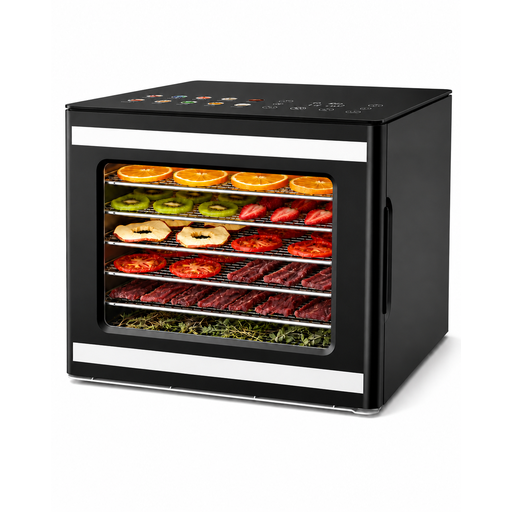 No image available
For smaller batches of herbs; the product title lists herbs as suitable for drying.
6 stainless steel trays, touch display, interior light and overheat protection. The model is described as suitable for small to medium quantities, so it may be a little limited for larger harvests.
Remove any damaged or dirty parts of the plant. If necessary, rinse the herbs and carefully drain off any excess water. Warmth, low humidity and good airflow help the drying process. Delicate, moist leafy herbs shouldn’t be left to dry slowly in tightly packed bunches. Penn State Extension warns of the risk of mould if delicate herbs dry too slowly.
Wait until the herbs are completely dry, then store them in an airtight container in a cool, dry, dark place. Penn State Extension recommends keeping leaves whole where possible to preserve their flavour for longer. The Federal Centre for Nutrition describes storing dried herb mixes in a tightly sealed, dark-coloured jar.
Yes, but the Federal Centre for Nutrition describes oven-drying as an energy-intensive method. For the low-temperature drying method described, at 40 to 50 °C, the oven door should be left slightly ajar so moisture can escape. This isn’t a measured comparison of electricity use specifically for drying garden herbs.
For a distance-selling contract covered by the rules, you generally have 14 days from delivery to withdraw from the purchase. Certain exceptions may apply, and return costs should be checked separately. The European Union also sets out a legal guarantee of at least two years from receipt of the goods. This is different from a voluntary manufacturer’s warranty.
No. The European Commission describes the CE mark as the manufacturer’s declaration that the relevant EU requirements have been met. It isn’t a centrally issued certificate or a 100% guarantee of safety. When considering a specific offer, check the model identity, manufacturer’s information and warnings. The mark alone doesn’t prove that a particular offer complies with the requirements.