What should you look for when buying?
First decide whether the oven will be available while the pears dry, and how many slices you want to fit in a single cycle.
Compact food dehydrator
A good fit if: you tend to dry small batches and want to keep counter space to a minimum.
Consider: A compact design may not have enough capacity for a larger harvest, so you may need to run several cycles.
Food dehydrator with more drying space
A good fit if: you want to process lots of pears at once and keep the oven free for cooking. Rommelsbacher lists 0,42 m² across five shelves for the DA 350 and 0,5 m² across seven trays for the DA 650.
Consider: More drying space takes up room, so also check the shelf dimensions, cleaning requirements and the overall size of the appliance.
Use an oven you already own
A good fit if: you only dry a small batch now and then, and the oven will not be needed for cooking for the whole cycle.
Consider: The oven will not be available for your usual cooking plans while the pears dry. The University of Minnesota Extension and an SRF Kassensturz appliance test reach different conclusions about energy use in their respective contexts; neither supports a general claim that one method is cheaper.
| Priority |
What to check when buying |
Who it matters most to |
| Keep to shared cooking plans |
Check the temperature control, timer and safe position for the specific appliance. |
If I want to dry pears while the oven is needed for cooking, I need a separate space and a cycle I can plan around; around 36 % of consumers prioritise keeping to shared cooking schedules. |
| Process the number of pears I have |
Compare usable drying area, shelf dimensions and the space available for the appliance. |
If I want to process several pears at once, I check how many slices will fit without overlapping; around 29 % of consumers put having enough space for a larger batch first. |
| Dry evenly and store safely |
Check the temperature control and airflow; cut the slices as evenly as possible and check them once they have cooled. |
I want to be sure the pear slices are dry enough before storing them; around 21 % of consumers prioritise reliable drying and storage results. |
| Weigh up extra costs |
If you only plan to use it occasionally, check whether your oven is suitable and available; compare electricity costs using the kWh consumed during a complete cycle and your own electricity rate. |
If I only want to dry pears now and then, I check whether an oven I already own will do the job before buying another appliance; around 14 % of consumers prioritise weighing up the purchase and running costs. |
Joybuy products for drying pear slices
This selection features standalone food dehydrators with temperature control and timers, so you can dry a batch separately and keep the oven available for cooking.
 No image available
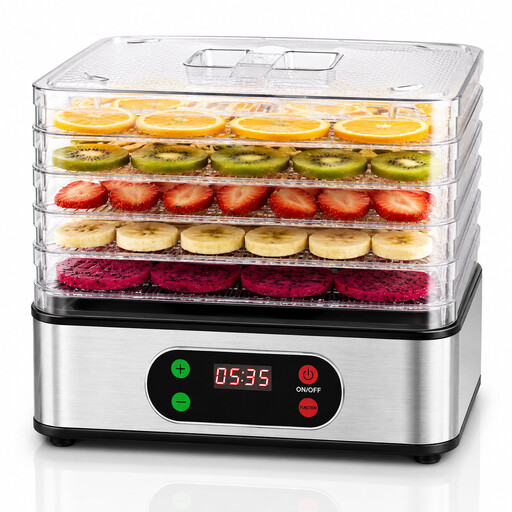
Food dehydrator with LED display, 35–70 °C, 0,5–72-hour timer, 350 W
For drying pear slices in a separate cycle, keeping the oven free for cooking.
Temperature range: 35–70 °C. Timer: 0,5 to 72 hours in 30-minute increments. Power: 350 W.
The timer sets the cycle length but does not guarantee a particular level of dryness; check the pears when the cycle is over.
View at Joybuy
 No image available
Havenwell stainless steel food dehydrator with 10 trays, variable temperature control, 48-hour timer
For anyone looking to use several drying levels while keeping the oven free.
Features ten stainless steel trays, variable temperature control, a 48-hour timer and 850 W of power.
The timer sets the cycle length but does not guarantee a particular level of dryness; check the pears when the cycle is over.
View at Joybuy
 No image available
Havenwell food dehydrator with 8 stainless steel racks, 35–85 °C, 48-hour timer
For a separate drying cycle across several levels, whether or not the oven is in use.
Features eight stainless steel drying racks, a temperature range of 35–85 °C, a 48-hour timer and 650 W of power.
The timer sets the cycle length but does not guarantee a particular level of dryness; check the pears when the cycle is over.
View at Joybuy
 No image available
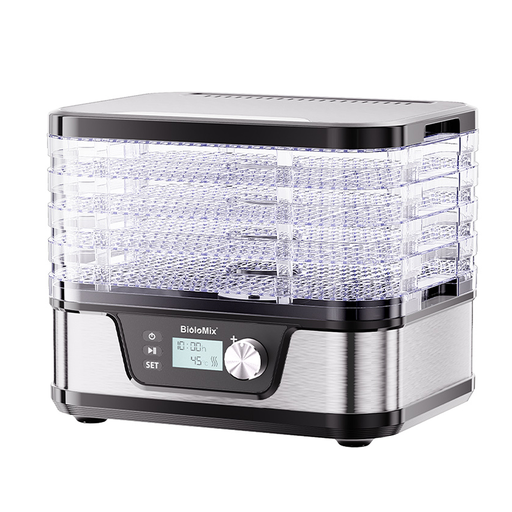
BioloMix BFD1300 food dehydrator with 5 trays, 35–75 °C, 24-hour timer
For a standalone drying cycle using several trays, while keeping the oven available for cooking.
Features five trays, adjustable temperature from 35 to 75 °C, a 24-hour timer and 360° hot air circulation.
The timer sets the cycle length but does not guarantee a particular level of dryness; check the pears when the cycle is over.
View at Joybuy
Frequently asked questions
Will the timer make sure the pear slices are ready to store at the planned time?
No. A timer does not prove that the pears are dry enough. The University of Minnesota Extension lists slice thickness, moisture content and drying method among the factors that affect drying time. Let the pieces cool and check them before storing.
How should I prepare and store dried pears?
Wash the fruit, remove any bruised or mouldy pieces, and cut the pears into slices of an even thickness. The Colorado State University Extension recommends conditioning dried fruit for four to ten days, then storing it in airtight containers in a cool, dry place.
Is an oven always cheaper to run?
There is no blanket answer. The University of Minnesota Extension describes oven drying in general as slower and more energy-intensive, while SRF Kassensturz found that an oven was competitive among the specific appliances it tested. Compare the electricity used by complete cycles on your appliances, rather than looking at the wattage alone.
What should I do if the appliance develops a fault after purchase?
If a product is faulty, the retailer is responsible for your statutory consumer rights. The EU consumer information service Your Europe states that these rights apply for a minimum of two years from receipt of the goods. An additional manufacturer’s guarantee does not replace those rights.
What should I check to make sure an electric food dehydrator meets requirements?
The Bundesnetzagentur lists the CE marking, an identifiable product, manufacturer details and German instructions with the necessary warnings among the points it checks when monitoring the market. A CE marking does not tell you how well an appliance dries pears.


