If you regularly dry pear slices, choose a dehydrator with enough drying area for the amount you want to process in each batch, and check that you have space to use and store it. A compact appliance may suit smaller batches. For a one-off, you could also use the oven you already have, although the Federal Centre for Nutrition says that drying food in the oven with the door slightly ajar uses a lot of energy. Drying time depends on factors such as the thickness of the slices, so check the results rather than relying on the timer alone.
Which option is right for you?
Holidaymakers with limited kitchen space
If you only want to dry a small batch of pears, consider the appliance’s actual dimensions, its drying area and how easy the trays are to clean. Check the manufacturer’s measurements for the specific model against the space you have for using and storing it.
Holidaymakers with a larger pear harvest
If you want to process a lot of slices, weigh up the extra drying area against the space the appliance will take up. Manufacturers’ figures are useful for comparing drying areas, but they don’t tell you on their own how many pears will fit in each batch.
Occasional users who aren’t ready to buy
If you only want to dry pears once while staying in a holiday cottage, your existing oven could be an alternative. The consumer advice centre lists it as an option for a one-off, although the Federal Centre for Nutrition says that drying food in the oven with the door slightly ajar uses a lot of energy.
What should you look for when buying?
Compact dehydrator
A good fit if: You have limited space for using and storing it, and usually dry small batches.
The trade-off: A smaller drying area may mean you need to run several batches when you have a larger harvest.
Dehydrator with a larger drying area
A good fit if: You regularly want to process larger quantities at once.
The trade-off: Weigh the larger drying area against the space needed to set up and store the appliance.
Your existing oven
A good fit if: You only dry food occasionally and don’t want to buy another appliance just yet.
The trade-off: The Federal Centre for Nutrition describes drying food in the oven with the door slightly ajar as energy-intensive.
| Priority |
What to check when buying |
Who it matters most to |
| Control over the drying result |
Temperature control and easy-to-reach trays; slice the pears as evenly as possible and check the results. |
If I’m drying pear slices for later, I want to be able to check their progress rather than rely on a timer alone. Around 33% of consumers prioritise having control over the drying result. |
| Space to use and store it |
Compare the appliance’s external dimensions and drying area with the space available in your holiday cottage kitchen. |
If the kitchen is small, I want to be able to put the appliance away easily after use, without choosing a drying area that doesn’t meet my needs. Around 27% of consumers put space requirements first. |
| Capacity for larger quantities |
Compare your usual batch size with the drying area and number of trays on the model you’re considering. |
If I want to process several pears at once, I want to be able to judge whether the drying area is large enough for my needs. Around 20% of consumers are particularly interested in larger batches. |
| Infrequent use |
Think about how often you’ll dry food and whether your existing oven could work for a one-off. |
If I only want to dry one batch, I want to consider whether I really need another appliance. Around 20% of consumers prioritise infrequent use and whether to buy a dedicated appliance. |
Common buying mistakes
-
Choosing by the number of trays alone
Five trays don’t necessarily mean the same stated drying area across different models. A smaller area may mean extra batches when you have a larger pear harvest.
Compare the drying area and external dimensions of the specific model with your usual quantity of pears and the space available.
-
Assuming the timer means the pears are dry
The Federal Centre for Nutrition says drying time depends on factors such as the size and thickness of the pieces. So a timer alone can’t tell you whether the fruit is ready.
Slice the pears as evenly as possible and check their texture as they dry. The Federal Centre for Nutrition says dried food is ready when it is still slightly flexible and no juice comes out when you press it firmly.
-
Buying an appliance too quickly for a single batch
Your existing oven could also work for a one-off. The Federal Centre for Nutrition points out that drying food in the oven with the door slightly ajar uses a lot of energy.
When deciding, think about how often you’ll want to dry food in future and whether you have permanent space for another appliance.
Key brands at a glance
Rommelsbacher
The DA 450, DA 350 and DA 650 models can be compared by their stated drying area.
- Rommelsbacher gives the drying area as around 0.2 m² for the DA 450, 0.42 m² for the DA 350 and 0.5 m² for the DA 650.
- These area figures don’t guarantee a particular quantity of pears per batch or a specific drying quality.
WMF
The KÜCHENminis Dörrautomat Snack to go is a compact model option with stackable trays.
- WMF lists five stackable trays, a temperature range of 30–70 °C and a timer of up to 24 hours for this model.
- These details describe this particular model and aren’t an independent comparison of drying performance.
Stöckli
Dörrex appliances may appeal to buyers comparing stackable trays and additional accessories.
- For variant 0076.70, Stöckli lists three supplied plastic trays and a 12-hour timer.
- Details for variant 0076.70 don’t necessarily apply to other Dörrex models.
Severin
Severin lists the OD 2940 dehydrator for drying fruit, vegetables and herbs.
- Fruit is among the food types listed by the manufacturer, making this model relevant for drying pears.
- Being suitable for fruit doesn’t in itself tell you how well this model dries pear slices compared with other appliances.
Dehydrators at Joybuy
The Joybuy options below include compact dehydrators and models with multiple trays. Choose one based on the space you have, the drying area you need and the features you’ll actually use.
 No image available
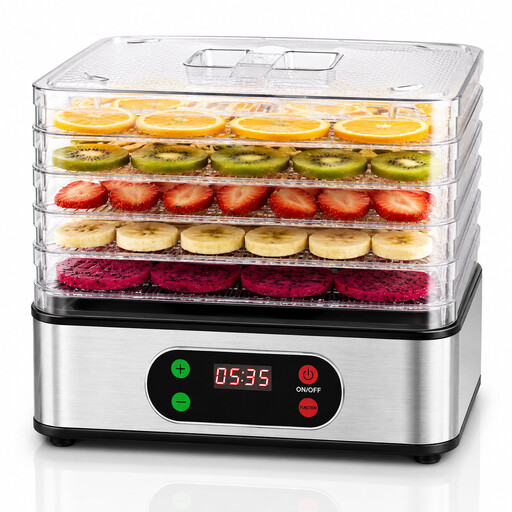
Dehydrator with LED display, 35–70 °C
Its compact design may suit buyers who want to make the most of limited storage space when drying smaller batches.
The product name lists temperature control from 35–70 °C, a timer from 0.5–72 hours in 30-minute increments, 350 W and BPA-free materials.
According to the product description, some parts are removable and dishwasher-safe.
View at Joybuy
 No image available
Havenwell stainless steel dehydrator with 10 trays
With ten trays, this is an option to consider if you’re comparing models with several levels for drying larger quantities.
The product name lists ten stainless steel trays, 850 W, ten programmes and a 48-hour timer.
The product name says the temperature is adjustable, but doesn’t specify a particular temperature range.
View at Joybuy
 No image available
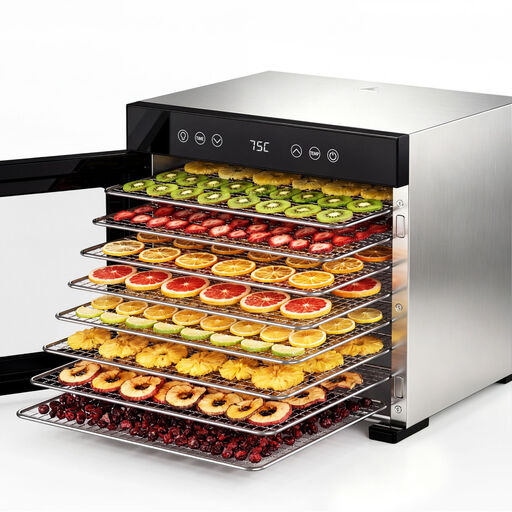
Havenwell dehydrator with 8 stainless steel trays
Eight trays may be useful for buyers comparing appliances for drying several batches.
The product name lists 650 W, temperature control from 35–85 °C and a 48-hour timer.
A touch display and interior light are also listed.
View at Joybuy
Frequently asked questions
How should I prepare pears, and when are the slices dry?
Wash the pears, remove the cores and cut them into thin, evenly sized slices. The Federal Centre for Nutrition says dried food is ready when it is still slightly flexible and no juice comes out when you press it firmly. There’s no set drying time that works for every slice thickness.
Do I need a dehydrator for a one-off in a holiday cottage?
Not necessarily: the consumer advice centre lists an oven as an option for a one-off. The Federal Centre for Nutrition points out that drying food in the oven with the door slightly ajar uses a lot of energy. A dedicated appliance may be worth considering if you’ll dry food regularly or in larger quantities.
What should I check when setting up, using and cleaning the appliance?
Check the external dimensions and make sure the trays are easy to reach for checking and cleaning. Also follow the instructions and safety guidance for the specific model, and check the food as it dries as needed.
What happens if an appliance develops a fault after purchase in Germany?
Your statutory rights apply against the seller; a guarantee is a separate, voluntary offer. If there’s a fault, you should first request a remedy in the form of a repair or replacement.
Is the CE mark an independent safety test?
No. According to information from the European Union, the manufacturer uses the CE marking to declare that the product meets the relevant requirements; no central EU body issues a certificate for it. Also check the manufacturer’s information and the instructions and warnings for the specific appliance.


