Households with slow-drying bedding
If you regularly dry pillowcases indoors, check whether heated rails suit your needs and whether you can hang the cases with enough space between them. The airer specifications are from Adler and Todeco.


A heated airer may be worth considering if you regularly dry pillowcases indoors and want to add some warmth. An unheated airer could suit you if you have time and don’t want to use electricity for heating while drying. With either type, compare the usable rail space with the size of your pillowcases and the room you have available. Heat from the airer doesn’t replace ventilation, and manufacturers’ specifications can’t tell you exactly how long your pillowcases will take to dry.
If you regularly dry pillowcases indoors, check whether heated rails suit your needs and whether you can hang the cases with enough space between them. The airer specifications are from Adler and Todeco.
Check whether the airer fits in your drying area when fully open and can be stored away easily afterwards. Specifications from Adler, Todeco and Leifheit can help you compare designs and dimensions.
If you’re weighing up the cost of electricity for heating, compare heated rails with an unheated airer. When drying clothes indoors, remember to allow for ventilation too. The German Environment Agency lists damp laundry as an additional source of moisture.
First, check that your pillowcases will actually fit on the rails. Then you can weigh up the design, floor space and heated operation. Whichever type you choose, regular ventilation is part of drying laundry indoors.
| What you’re looking for | What to check before buying | Who may find this especially important |
|---|---|---|
| Usable hanging space | Compare the rail layout and usable width of each rail with your pillowcases laid flat. Leave enough space between them and other laundry. | If I want to hang pillowcases as flat as possible, the usable space on each rail matters more than the total number of rails. Around 33% of consumers say hanging space is their top priority. |
| Moisture in the drying room | Choose a spot where you can ventilate regularly. If dampness or condensation persists, consider drying your laundry somewhere else. | If I dry laundry indoors, I need a spot where the air can be refreshed regularly. Around 25% of consumers say indoor humidity is their top priority. |
| Power use and heat | For a heated model, check the rated power and how long you plan to run it. Adler gives the AD 7821 a rating of 220 W, while Todeco lists 300 W for its heated three-tier model; neither figure tells you how long drying will take. | If I want extra warmth but also need to consider electricity use, I compare heated rails with an unheated airer. Around 25% of consumers say running costs are their top priority. |
| Floor space and storage | Check the open dimensions against your walkways and drying area. Also make sure the folded airer will fit in the space where you plan to store it. | If I need to put the airer away after drying, I need a design that fits in my home both when open and when stored. Around 17% of consumers say floor space is their top priority. |
Even when you use a heated airer, moisture from the pillowcases still enters your home. Heat from the airer doesn’t carry it outside.
Choose a spot where you can ventilate, and look out for persistent dampness or condensation.
The total drying length and number of tiers don’t tell you how much room there is for each pillowcase when laid flat.
Measure your pillowcases and the space available, then check the rail layout, dimensions when open and maximum load for the specific model.
The EASYmaxx Elektro-Wäscheständer 900 is described as using a cool flow of air rather than heated rails. The product specifications also list different wattages.
Before comparing running costs, check the technology and clarify any conflicting power figures for the exact model.
The heated winged airer AD 7821 is worth comparing if you’re looking for heated rails and a foldable design.
The heated three-tier airer is an option if you want to spread smaller items across several levels.
The unheated Pegasus Family 18m is a useful point of comparison for air-drying without a built-in heating function.
The Elektro-Wäscheständer 900 is a technical alternative that uses airflow rather than heated rails.
The selection includes a heated folding airer and a range of airers for natural drying. Compare the rail layout and available dimensions with your pillowcases and the space you plan to use for drying.
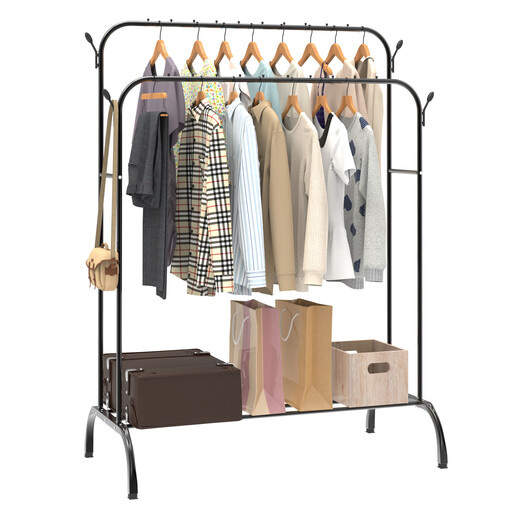 No image available
The two rails give you the option of hanging laundry separately; check that they’re wide enough for your pillowcases.
Includes a shelf at the bottom.
 No image available
An option if you want heated rails and would like to fold the airer away after drying.
Manufacturer’s specifications in the product title: 45–55 °C; dimensions 144 × 53 × 96 cm.
Heating uses electricity, and the actual drying time for pillowcases depends on more than the stated temperature.
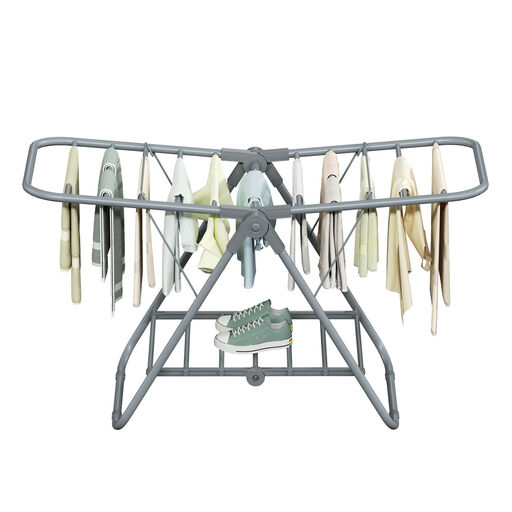 No image available
A foldable airer with two wings if you want to hang pillowcases on an unheated clothes airer.
Compare the rails with the dimensions of your pillowcases and check how much space the airer needs when open.
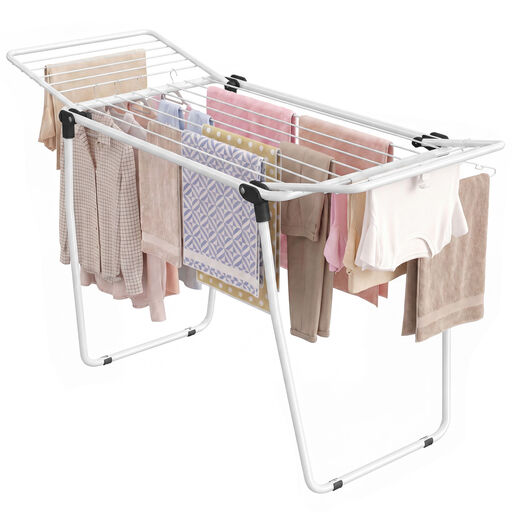 No image available
The unheated winged airer is an option if you want to dry laundry without added heat and its dimensions suit your drying space.
Dimensions when open: 158 × 53 × 93 cm; matt white and dove grey colourway.
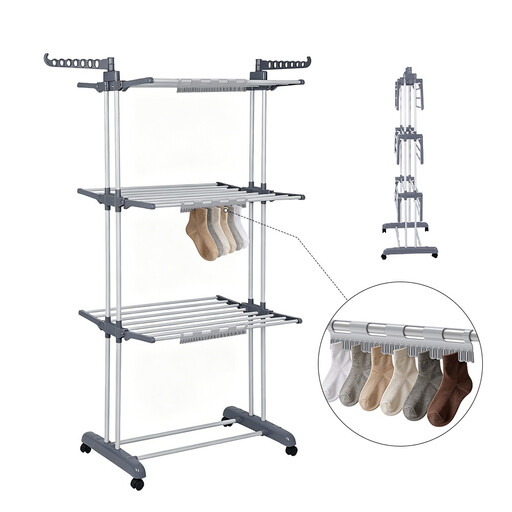 No image available
Several tiers give you another way to spread out your laundry. Check that the height and floor space suit your drying area.
Extendable and foldable; dimensions according to the product title: 75 × 64 × 170 cm.
First, compare your pillowcases with the usable rail space and leave room between each item. Then check the care label before placing a delicate pillowcase directly on warm rails. The model specifications don’t guarantee a particular drying time for pillowcases.
No. The German Environment Agency lists damp laundry as an additional source of moisture and recommends paying particular attention to regular ventilation when drying laundry indoors. Heated rails don’t replace air circulation.
Neither the term ‘clothes airer’ nor a stated IP rating gives blanket approval for every spot in a bathroom. Check the instructions for the specific model and where it’s intended to be used. The VDE explicitly advises keeping electrical appliances away from showers and baths. This is a safety warning, not a general statement that all use in a bathroom is prohibited.
For a rough estimate, multiply the rated power in kilowatts by the number of hours the airer is running and your price per kilowatt-hour. Actual consumption may vary. The rated power alone also doesn’t tell you how long your pillowcases will take to dry.
Purchases from businesses generally come with a 14-day right to cancel, subject to exceptions and the terms of the specific contract. This general statement doesn’t apply to purchases from private individuals.