Drying pyjamas with limited floor space
If you dry laundry in a small flat and need to put your airer away between wash days, compare its dimensions both when set up and when folded.


For drying pyjamas in a small flat, a heated folding airer could be a good option if you have enough room to set it up and want to warm your laundry as it dries. If you’d rather not use electricity for your airer, an unheated model may be all you need. Check its dimensions both open and folded, make sure there’s enough space between garments for air to circulate, and follow the care instructions for each pyjama. If you’re considering a specific electric model, check its electrical safety information and CE marking too. The European Union describes the CE marking as the manufacturer’s declaration that the product complies with the relevant regulations.
If you dry laundry in a small flat and need to put your airer away between wash days, compare its dimensions both when set up and when folded.
If you often dry several pyjama items indoors, check that the bars and tiers leave enough room for air to circulate. The German Federal Ministry for the Environment notes that drying laundry creates moisture in the air.
If running costs and the potential effect of heat on fabrics matter to you, consider how you plan to use the airer and check the care labels on your pyjamas before making a decision.
A good fit if: You want to hang up a few pyjama items and put the airer away after use.
Consider: The heating function uses electricity, and you’ll still need to ventilate the room.
A good fit if: You want to dry several items at once and have room for a multi-tier design.
Consider: Extra tiers don’t replace the need to leave space between garments or check the airer’s dimensions when open and folded.
A good fit if: You need drying space and somewhere to store the airer, but don’t need heated bars.
Consider: The frame doesn’t provide direct heat, so you’ll still need to leave space between garments for air to circulate.
A good fit if: You want to keep your existing airer and use airflow rather than adding heat.
Consider: HEYDRY describes its device as a solution that doesn’t add heat. Claims about shorter drying times come from the manufacturer and aren’t based on a verified comparison using pyjamas.
| What matters when buying | What to check | Who is it important to? |
|---|---|---|
| Floor space and storage | Compare the airer’s dimensions when open and folded, and check there’s room for both the top and bottom halves of your pyjamas. | If I need to put my airer away after drying, its dimensions when set up and folded are important to me; around 36% of consumers put available floor space first. |
| Heating function and drying process | Check which parts are heated, how many tiers there are and the stated power in watts. | If I want to hang several pyjama items up at once, I need to know whether the heated area suits my needs; around 29% of consumers focus mainly on the heating function and drying process. |
| Room humidity while drying | Consider where to position the airer, leave gaps for airflow and make sure you can ventilate the room. | If I dry laundry indoors, I need a well-ventilated space and make sure items aren’t crowded together; around 21% of consumers pay particular attention to room humidity. |
| Electricity use and fabric care | Consider the power rating separately from the planned running time and drying performance; check the care label on each pyjama. | If I need to balance electricity use with caring for delicate fabrics, I follow the running time and care label; around 14% of consumers prioritise electricity use or fabric care. |
An airer that folds flat for storage can still take up a lot of room when it’s open.
Measure the space you have available both for the airer when set up and for storing it away.
Drying laundry on a heated airer still creates moisture in the air. The German Federal Ministry for the Environment recommends ventilating when water vapour is produced.
Choose a well-ventilated spot for the airer and plan to ventilate the room even when the heat is on.
The power rating tells you how much electricity the appliance draws, not how long your particular pyjamas and load will take to dry.
Consider how long you plan to run the airer, and compare its design and the space it offers for airflow rather than assuming the wattage gives you a set drying time.
Heated airers from the same brand can have different dimensions and model numbers.
Before buying, check the full model number, dimensions and features that matter to you.
The AD 7821 is a heated folding airer. You can compare its dimensions when open with its folded size to see if it will suit your space.
The 850-032 is described as a small heated airer for individual items of laundry.
This heated drying tower is a multi-tier option for households that want to hang up several items.
The CA20 BK has three heated tiers in a folding design.
The Classic 250 Flex is an unheated alternative to consider if flexible drying space matters more to you than heated bars.
The following Joybuy options include heated and unheated folding clothes airers. Choose one based on whether you need heat, how much floor space you have and where you’ll store it.
 No image available
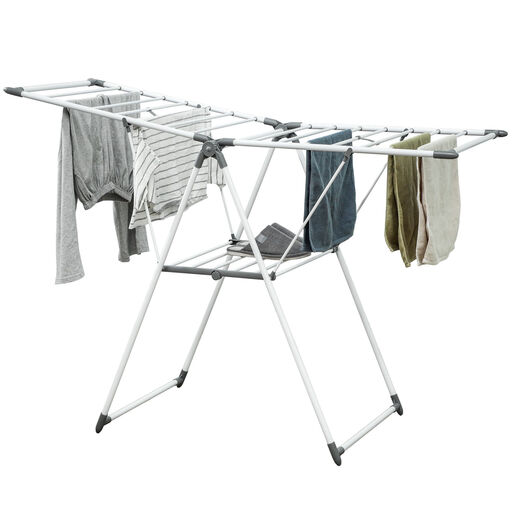
For drying several items of laundry when you’re looking for a heated, foldable design. The product details list 45–55 °C, 230 W, a 10 kg capacity and dimensions of 144 × 53 × 96 cm when open. The side wings extend outwards.
 No image available
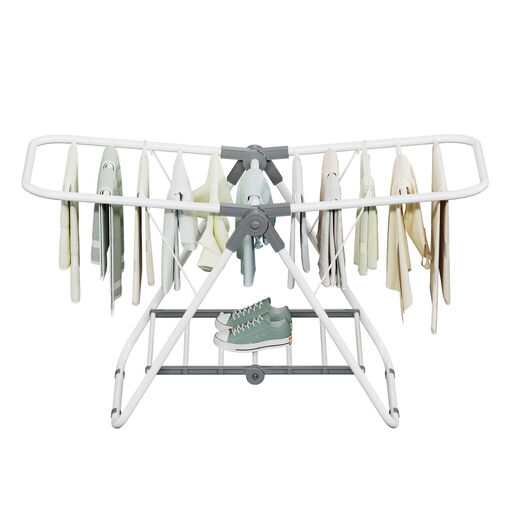
A good option if you want to dry laundry without heated bars and put the airer away afterwards. The listed dimensions are 156,5 × 61,5 × 97 cm when open and 106 × 61 × 8 cm when folded. It has two adjustable tiers and a 15 kg capacity.
 No image available
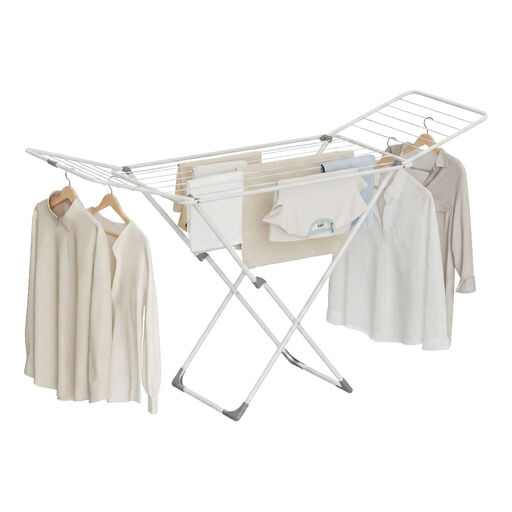
For air-drying laundry without a heating function, with a folding design and wings. The listed dimensions are 101 × 44 × 50 cm. It has two adjustable wings and a 10 kg capacity.
 No image available
For air-drying laundry, with a design that folds flat after use. It offers 18 m of drying space across 17 bars and has a 15 kg capacity. The product details state that the frame is made from rust-resistant steel.
Yes. Drying laundry creates moisture in the air, and the German Federal Ministry for the Environment recommends ventilating when water vapour is produced. The airer’s heating function doesn’t dehumidify the room.
There isn’t a universal answer. Check the care label on each pyjama: the symbols distinguish between line drying and drying flat, among other things. A general claim from the manufacturer about gentle drying doesn’t replace the care label.
Multiply the rated power in watts by the actual number of hours the airer is running, then divide the result by 1,000 to calculate kilowatt-hours. With a manufacturer’s rating of 220 W, four hours of continuous use at rated power would work out at 0,88 kWh. This isn’t a measurement of actual electricity use or drying time.
For an electrical appliance covered by the relevant EU regulations, CE marking forms part of the conformity requirements. The European Union describes it as the manufacturer’s declaration that the product complies with the relevant regulations, not as approval from a central EU body. Check the manufacturer’s information and safety advice for the specific product you’re considering too.
According to the consumer advice centre, online orders generally come with a 14-day cancellation period from delivery. Your statutory rights against the seller are separate from any voluntary guarantee.