Hikers with several damp towels
After outings, you regularly have several damp textiles to dry. The key question is whether you have enough hanging space and room for a heated rack.


For one or two towels that only need drying occasionally, an unheated rack is often enough, provided you have plenty of time and a way to ventilate the room. If you regularly have several towels to dry after hiking, a folding rack with heated bars could be a good fit. The key considerations are usable hanging space and room to position it, not a drying time inferred from the wattage. Even with a heated model, you still need to remove moisture from the room and check that the specific appliance is suitable for the location and electricity supply.
After outings, you regularly have several damp textiles to dry. The key question is whether you have enough hanging space and room for a heated rack.
If you only dry small amounts occasionally, you could consider an unheated folding rack that you can put away when you’re finished.
A fixed towel rail may be an option if you hang towels in the same place regularly. Before buying, check the specific location and electrical installation.
| What you need | What to check before buying | Who it matters most to |
|---|---|---|
| Space for several towels | Compare the dimensions and bar layout. You should be able to hang the towels with enough space between them. | If I’m hanging several damp towels after a hike, I need enough space and a suitable layout. Around 34% of consumers put usable hanging space first. |
| Storage after occasional use | Check the dimensions when open and the storage space available for the folded appliance. | I want to be able to put the rack away after drying, so I also consider its folded dimensions. Around 25% of consumers prioritise ease of storage. |
| Using electricity or drying without it | Consider the rated power and intended running time separately. An unheated rack needs no electricity for drying. | If I only dry a few towels occasionally, I want to weigh up whether active heating is worth the extra electricity. Around 25% of consumers prioritise electricity use. |
| Positioning in damp rooms | Check ventilation options, the appliance instructions and its position in relation to the shower, bath and electrical connection. | I need a spot that can be ventilated, without placing an electrical appliance next to the shower or bath without checking first. Around 16% of consumers say a suitable location is their main concern. |
The rated power and number of heating elements don’t guarantee a particular drying time for your towels.
First, check how many towels will actually fit on the rack with enough space between them. To estimate electricity costs, you’ll also need a realistic running time and your electricity tariff.
Requirements for the installation location depend, among other things, on the area around the shower and bath, as well as the electrical installation. ELEKTRO+ describes different requirements for different zones.
Check the intended location against the instructions for the specific appliance and the existing electrical installation.
When you dry towels indoors, moisture gets into the air. A heating function doesn’t remove that moisture from the room.
Hang the towels with space between them and ventilate the room properly. The German Environment Agency also recommends extra ventilation when drying laundry indoors.
Some appliances use heated bars, while others use airflow. EASYmaxx describes the tower rack we looked at as using cool air, while the product page also gives different power ratings.
Check the technology and specifications of each model before comparing features or electricity use.
Adler offers folding clothes airers with heated bars, including the AD 7821 and AD 7829 models.
The Pegasus Bath 12m is an unheated airer for buyers who are happy with a solution without heating.
The version we researched is an electric towel rail with six bars.
According to the product description, this electric tower rack uses a cool airflow rather than heated bars.
The following Joybuy products include a heated folding airer, as well as electric towel radiators and rails for permanent locations. An unheated airer is still an option if you only need to dry a few towels occasionally.
 No image available
For several damp towels if you’re looking for a heated folding airer.
Specifications include 45–55 °C, 230 W and dimensions of 144 × 53 × 96 cm when in use.
Check that the specific version is suitable for your electricity supply and intended location.
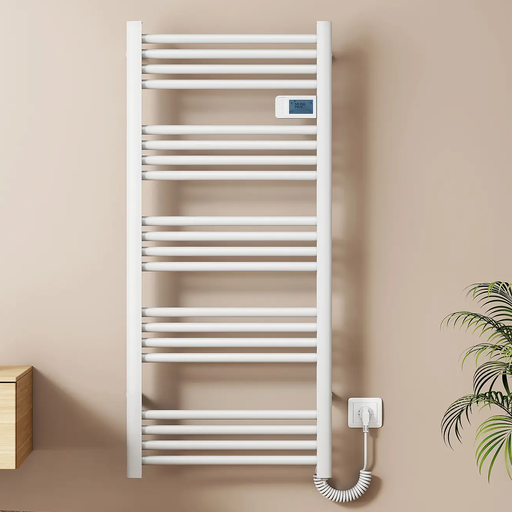 No image available
For a permanent spot to warm and dry towels; the description says it can be freestanding or wall-mounted.
Specifications include 600 W, touch controls and a timer.
Check in advance which installation type is intended for your space and whether the appliance and connection are suitable.
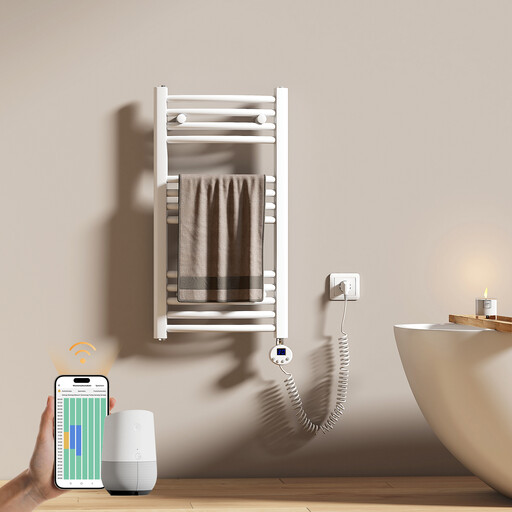 No image available
For towels in a permanent location, if the specified size of 750 × 400 mm fits the space available.
Specifications include a WiFi version, thermostat and timer.
Check the intended installation method and the electrical suitability of the specific version.
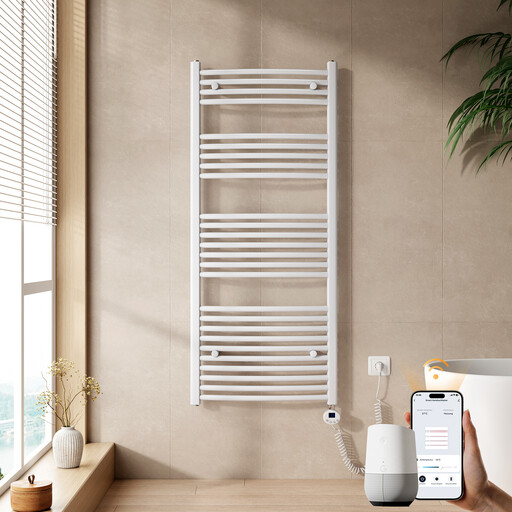 No image available
For several towels in a permanent location; the specified size and wall-mounted design require enough suitable space.
Specifications include 600 W and 220–240 V, 50 Hz. The description also lists WiFi control, a thermostat and timer programming.
Also check the conformity marking and whether the specific location is suitable.
 No image available
For towels in a permanent location, if you’re planning to wall-mount it and a top shelf suits your needs.
Specifications include touch controls, a digital display and a top shelf.
Wall mounting is intended for a permanent location, so you can’t put it away after use like a folding airer. Check that the specific appliance and location are electrically suitable.
If you’re not in a hurry, an unheated airer may be enough and uses no electricity for drying. Ventilation is still important when drying towels indoors.
Yes. When you dry towels indoors, moisture gets into the air; the German Environment Agency recommends extra ventilation. A heating function doesn’t remove the moisture.
The description “suitable for bathrooms” doesn’t mean an appliance is approved for every location. Requirements vary depending on the zone and installation. Check the instructions for the specific appliance and the intended location.
Multiply the power in kilowatts by the running time in hours to calculate the theoretical consumption in kilowatt-hours. At a constant rated power, 220 W for one hour would theoretically use 0.22 kWh; the actual running time and electricity price affect the cost.
No. The European Commission describes CE marking as the manufacturer’s declaration that the product meets the relevant EU requirements; it isn’t an independent certification mark.
For consumers buying online in Germany, the Verbraucherzentrale says the usual cancellation period is 14 days from receipt of the goods ordered. Legal exceptions may apply, so check the information provided by the specific seller and the conditions that apply to your situation.