If you have delicate swimwear
If you mainly dry swimming costumes or trunks, check the care label and keep them away from direct heat sources. adidas Germany recommends rinsing swimwear after wearing it and leaving it to air-dry.


If you mainly need to dry swimwear, an unheated clothes airer is the better choice: adidas Germany recommends air-drying swimwear away from heat sources. A heated airer may be suitable for other textiles, but only if their care labels allow the selected temperature. In a damp utility room, you’ll still need to ventilate and keep an eye on humidity, whatever type of airer you use. Before buying a mains-powered heated appliance, check whether the relevant EU regulations apply and whether it has the required CE marking, as well as German instructions and safety warnings. CE marking is not an independent quality mark.
If you mainly dry swimming costumes or trunks, check the care label and keep them away from direct heat sources. adidas Germany recommends rinsing swimwear after wearing it and leaving it to air-dry.
If you regularly dry clothes indoors, consider ventilation and room humidity as well as the clothes airer. The Verbraucherzentrale (German consumer advice service) warns that moisture which isn’t removed can increase the risk of mould.
If you’ll use the same airer for other textiles, check that the care label for each item allows the selected temperature. An additional heating function is only useful if you can actually use it for suitable laundry.
Suitable if: you mainly need to dry swimwear or the care label says to keep the item away from heat sources.
Keep in mind: You’ll still need to remove moisture from the room. The amount of laundry on the airer and the room conditions also matter.
Suitable if: you also want to dry textiles whose care labels allow heat.
Keep in mind: The heating function isn’t automatically suitable for swimwear. You’ll need to check the energy consumption and whether the appliance is right for your needs.
Suitable if: you want to set the temperature and running time when drying other heat-safe laundry.
Keep in mind: A low setting doesn’t override the care instructions, and the timer won’t remove damp air from the room.
| What matters | What to check when buying | Who is it important to? |
|---|---|---|
| Gentle drying | Read the care label; check for hanging space or a drying net. | When I dry swimwear, I want to follow the care label and avoid direct heat. This is the top priority for around 33 % of consumers. |
| Room humidity | Check whether you can ventilate the space where you’ll set up the airer; consider using a thermo-hygrometer to monitor conditions. | If I regularly dry clothes in the utility room, I want to keep an eye on moisture levels and be able to ventilate the space. Room humidity is a priority for around 27 % of consumers. |
| Floor space and drying capacity | Compare the airer’s open dimensions and the clearance needed to walk past it; consider where you’ll store it. | If space is limited, I want to be able to set up the airer and store it away afterwards. Available space is the top priority for around 20 % of consumers. |
| Energy consumption | Consider the wattage, actual running time and your own electricity tariff when using the heating function. | If I plan to use a heated model regularly, I want to weigh its energy consumption against the benefit of the extra heat. Running costs are the top priority for around 20 % of consumers. |
Swimwear care instructions recommend air-drying away from heat sources. Being able to set the temperature doesn’t override the care label.
Check the label on each item. Don’t place swimwear on switched-on heated bars if the care instructions say to keep it away from heat.
Drying releases moisture into the air. Without enough ventilation, the risk of mould can increase.
Whatever type of airer you choose, check whether you can ventilate the room and whether you need to monitor the humidity.
Clothes airers from the same brand can have different heating functions and designs. A model with a similar name or appearance isn’t necessarily the same appliance.
Compare the full model number, heating function and technical details on the product page.
HOMCOM is represented here by heated clothes airers. Check the features and dimensions of the specific model rather than assuming they’re the same as those of a similar model.
InnovaGoods describes Warmmat as a heated winged airer for textiles whose care labels allow the selected temperature.
The Classic 250 Flex Black from Leifheit is an unheated option for air-drying. The manufacturer describes adjustable tiers and a net for drying delicate items flat.
The following Joybuy products are clothes airers for indoor use, including both unheated and heated designs.
 No image available
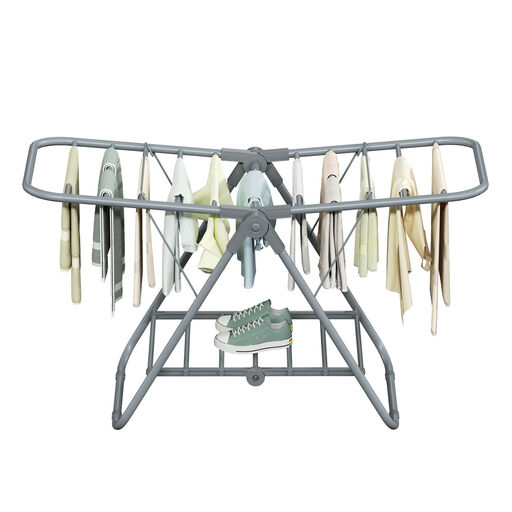
For small utility rooms and smaller items, with height-adjustable wings to make hanging laundry easier.
The Joybuy product description lists two wings, three height settings and a load capacity of up to 10 kg.
 No image available
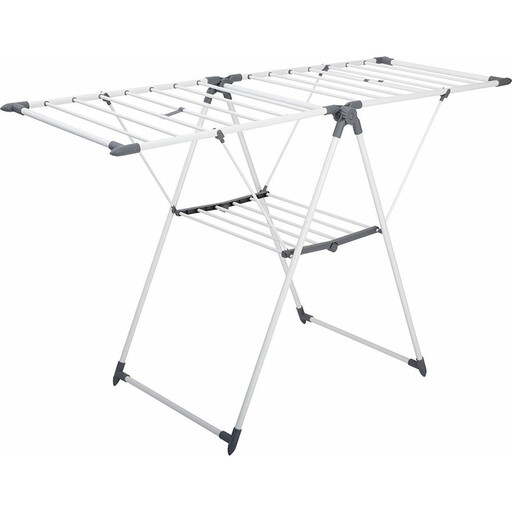
For indoor drying if you want to fold the airer away after use.
The Joybuy product description lists 15 m of drying space and a load capacity of up to 20 kg when the weight is evenly distributed.
 No image available
For other textiles whose care labels allow the stated temperature. Don’t dry swimwear with the heater switched on if its care label says to keep it away from heat sources.
The Joybuy product description lists 230 W and fold-out side wings. Before buying, check whether the relevant EU regulations apply and whether the required marking, German instructions and safety warnings are present.
Not necessarily. The care instructions we checked recommend air-drying swimwear away from heat sources. Follow the label on the individual item; an adjustable temperature setting doesn’t override its care instructions.
Yes. Drying releases moisture into the room. The Verbraucherzentrale recommends ventilating regularly and monitoring humidity; a heated airer doesn’t remove moisture from the air.
Multiply the wattage in kilowatts by the actual running time in hours and your price per kilowatt-hour. InnovaGoods lists Warmmat at 230 W, or 0,230 kW. Without the running time and your own tariff, you can’t work out the cost per drying session.
If the appliance is covered by the relevant harmonised EU regulations, it must have the CE marking required under those regulations. Your Europe explains that CE marking applies only to products for which regulations specifically require it; it isn’t an independent quality mark. The Bundesnetzagentur also lists manufacturer details and German instructions with usage information and safety warnings among the points to check.
The Verbraucherzentrale explains that online purchases generally come with a 14-day right to cancel, starting from the day you receive the goods. If an item is faulty, you have statutory rights against the seller; these are separate from any voluntary guarantee.