Swimmers with delicate swimwear
If you’re drying a swimming costume or swimming trunks, check the care label first. For the fabric described by arena, the advice is to air dry it away from heat sources.


If the care label on your swimwear says to air dry it away from heat sources, an unheated drying space is the right choice. Use heat only for fabrics whose care instructions allow it. In a shared utility room, you’ll also need to consider the space available, safe installation and ventilation. For the swimwear described by arena, the recommendation is to air dry it away from heat sources.
If you’re drying a swimming costume or swimming trunks, check the care label first. For the fabric described by arena, the advice is to air dry it away from heat sources.
If several people use the utility room, compare the drying rack’s dimensions both when in use and when stored away. Depending on the model, installation options are specified by DOMO, Adler and Leifheit.
When drying clothes indoors, bear in mind the moisture this releases into the air. The consumer advice centre recommends airing the room regularly by opening windows wide or creating a through-draught.
A good fit if: The care label rules out heat, or you want to hang your swimwear up without applying extra heat.
Things to consider: A wall-mounted model can free up floor space, but you’ll need a suitable place where installation is permitted.
A good fit if: The specific swimwear can be dried with heat and you have limited floor space.
Things to consider: The hanging space, power supply and location need to work for everyone using the room.
A good fit if: You need to hang several items separately that are suitable for heat according to their care labels, and there’s enough floor space while the rack is in use.
Things to consider: It needs space while in use and a power supply. According to the manufacturer, the Adler AD 7821 folds away.
| What matters to you | What to check before buying | Who should pay particular attention |
|---|---|---|
| Suitability for your swimwear | Check the care label and whether the garment can be exposed to heat. If the label warns against heat, dry it without heat. | If I want to dry my swimming costume or trunks according to the care instructions, I shouldn’t base my decision on the appliance description alone. Around 36 % of consumers say textile care is their main concern. |
| Space in a shared utility room | Check the dimensions when in use and when stored away, as well as any installation requirements. | If I don’t want the drying space to obstruct walkways or other people using the room, I also need to allow for the rack when it’s set up. Around 29 % of consumers prioritise floor space and sharing the room. |
| Moisture in the room | Consider how you can ventilate the room and, if needed, check the humidity. | If I dry clothes indoors and can’t ventilate the room much, removing moisture needs to be part of choosing where to dry them. Around 21 % of consumers say room humidity is their main concern. |
| Power use | For heated models, take the rated power, how long you’ll use it and your electricity tariff into account. | If I only need extra heat occasionally, I want to weigh up the electricity use against an unheated drying space. Around 14 % of consumers say running costs are the deciding factor. |
A general product description can’t replace the care instructions for the specific garment. For the swimwear described by the brand, arena recommends air drying it away from heat sources.
Check the label before drying your swimwear. If it rules out heat, choose an unheated drying space.
Exposure to unsuitable heat can put strain on the fabric, so choosing the right place to dry it means checking the care label first.
Adler gives different dimensions for the AD 7821 when it’s set up and folded away. Its compact storage size doesn’t tell you how much space it takes up while drying clothes.
Check the space it needs when in use, where you’ll store it and where the power socket is separately.
If the rack blocks walkways or other drying spaces in the shared utility room, you’ll need to find a different place for each use.
Drying clothes releases moisture into the air. A heated rack won’t automatically remove that moisture from the room.
Choose a spot that can be ventilated and follow the ventilation advice from the consumer advice centre.
Sharing the room may mean taking extra care to air it regularly and, if necessary, monitor the humidity.
DOMO describes the DO7117DR as a compact heated drying rack that can be freestanding or wall-mounted.
Adler describes the AD 7821 as a heated winged drying rack that folds away.
The unheated Telegant 30 Protect wall-mounted dryer is an option for smaller drying spaces, provided wall mounting is possible and permitted.
Unheated, folding HangOn drying racks are an alternative if separate hanging spaces matter more to you than heat.
This selection includes wall-mounted, unheated drying spaces for rooms with limited floor space, as well as a folding heated winged rack for swimwear whose care label allows heat.
 No image available
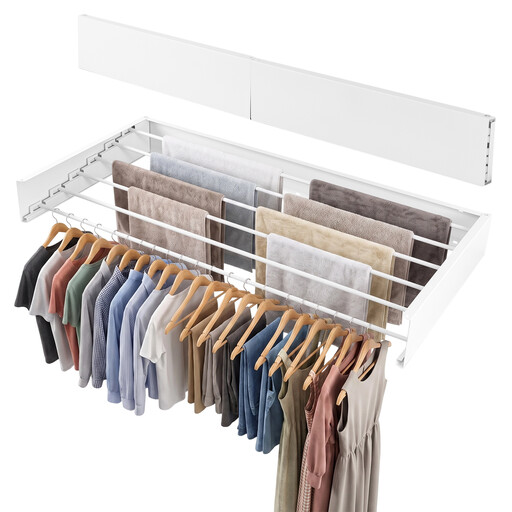
A drying space that folds back against the wall when it’s not in use.
Measures 100 × 50 cm when extended; stated load capacity: 15 kg. The description says installation requires drilling and a suitable wall.
 No image available
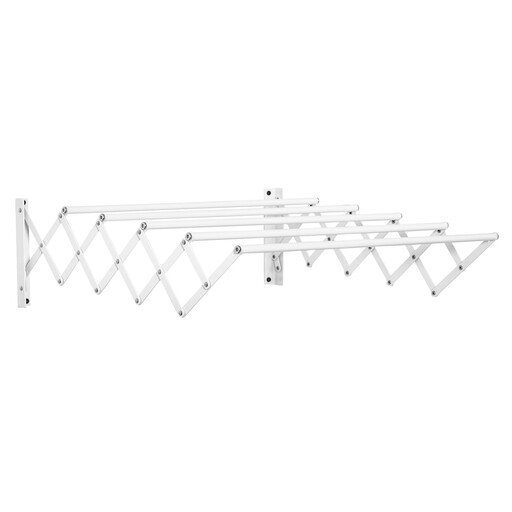
For extra hanging space on the wall when a freestanding rack would take up too much floor space.
The description lists five drying bars, with a maximum of 2 kg per bar and a total load of 10 kg. Suitable fixings are needed for installation.
 No image available
Suitable for swimwear only if its care label allows the recommended exposure to heat.
The product details list 45–55 °C, 230 W and a maximum load of 10 kg. The side wings fold out. The temperature listed doesn’t indicate how long a specific garment will take to dry.
 No image available
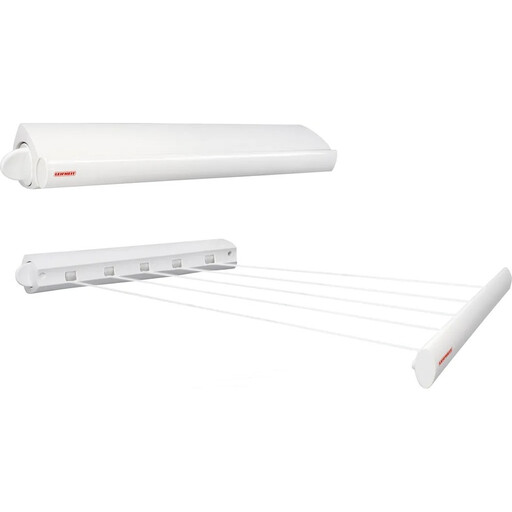
For air drying on retractable lines, if you can install it on a suitable wall.
The description lists five lines, each up to 4,20 m long, giving 21 m of drying space in total. The wall-mounted dryer retracts automatically when it’s not in use.
 No image available
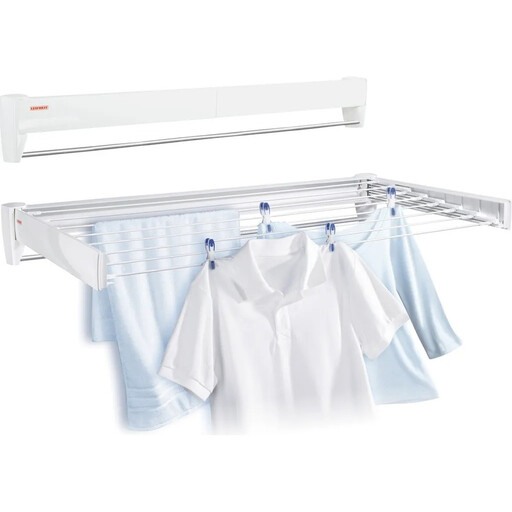
For an unheated wall-mounted drying space that folds flat against the wall after use.
The description lists dimensions of 103 × 53 cm when open, 8,10 m of drying space and a separate towel rail. It needs to be securely installed on a suitable wall.
No, there’s no general rule. For the swimwear described by the brand, arena recommends air drying it away from heat sources and advises checking the care label. If your garment also needs to be kept away from heat, don’t use heated bars.
Yes. The consumer advice centre recommends airing the room regularly by opening windows wide or creating a through-draught to replace the damp air. Heat from the rack won’t remove moisture from the room.
Only if the specific model is designed for wall mounting, the location is suitable according to the instructions and installation is permitted in the shared room. DOMO lists this as an option for the DO7117DR; that doesn’t mean the folding Adler AD 7821 is also a wall-mounted model.
Multiply the rated power in kilowatts by the number of hours it’s used to calculate the kilowatt-hours. To work out the cost, you’ll also need your electricity tariff. At the 220 W specified by Adler, four hours would use 0,88 kWh based on this calculation. This is neither a measured drying time nor a guaranteed amount of electricity used per swimming costume.
No. For electrical appliances covered by the relevant EU rules, the CE marking is the manufacturer’s declaration that the product meets the applicable requirements. On its own, it doesn’t prove that the product has undergone independent safety testing. You should also follow the instructions and choose a suitable location.