Households that need napkins frequently
If you want to dry several washed table napkins between uses, consider the usable rail space and whether you need the extra heat.


If you often need to dry table napkins between uses, a heated airer could be a good fit, provided its usable rail space and heat are suitable for your napkins. If you have enough time for them to dry, an unheated airer is another option; both types release moisture into the room. Before buying, check the care instructions, dimensions, ventilation options and, for an electrical appliance, the documentation for the specific model on offer.
If you want to dry several washed table napkins between uses, consider the usable rail space and whether you need the extra heat.
Here, you’ll need to consider both the dimensions of the airer when open and the space it takes up when folded away.
If you dry laundry indoors, consider ventilation and room humidity as well as the space available for drying.
Drying releases moisture into the air, which is why the Verbraucherzentrale and the German Environment Agency recommend regular ventilation.
| Consideration | What to check before buying | Who cares most about this? |
|---|---|---|
| Drying space and time | Compare the size and number of napkins with the usable rail space; don’t take heat specifications as a guaranteed drying time. | If I need to dry several napkins between uses, I want to be able to hang them with space between them. Around 26% of consumers prioritise usable drying space and time. |
| Room humidity | Consider ventilation options and room humidity; a heated airer does not carry moisture outside. | If you want to avoid damp in the utility room, pay particular attention to airflow. Around 21% of consumers put room humidity first. |
| Floor and storage space | Compare the airer’s open and folded dimensions with the space where you plan to use and store it. | If space is limited, I want to know whether the airer has room for my napkins while in use and can be put away afterwards. Around 21% of consumers prioritise the space it takes up. |
| Fabric care | Check the napkins’ care labels and the airer’s instructions; heated rails are not automatically suitable for every fabric. | If you dry delicate napkins or fabrics with different care requirements, use heat only if both the fabric and appliance are suitable. Around 16% of consumers prioritise fabric care. |
| Electricity use | Consider the rated power, actual running time and your electricity tariff on a like-for-like basis. | If I want to use additional heat, I want to factor in the electricity use when making my decision. Around 16% of consumers prioritise running costs. |
Moisture from the napkins still enters the room as they dry. Heated rails don’t carry it outside.
Check how you can ventilate the room and keep an eye on humidity levels.
The rated power alone doesn’t tell you how long napkins will take to dry in different conditions or how much each drying session will cost.
Consider the actual running time and your electricity tariff instead of comparing models on wattage alone.
The manufacturer describes the EASYmaxx Electric Clothes Airer 900 as using cool air circulation. This is a different design from an airer with heated rails.
If you specifically want heated rails, check the functional description of the exact model.
The foldable AD 7821 winged airer is an example of a heated model with multiple rails.
The heated models described include a compact five-rail version and a folding airer with two tiers.
Leifheit offers unheated clothes airers as an alternative if extra drying space matters more to you than heated rails.
The unheated, folding HangOn clothes airer is an option if you have enough time for items to dry.
The Electric Clothes Airer 900 is described as a technical alternative that uses airflow rather than heated rails.
The products below include heated towel rails, heated towel radiators and a folding heated clothes airer. Before buying, check that the hanging options, spacing, dimensions and care instructions are suitable for your table napkins.
 No image available
Could be suitable if you have a dedicated wall space and the napkins fit on the rail; check their dimensions and heat tolerance.
Wall-mounted; stated dimensions: 58.5 × 55 cm. A top shelf, touch controls and a digital temperature display are listed.
 No image available
If you want to hang several napkins with space between them, compare the dimensions and side wings with the space available and the size of your napkins.
The description lists a central drying area, two fold-out side wings, 230 W, a maximum load of 10 kg and a temperature range of 45–55 °C. The airer folds away for storage.
Before placing napkins directly on heated surfaces, check their care instructions and the appliance manual.
 No image available
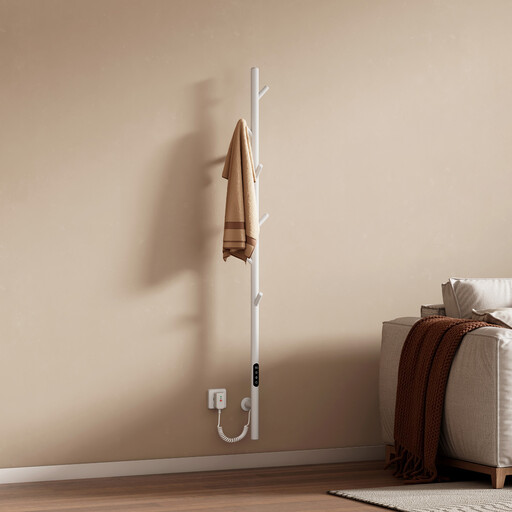
This design could work for napkins if you can hang them from the rail or hooks with enough space between them.
The description lists 100 W, one rail, six hooks, a temperature setting of 30–70 °C and a timer from 1–9 hours. The stated height is 150 cm.
Check the napkins’ care instructions before putting them in contact with heated surfaces.
 No image available
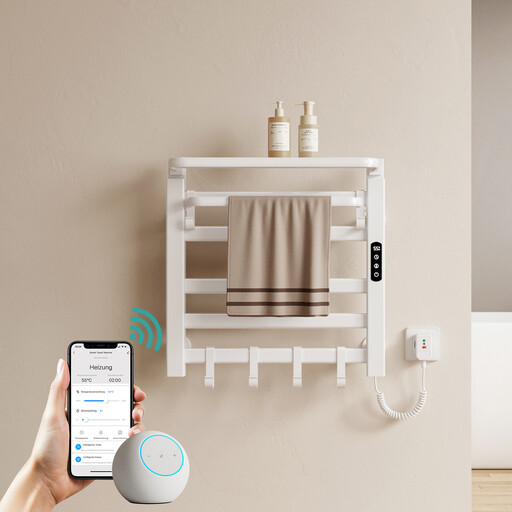
Could be an option if you have enough wall space and the stated dimensions suit the space you have for hanging napkins.
The description lists a folding shelf, a towel rail and six hooks that are specifically stated to be unheated. The specifications include 50 × 50 cm, 140 W, Wi-Fi app control and IPX5.
Check the napkins’ care instructions before putting them in direct contact with heated surfaces.
 No image available
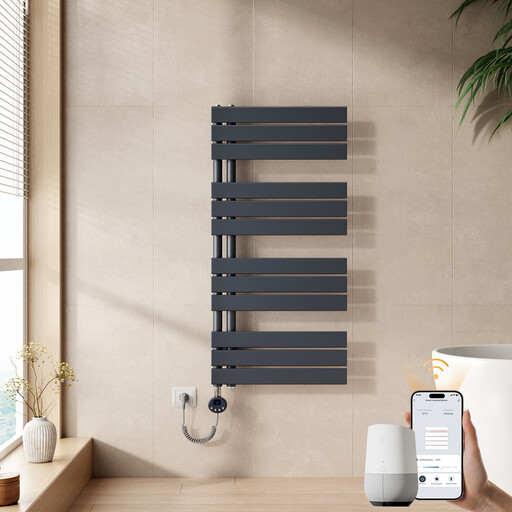
The open-frame design could be suitable if you have enough wall space and room to hang the napkins.
The description lists an open-frame design for hanging towels, Wi-Fi control, a thermostat and a timer. Stated dimensions: 1041 × 500 mm.
Check the napkins’ care instructions before using heated surfaces.
No. Drying releases moisture into the air, and a heated airer does not carry it outside. Keep an eye on room humidity and ensure there is suitable airflow. The Verbraucherzentrale and the German Environment Agency also provide advice on ventilating indoor spaces and cellars.
There’s no single answer that applies to all napkins. Check the care label for the specific fabric and the airer’s instructions; permission to tumble-dry an item does not automatically mean it can be placed in direct contact with heated rails.
Multiply the rated power in kilowatts by the operating time in hours and your electricity price per kilowatt-hour. For Adler’s AD 7821, which is rated at 220 W, two hours running continuously at its rated power would use 0.44 kWh, before applying your tariff. This is a theoretical calculation, not a measured drying cycle.
In Germany, the 1. ProdSV (Section 1) applies to new electrical equipment designed for a rated voltage of 50 to 1,000 V AC, as explained by the Federal Ministry of Justice. For equipment covered by the Low Voltage Directive, EUR-Lex lists conformity assessment, an EU declaration of conformity and CE marking among the requirements. A product description alone does not prove that a specific appliance on offer meets these obligations.
No. If an item is faulty, your statutory rights are against the seller; a guarantee is an additional voluntary promise subject to its own terms. The Verbraucherzentrale explains the difference between the two.