Households that regularly need tea towels
If you repeatedly hang small batches out to dry, a heated airer could be an option. Manufacturers describe the heating function, but don’t guarantee a particular drying time.


A heated airer can be useful if you regularly need small batches of tea towels ready again quickly. For several towels, having enough usable hanging space is the main consideration. If you’re not in a hurry, an unheated airer avoids using electricity for heat. In either case, the space available and ventilation in your utility room need to suit the airer, as heat won’t remove moisture from the room.
If you repeatedly hang small batches out to dry, a heated airer could be an option. Manufacturers describe the heating function, but don’t guarantee a particular drying time.
Check the space needed when the airer is in use separately from the space needed for storage. Models vary in size; DOMO also describes the DO7117DR as suitable for freestanding or wall-mounted use.
Drying clothes on a heated airer still releases moisture into the room. The Consumer Advice Centre recommends ventilating regularly and, if needed, checking humidity with a thermo-hygrometer.
| What you need from an airer | What to check | Who it matters to most |
|---|---|---|
| Drying small batches in time | Number of usable rails, space between towels and, if applicable, a timer. | If I regularly need a few towels ready again quickly, I make sure they can hang separately. Around 33% of consumers prioritise having small batches of towels ready when needed. |
| Space for use and storage | Clear floor space with the airer fully set up, as well as its dimensions when folded away. | If my utility room is cramped, I want to keep walkways and work surfaces clear and store the airer neatly. Around 25% of consumers pay particular attention to space for use and storage. |
| Humidity in the room | Ventilation options and, if you dry clothes repeatedly, the humidity level using a hygrometer if needed. | If I’m drying clothes in a room that’s already damp, I need a way to keep an eye on humidity and ventilate the room. Around 25% of consumers give room humidity particular priority. |
| Electricity for heating or passive air-drying | Rated power, expected running time and the option to avoid using additional heat. | If I want to avoid using electricity for heating and don’t need extra warmth, an unheated airer is also an option. Around 17% of consumers prioritise electricity use for heating. |
Rated power alone doesn’t reliably tell you how long your tea towels will take to dry in your room.
First, check that there’s enough space to hang towels separately. Then take the rated power and the expected running time into account when choosing an airer.
For the same running time, a heated airer uses electricity for heating; actual consumption depends on how it’s used.
An airer may take up little space when stored, yet need a lot of floor space when in use. For the Adler AD 7821, the manufacturer gives dimensions of 148 × 52,5 × 90 cm when set up and 113 × 52,5 × 8 cm when folded.
Measure the space needed for both positions separately.
Drying releases moisture into the room. A warm rail also doesn’t prove that the entire tea towel has been hygienically treated.
Ventilate the room and consider how you care for your tea towels separately from the heating function. For towels where germs can multiply easily, the Consumer Advice Centre recommends washing them regularly at a temperature of at least 60 °C.
The models described include a slim, freestanding airer and a foldable, two-tier version.
According to the manufacturer, the DO7117DR is designed for use as a freestanding unit or for wall mounting with the sets supplied.
The AD 7821 is a wide heated airer that folds down flat, suited to households with enough floor space while laundry is drying.
This selection includes a heated, foldable clothes airer, as well as wall-mounted heated towel rails and dryers that you can hang towels on. For wall-mounted models, check that the design and installation are suitable for your room.
 No image available
The central drying area and two fold-out side wings may suit several items of laundry; measure the space required when the airer is set up.
Specified at 230 W, with a temperature range of 45–55 °C.
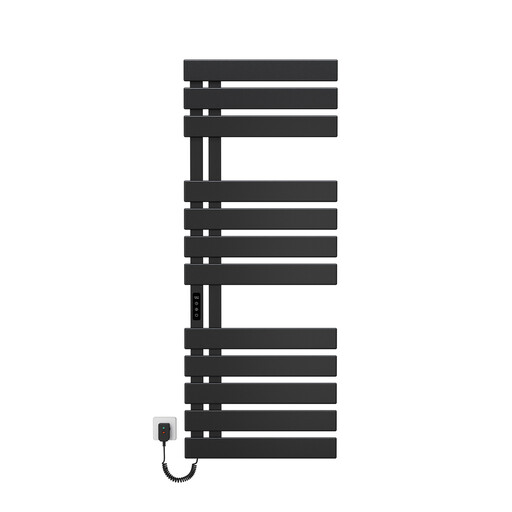 No image available
This wall-mounted heated towel rail could suit you if you want to hang towels on a wall; it isn’t a freestanding clothes airer.
The description lists temperature control and a timer from 1–24 hours. Professional installation is recommended for built-in installation.
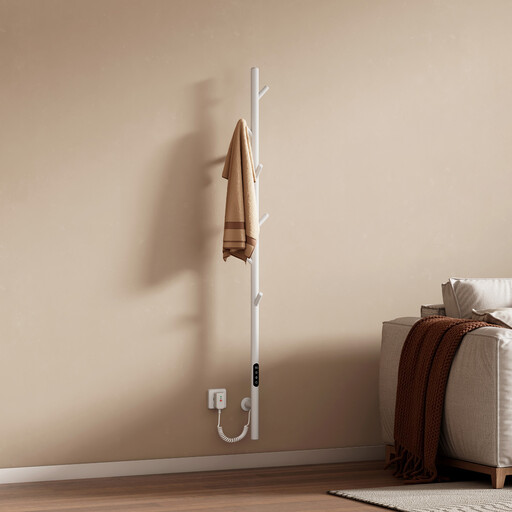 No image available
The rail and six hooks offer different ways to hang towels; check that the wall-mounted unit and its height are suitable for the space you have in mind.
The description lists 100 W and a timer from 1–9 hours.
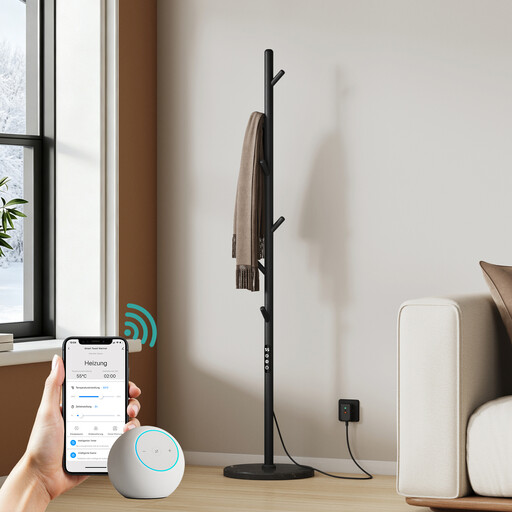 No image available
This wall-mounted model could be an option if you’re looking for a heated towel rail rather than a freestanding airer. Check that the specified fixing method is suitable for your wall and intended use.
The description lists temperature control, a timer and a weekly programme; the title specifies 100 W.
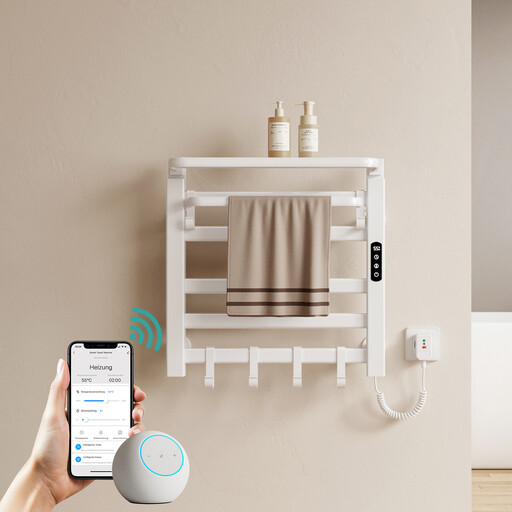 No image available
A towel rail, six hooks and a foldable top shelf offer different ways to hang or store items; bear in mind how much wall space you’ll need.
The product details list 50 × 50 cm, 140 W and IPX5.
No. A heated rail doesn’t disinfect the whole towel. For towels where germs can multiply easily, the Consumer Advice Centre recommends washing them regularly at a temperature of at least 60 °C.
Check the instructions for the specific location where you plan to use it. Drying creates humid air, so ventilate the room and check the humidity if needed. DOMO’s IPX4 rating applies to the DO7117DR and doesn’t replace checking whether the location is suitable.
For the DO7117DR, the manufacturer describes wall mounting with the sets supplied. Before use, check the installation instructions and make sure the chosen location is suitable for the unit, cable and hanging towels; not every heated airer is designed for wall mounting.
Multiply the rated power in kilowatts by the estimated running time in hours. At 100 W and a hypothetical three hours of continuous use, the calculation gives 0,30 kWh; actual running time and consumption may vary.
As part of its market surveillance, the Federal Network Agency lists CE marking, identifiable manufacturer details and German instructions with the necessary warnings among the points to check. CE marking is a declaration for which the manufacturer is responsible, not proof of an independent product test. The Consumer Advice Centre also distinguishes between statutory consumer rights and a voluntary guarantee.