People short on floor and storage space
If you wash your workwear regularly but can’t accommodate a permanently assembled airer or a large tumble dryer, compare the assembled and folded dimensions separately.


If you need your workwear ready again quickly between shifts, a folding heated airer can provide extra warmth. But you’ll need to consider the space it takes up, drying capacity and folded dimensions. If you can plan ahead for drying time, a non-electric airer is an alternative, while a model that uses cool airflow is not the same as one with heated bars. For electric models, check the safety information for the specific product listing, and make sure the room is well ventilated when drying clothes indoors.
If you wash your workwear regularly but can’t accommodate a permanently assembled airer or a large tumble dryer, compare the assembled and folded dimensions separately.
If you need your washed workwear again soon, extra warmth may be worth considering. The actual drying time will still depend on the clothes and how you use the airer.
If you can plan for drying time, compare non-electric drying with electric assistance and follow your garments’ care instructions.
First decide whether extra warmth matters for your shift pattern. Then check that the airer’s footprint, storage requirements and drying method suit your space and the care instructions for your workwear.
A good fit if: you want to dry a few suitable garments with extra warmth, and the assembled and folded dimensions work for you.
The trade-off: The airer needs electricity and floor space; its rated power does not tell you how long your workwear will take to dry.
A good fit if: you have time to air-dry your clothes and don’t want to use electricity for an appliance.
The trade-off: There’s no active heating, and you’ll still need space for the airer while your clothes dry.
A good fit if: hanging clothes on hangers matters more to you than heated contact bars.
The trade-off: Cool airflow is not the same as heated bars and does not provide the same warmth.
| What matters | What to check when buying | Who should pay particular attention? |
|---|---|---|
| Space needed | Compare the assembled and folded dimensions, and allow for clear walkways and hanging clothes. | If I’m short on floor space and need to store the airer after drying, both sets of dimensions matter. Around 36 % of consumers put space requirements first. |
| Having clothes ready between shifts | Check the hanging options, the space between garments and whether the airer suits the way you plan to use it. | If I need my workwear again soon, I look for suitable hanging options but still allow extra time. Around 29 % of consumers prioritise having their clothes ready. |
| Fabric care | Check the care label against the appliance instructions; the right drying method may vary from one garment to another. | If my workwear has different care instructions, I follow the guidance for each individual garment. Around 21 % of consumers prioritise fabric care. |
| Electricity use | Consider the rated power and planned operating hours on the same basis; a non-heated airer uses no electricity for an appliance. | If I can leave clothes to air-dry for longer and want to avoid using electricity for an appliance, a non-electric airer is one option. Around 14 % of consumers prioritise electricity use. |
Even a heated airer that folds flat needs room when open, both for the frame and for hanging clothes.
Before you buy, compare the assembled and folded dimensions separately with your available drying and storage space.
When you dry clothes indoors, moisture needs to be removed from your home. The German Environment Agency recommends ventilating more when drying clothes indoors.
Consider whether you can ventilate the room where you plan to dry your clothes, even if you’re using a heated appliance.
A model that uses cool airflow does not work in the same way as an airer with heated bars.
Check how the specific model works. If its power specifications conflict, clarify them before using them to calculate electricity costs.
The rated power does not prove how long your workwear or a particular load of laundry will take to dry in independent testing.
Allow enough drying space and extra time rather than assuming your clothes will be ready by a set time.
The AD 7821 is an example of a folding clothes airer with heated bars.
Warmmat is an alternative with heated bars for anyone who wants to use temperature controls and a timer.
The DD6003 is described as a heated winged airer.
The Classic 250 Flex is a non-electric alternative if you can plan ahead for drying time.
According to the supplier, the Electric Clothes Airer 900 uses cool airflow rather than heated bars.
This selection includes folding models for heated drying and non-electric air-drying. Compare the dimensions with your available drying and storage space. For electric appliances, check the safety information for the specific product listing.
 No image available
An option if you’re looking for a folding airer with a heating function.
The product name lists a temperature of 45–55 °C and dimensions of 144 × 53 × 96 cm.
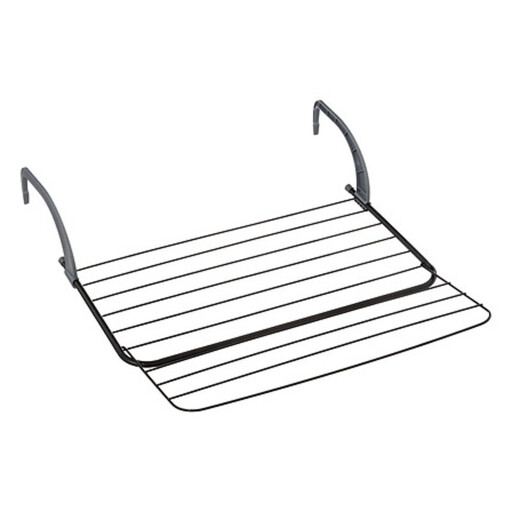 No image available
A compact option if you want to put the airer away after use.
The product name lists dimensions of 60 × 55 × 13 cm. You’ll need a suitable, stable surface for installation; secure the airer before loading it.
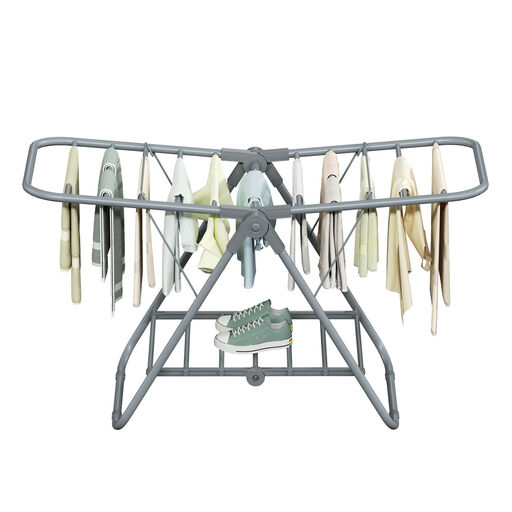 No image available
A non-electric option for natural air-drying if a folding frame suits your storage space.
The product name specifies two wings and a folding design.
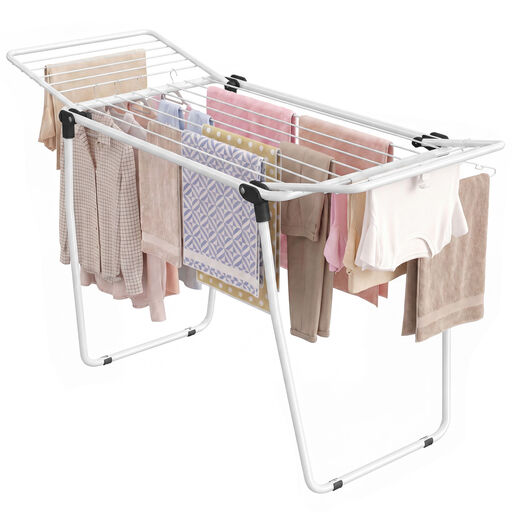 No image available
A non-electric option if you want to air-dry your workwear and fold the airer away afterwards.
The product name lists dimensions of 158 × 53 × 93 cm when open.
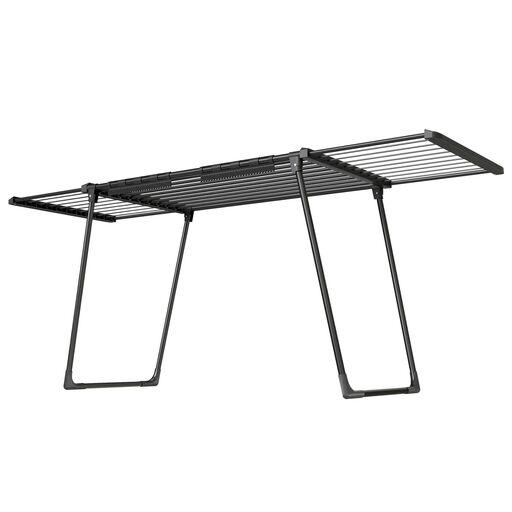 No image available
A non-electric option for natural air-drying if a folding airer suits the space you have available.
The product name lists dimensions of 62.5 × (113.5–200) × 90 cm.
No. Check the drying instructions separately and compare them with the appliance manual. GINETEX treats washing and drying as separate care categories.
Ventilate while drying clothes indoors and, if possible, use a suitable drying room. The German Environment Agency recommends ventilating more when drying laundry indoors; a heated airer is no substitute for this.
Multiply the power in kilowatts by the actual operating hours and your price per kilowatt-hour. For the Adler AD 7821, rated at 220 W, two hours at an assumed continuous rated power would work out to 0.44 kWh. This is neither a measured drying time nor a measured energy use per load of laundry.
If the appliance falls within the scope of the 1. ProdSV, it must meet its safety requirements. Laws on the Internet, published by the Federal Ministry of Justice and the Federal Office of Justice, gives the voltage range as 50 to 1.000 V for alternating current and 75 to 1.500 V for direct current. Under § 12, before making the product available, the retailer must check, among other things, the CE marking and that the operating instructions and safety information are provided in German. A CE mark is not an independent performance test.