
Lieferung heute & morgen

Qualitätsgarantie

Willkommens-Angebote freischalten: KOSTENLOSE Lieferung | Bis zu 80 % RABATT | Kostenlose 30-Tage-JoyPlus-Testphase
App herunterladen
A dual-basket air fryer promises to revolutionise meal prep for families and health-conscious individuals: cook your main course and side dish simultaneously, oil-free, and have them ready to serve at the exact same time. In practice, however, common flaws in many models lead to frustration instead of efficiency. Before you make a purchase, it's crucial to understand the typical pitfalls often hidden behind tempting marketing promises.
This guide will help you identify the critical features and make an informed choice.
Many models on the market look convincing at first glance, but a closer inspection reveals functional weaknesses. Pay special attention to these three points:
To avoid the problems mentioned above, you should focus on three core technical parameters in your selection. These define the performance and practical utility of a 2-zone oil-free fryer.
The fundamental requirement for flexibility is that both chambers function completely autonomously from one another. This means:
A well-implemented air fryer with a sync function takes the guesswork out of your planning. Instead of calculating when to start the second dish yourself, you simply enter the cooking times and temperatures for both chambers. The appliance automatically starts the chamber with the shorter cooking time later, so both dishes are ready at the exact same second. Look for terms like "Sync Finish" or "Just In Time," which indicate such smart control.
Instead of being dazzled by the total litre capacity, check the distribution and shape of the cooking baskets. A combination of a larger and a smaller chamber (e.g., 5.5 litres and 3.5 litres) is often more practical than two identically small chambers. This allows you to cook a main course for the whole family in the large zone, while a side dish or a smaller portion for someone with different dietary preferences cooks in the smaller zone. Also, look for a non-stick coating on the containers, as this makes cleaning significantly easier.
Based on the criteria above, we have identified models that are well-suited for specific user profiles.
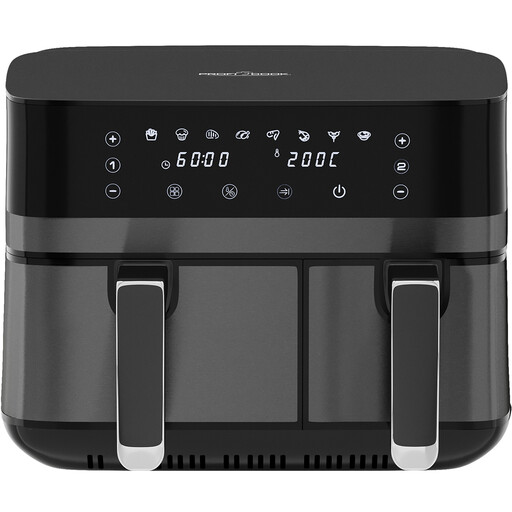
Why This Fits Their Persona: This model is designed for the needs of households where complete meals need to be prepared efficiently and simultaneously. The combination of a 5.5-liter and a 3.5-liter chamber provides the necessary flexibility for main courses and side dishes.
The "Just In Time" system, as stated by the manufacturer, directly addresses the synchronisation problem and ensures perfectly timed serving. The two separate control panels allow for stable, independent control of both zones, and the clear 5.5 + 3.5-liter capacity split avoids misleading volume claims.
High flexibility thanks to 8 automatic programs and individual temperature settings (80–200°C). The non-stick containers simplify post-use cleanup.
We have compiled a complete, real-time list of products that fully satisfy these strict selection criteria and UK safety regulations.
With an air fryer that has a well-implemented sync function (often called "Sync Finish" or "Match Cook"), you program both chambers with their respective cooking times and temperatures. The appliance then automatically calculates when to start the chamber with the shorter cooking time so that both dishes finish at the exact same moment. You don't have to do anything other than load the food and start the program.
In most cases, yes. An air fryer has a much smaller cooking chamber than a conventional oven and therefore heats up much faster. The preheating time is often eliminated entirely or is very short. For preparing small to medium-sized meals, an air fryer typically consumes less energy than a large oven, which can lead to time and cost savings.
Most modern models feature cooking baskets and inserts with a non-stick coating. After use and once they have cooled down, these parts can usually be cleaned easily with warm water, a mild dish soap, and a soft sponge. Many components are also dishwasher-safe, which simplifies cleaning even further. Always check the manufacturer's instructions for this. Avoid using abrasive sponges or harsh cleaning agents to prevent damaging the coating.