
Lieferung heute & morgen

Qualitätsgarantie

Willkommens-Angebote freischalten: KOSTENLOSE Lieferung | Bis zu 80 % RABATT | Kostenlose 30-Tage-JoyPlus-Testphase
App herunterladen
A dual-basket air fryer can prepare two dishes at the same time, without requiring potato wedges, vegetables or fish to use the same temperature and cooking time. This is particularly practical for families, couples and frequent cooks. However, models differ considerably in terms of basket configuration, footprint, controls and cleaning.
As a Joybuy Product Recommendation Officer, I filter the relevant information and distinguish verifiable product data from general marketing claims. Before buying a dual-chamber air fryer, you should be aware of three common pitfalls in particular.
A specification such as 8, 9 or 10 litres usually refers to the combined capacity of both baskets. What matters, however, is how much space is available in each chamber and whether the baskets are arranged side by side or vertically. Two equally sized chambers are suitable for preparing parallel portions. Baskets of different sizes can be more practical if you often prepare a main dish together with a smaller side dish.
With a dual-basket air fryer, you should also check whether both zones can be operated independently. Some models offer only synchronised programmes, while others allow you to set the temperature, time and function separately.
An air fryer with a sync function can coordinate the end times of different programmes. This is useful when, for example, vegetables cook faster than chicken. However, the Sync Finish function is not automatically available on every model and says nothing about chamber size or heating performance.
Pay close attention to the specific product description: Does the model offer two independent cooking zones, separate temperature controls and combined or individual operation? These details matter more than a high number of preset programmes.
An oil-free air fryer does not generally require frying oil in the basket. Depending on the food, however, a small amount of oil may still be applied to the surface. Adding larger quantities of oil or fat is not what these appliances are designed for and may pose a safety risk.
The term “healthy” should also not be interpreted as a blanket claim. Actual nutritional values depend on the ingredients, quantities and cooking method. Proper temperature control, even food distribution and following the instructions in the user manual are therefore the key considerations.
For a family-sized air fryer, a total capacity of 8 to 10 litres may be suitable. An 8-litre model with two 4-litre baskets distributes the cooking area differently from a 10-litre air fryer with one 3.5-litre and one 6.5-litre compartment.
An XXL air fryer requires sufficient clearance from walls and other appliances. For the 9-litre Ochama model, at least 10 centimetres of clearance at the sides and rear is specified. In addition to width and depth, check the height—especially with vertically arranged chambers.
The selected appliances have rated power outputs of approximately 2,000 to 2,850 watts. A higher wattage is not, on its own, a reliable measure of quality. The temperature range, independent controls and airflow are more relevant. Depending on the model, settings may range from 80 to 200°C or from 30 to 230°C, for example.
A lower temperature range can be useful for delicate foods, reheating or slower cooking. For crisp surfaces, follow the manufacturer’s guidance on preheating, shaking and turning the food.
A dishwasher-safe air fryer can significantly reduce cleaning time, provided the baskets and crisper plates are explicitly approved for dishwasher use. The main unit, which contains the electronics and heating element, must not be immersed in water. Non-stick coatings should be cleaned with soft sponges and mild detergent; metal utensils and abrasive cleaners can damage the surface.
For appliances with a ceramic coating, check the manufacturer’s specific information regarding its composition and care. A digital air fryer with a touchscreen can make operation easier, but it is not automatically easier to maintain than a model with rotary controls.

Why this product suits the profile: Two 4.5-litre baskets and ten preset programmes cover typical everyday dishes without the need for a larger single-compartment appliance.
The capacity is specified as 9 litres in total, with a clear 2 × 4.5-litre split. This makes it easier to assess the available basket space.
Separate temperature control, ten programmes and removable baskets with a non-stick ceramic coating.
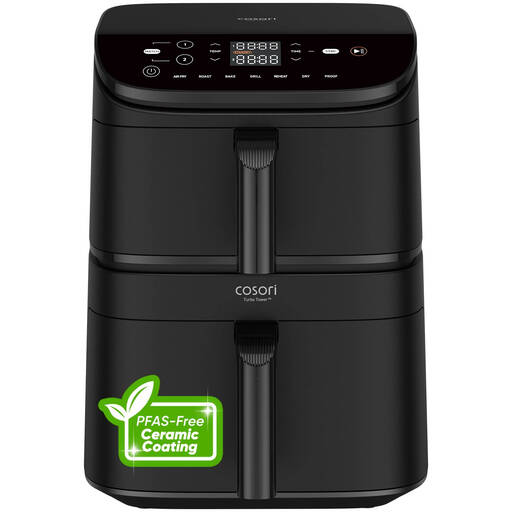
Why this product suits the profile: Its vertical design combines two chambers measuring 4.3 and 6.5 litres. This can be an alternative to side-by-side appliances when worktop space is limited.
The dimensions of approximately 41.3 × 30 × 40.5 cm make the required footprint and height clear. According to the product information, the baskets and accessories are dishwasher-safe.
10.8-litre total capacity, three levels with the additional rack, plus Sync Cook and Sync Match.
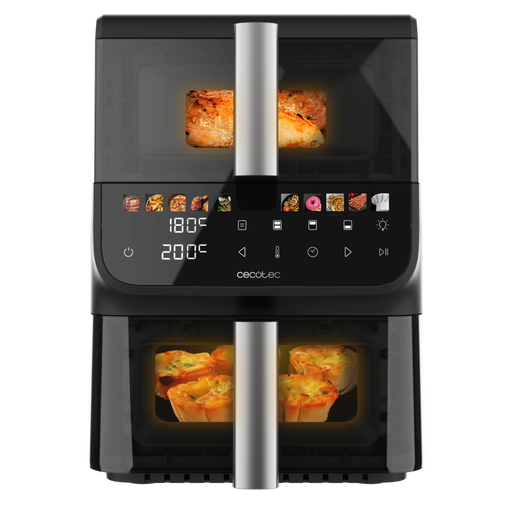
Why this product suits the profile: The stacked design, with 3.5- and 6.5-litre compartments, makes efficient use of vertical space and provides a viewing window in the upper basket.
The different basket sizes are explicitly stated. This makes it clear that the total litre capacity is not divided evenly between the two compartments.
10-litre total capacity, temperature settings from 80 to 200°C, ten menus and a sync function for coordinated end times.
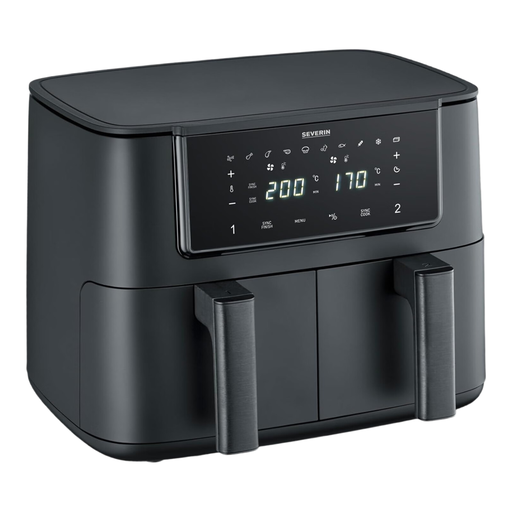
Why this product suits the profile: Two 4-litre chambers, ten programmes and separate settings are well suited to regular meals featuring ingredients with different cooking requirements.
Sync Cook and Sync Finish are listed separately. This confirms that the appliance supports both identical settings and coordinated end times.
8-litre total capacity, keep-warm function, touchscreen and dishwasher-safe baskets according to the product description.
We have compiled a complete, regularly updated list of products that fully meet these strict selection criteria and the safety regulations applicable in the EU.
In addition to the appliance’s external dimensions, you should allow for clearance around the air vents. Models with side-by-side baskets generally require more width, while a stacked air fryer takes up more vertical space. Do not reduce the clear area recommended by the manufacturer.
That depends on how you plan to use it. For two people, an 8-litre model may be sufficient if you often cook two components at the same time. A 9- or 10-litre model provides more capacity for guests and larger portions, but requires more space for both placement and storage.
Costs depend on power consumption, cooking time, frequency of use and the electricity tariff. Consumption can be calculated as follows: Power in kilowatts × operating time in hours × electricity price per kilowatt-hour. Manufacturer claims regarding potential energy savings should be understood as comparisons under specific conditions and may not apply to every household.