
Lieferung heute & morgen

Qualitätsgarantie

Willkommens-Angebote freischalten: KOSTENLOSE Lieferung | Bis zu 80 % RABATT | Kostenlose 30-Tage-JoyPlus-Testphase
App herunterladen
A dual-basket air fryer lets you cook two dishes at the same time without flavours mingling directly. That’s handy for families, couples, meal prep and households where the side and main course need different temperatures or cooking times. However, a model with two baskets isn’t automatically right for every kitchen or every household.
A claim like “9-litre air fryer” usually describes the combined volume of both chambers. What matters is how it’s split: two baskets of 4.5 litres each suit similarly sized portions. A split of 5.5 and 3.5 litres can be more useful if you regularly cook a larger main and a smaller side.
The usable area is also important. Tall baskets offer volume, but they aren’t automatically good for large or flat foods. So check the internal dimensions, basket shape and accessories before you decide on an XXL air fryer.
An oil-free air fryer works with circulating hot air. Many foods don’t need extra oil. Depending on the recipe, a small amount of oil can affect browning or crispiness. So the term shouldn’t be taken as a health guarantee. What really counts are the ingredients, portion size and cooking method.
Automatic programmes are convenient, but the preset values don’t necessarily suit every quantity, brand or food size. We recommend separately adjustable temperature and time settings for both chambers. A good instruction manual and clear cleaning guidance are more important than a long list of programme names.
A 2-chamber air fryer should have two genuinely separate cooking areas. That way you can cook vegetables and potato products with different settings. For a dual-basket air fryer, these points matter:
A dual-zone air fryer needs enough space on your worktop. Vertically stacked baskets save width but can be taller and may cause problems under wall cabinets.
A wide temperature range is helpful for versatile cooking. The models mentioned in the product specs work, depending on the version, between 50 and 200 °C; some units go up to 230 °C. Low temperatures can be useful for keeping warm or drying, while higher temperatures are intended for certain frozen foods or short cooking processes.
The wattage alone doesn’t describe actual cooking performance. It should be considered together with basket size, ventilation and the intended mains voltage. For UK households, specs like 220–240 V and the correct mains frequency are relevant.
An air fryer with Sync Finish starts or finishes two cooking processes at coordinated times. That’s useful when, for example, meat takes longer than vegetables. Check whether the function works with two independently chosen temperatures and cooking times, or simply copies identical programmes.
For cleaning, the baskets and crisper plates should be removable. A dishwasher-safe air fryer reduces manual effort, but you should follow the manufacturer’s instructions for each accessory. The main unit, cable and controls must not be immersed in water.
Also look out for:
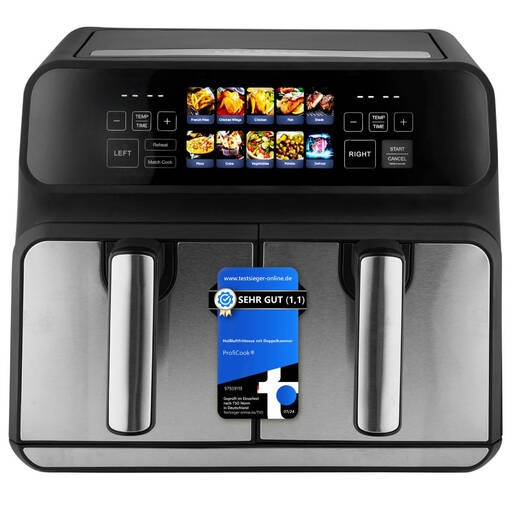
Why this product fits the profile: Two equally sized 4-litre chambers offer a clear split for couples and smaller families. The separate controls suit different dishes.
The capacity is clearly stated as 2 × 4 litres. Temperature and time can be set separately for both zones.
8 automatic programmes, 50–200 °C, multi-colour graphic display, cool-touch handles and dishwasher-safe, non-stick coated containers according to product specs.
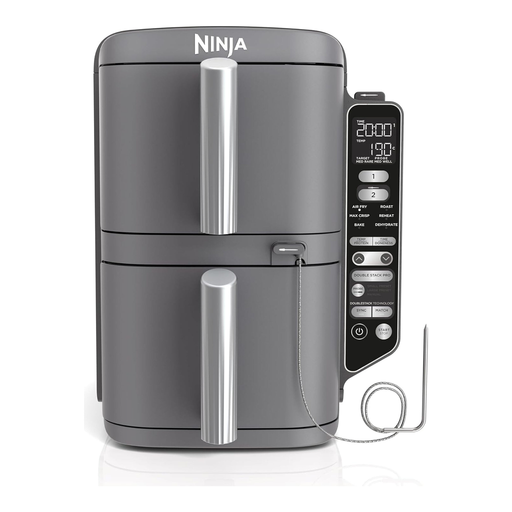
Why this product fits the profile: The vertical design uses worktop space efficiently. Two 4.75-litre drawers, additional wire racks and a digital thermometer appeal to users with a varied meal plan.
The four usable levels and independent drawers offer more flexibility than a single large chamber.
Six functions, digital thermometer and, according to the manufacturer, dishwasher-safe drawers, wire racks and accessories.
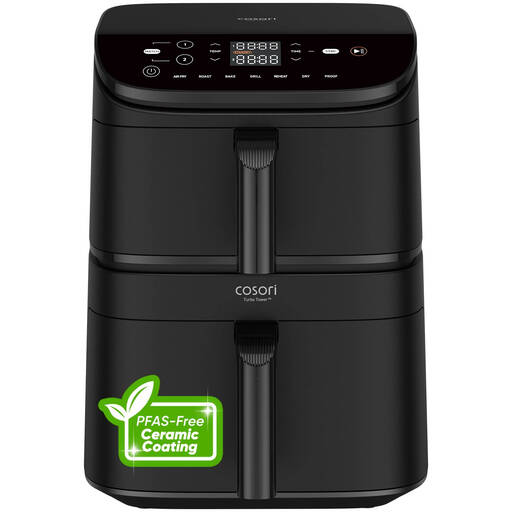
Why this product fits the profile: The vertical dual chamber with 6.5 and 4.3 litres is interesting for families and meal prep when several components are needed at once.
The separate volume figures make it clear that the chambers are different sizes. That makes planning the main course and side easier.
Three levels, seven functions, PFAS-free ceramic coating according to the manufacturer and dishwasher-safe baskets and accessories.
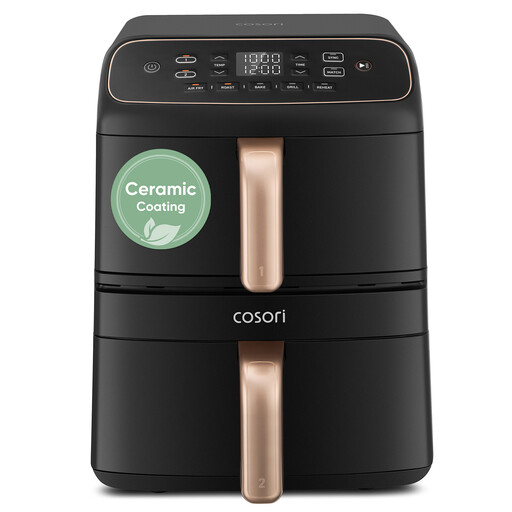
Why this product fits the profile: The stacked baskets, each 4.3 litres, suit kitchens where a wide appliance won’t fit on the worktop.
The compact external dimensions of roughly 42 × 27.5 × 36.5 cm according to product specs make worktop planning easier. Still, the vertical design should be checked against available height.
Five cooking functions, two DC motors according to the manufacturer, plus ceramic-coated and dishwasher-safe baskets.
We’ve put together a full, regularly updated list of products that fully meet these strict selection criteria and the safety regulations in force in the EU.
A dual-basket air fryer can be more practical than a large oven for smaller portions, because you only heat the appliance you need. The actual costs depend on power consumption, running time, your energy tariff and how fully you load it. Manufacturer claims like “up to 70 per cent less energy” or “up to 55 per cent faster” are comparative values under specific conditions and shouldn’t be taken as a general guarantee for every household.
For everyday use, these tips help:
As well as the external dimensions, you should allow extra room for air vents and pulling out the baskets. Often at least 10 cm clearance from walls and other appliances is recommended. With vertical models, pay particular attention to the appliance height under wall cabinets.
That depends on how you use it. For two people, a 9-litre dual chamber can make sense if you regularly cook two dishes at once, larger portions or meals for the next day. For small single portions, a more compact appliance may need less worktop space and energy.
It’s not possible to give a reliable lifespan for every model. It’s influenced by how often you use it, how you clean it, how you treat the coating and whether ventilation is correct. Look for available spare parts, warranty terms and a clear instruction manual. Damaged coatings, unusual noises or overheating are reasons to stop using the appliance and contact customer service.