
Lieferung heute & morgen

Qualitätsgarantie

Willkommens-Angebote freischalten: KOSTENLOSE Lieferung | Bis zu 80 % RABATT | Kostenlose 30-Tage-JoyPlus-Testphase
App herunterladen
A dual-chamber air fryer promises to revolutionise the preparation of complete meals: the main course and side dish cook in parallel and are ready to serve at the same time. However, the market is flooded with appliances whose real-world performance doesn't always live up to their marketing claims. Before you make a decision, it's crucial to understand the common pitfalls that often only become apparent after the purchase.
This guide will help you identify the key features and make an informed choice. We focus on the technical specifications that make a real difference in daily use.
Many models look impressive at first glance, but their weaknesses are revealed in the details. Pay close attention to these three points to avoid disappointment:
To avoid these pitfalls, you should focus on verifiable technical data. The following three parameters are crucial for an appliance's performance and overall value.
The total volume figure alone is not telling. Instead, pay attention to the specific capacity of each individual chamber. A 2-chamber air fryer can have a symmetrical (e.g., 2 x 4 litres) or asymmetrical (e.g., 1 x 5.5 litres + 1 x 3.5 litres) configuration.
Also, check the internal dimensions of the baskets. A larger surface area is more advantageous for an even cooking result than a deep, narrow design.
A high-quality Sync Finish function is the centrepiece of a good dual-chamber air fryer. It ensures that two dishes with different temperatures and cooking times finish at the exact same time. The appliance automatically calculates the delayed start time for the component with the shorter cooking duration. Without this automation, the main advantage of parallel cooking is lost. Make sure the appliance explicitly offers such a function for synchronising different cooking programmes.
The wattage of an appliance indicates its heating power. Models with 2,200 to 2,800 watts generally heat up faster and maintain a more stable temperature, leading to more even and crispier results. However, high power alone does not automatically make an appliance energy-efficient. Efficient devices combine high power with optimised air circulation and good insulation. Compared to a conventional oven, they can often save a significant amount of energy, according to manufacturer claims, as they heat a much smaller chamber and require no lengthy preheating time.
Here are some models that are interesting for specific user groups based on their objective specifications.

Why This Fits Their Persona: The asymmetrical split (5.5 L + 3.5 L) is ideal for a typical family meal where the main course (e.g., a roast chicken) requires more space than the side dish (e.g., vegetables or french fries).
The "Just In Time" system is an explicit Sync Finish function that automatically coordinates different cooking times. The clear specification of individual chamber sizes avoids the "XXL" trap.
Flexible capacity split for main course and side dish; 8 automatic programmes for easy operation.
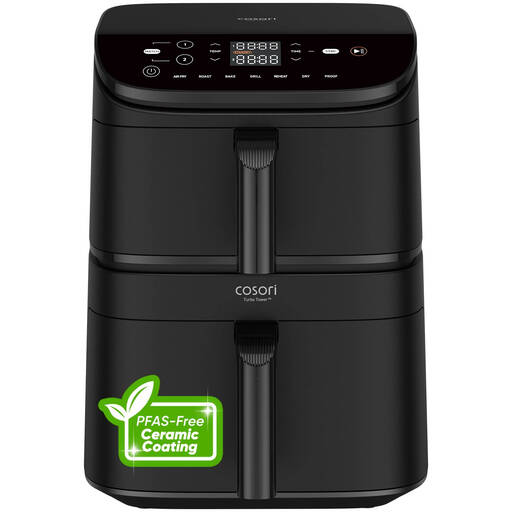
Why This Fits Their Persona: The vertical design saves valuable counter space, which is a critical factor in many kitchens. The PFAS-free ceramic coating meets the demand for health-safe materials.
The PFAS-free coating directly addresses concerns about peeling, potentially harmful materials. The space-saving design is a direct solution to the problem of bulky XXL appliances.
Space-saving vertical design; PFAS-free ceramic coating (according to the manufacturer) for more worry-free cooking.
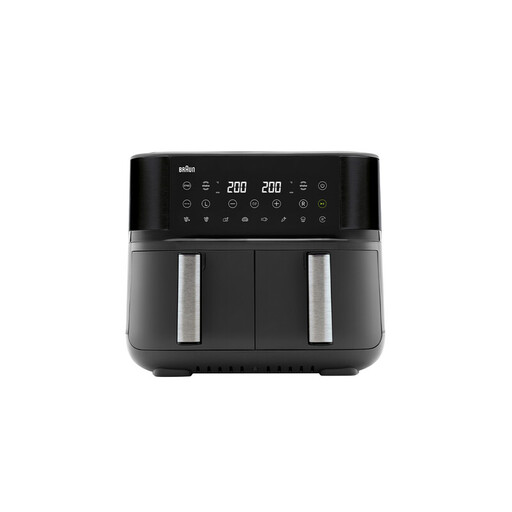
Why This Fits Their Persona: The symmetrical split with two equal 4-litre baskets is practical for anyone who regularly prepares two different but similarly-sized components, such as salmon fillets and asparagus or chicken wings and sweet potato fries.
The explicitly advertised Sync function ensures both baskets finish at the same time, solving the problem of cold side dishes. The high power of 2,850 watts ensures fast and even cooking results.
Two identical 4-litre baskets for balanced meals; powerful for quick results; dishwasher-safe baskets and plates made from BPA-free material.
We have compiled a complete, up-to-date list of products that fully meet these strict selection criteria and German safety regulations.
Power consumption depends on the wattage and duration of use. A 2,400-watt appliance uses 2.4 kilowatt-hours (kWh) in one hour of operation. However, since cooking times in an air fryer are significantly shorter than in a large oven (often only 15-25 minutes) and preheating time is minimal, the total energy consumption per meal can be lower. Some manufacturers claim their devices can be up to 70% more energy-efficient than conventional ovens.
Not necessarily. Most modern 2-basket air fryers feature non-stick, dishwasher-safe components. Cleaning two smaller baskets is often more manageable than handling one single, very large basket. Look for a high-quality coating and check the manufacturer's instructions on dishwasher suitability to ensure longevity.
No, there are differences in quality. Basic models might only synchronise the time, but not the start point for different programmes. A high-quality Sync Finish function calculates the cooking process so that both chambers finish at the exact same minute, even if one component needs 40 minutes at 180°C and the other needs 15 minutes at 200°C. It's worth looking for product descriptions that explicitly mention this intelligent time management.